


Apartment Soundproofing NYC: Fixes That Work, and Who to Call
- DJ Custom Contracting

- 11 minutes ago
- 10 min read
Start by sealing every gap around outlets, windows, and doors, then test what’s actually leaking sound before spending money on materials. Most NYC apartment noise problems have an obvious dominant source, whether that’s street traffic through single-pane glass or footsteps through a thin ceiling, and fixing the wrong thing wastes both time and money. Handle sealing, rugs, and door sweeps yourself this week; call a licensed contractor when the fix requires structural work or a Department of Buildings permit.
Three moves to try before anything else:
Seal gaps around outlets, baseboards, window frames, and door jambs with acoustic caulk.
Test each window and door by holding a hand near the edges on a windy or loud day to feel air (and sound) leaking through.
Add a dense rug with a felt pad and one substantial upholstered piece to break up hard, reflective surfaces.
Budget a moderate amount for weekend fixes and significantly more for contractor-installed assemblies, and expect several weeks if Department of Buildings coordination is involved. If a neighbor’s noise is ongoing and unreasonable, the city’s 311 complaint tracking tool gives you a documented paper trail.
Key Takeaways
Effective apartment soundproofing in NYC means matching the fix to the noise type: airborne noise responds to sealing and mass, while impact noise requires isolation at the source.
Point | Details |
Diagnose before spending | Identify whether noise is airborne, impact, or flanking before choosing a fix. |
Start reversible | Seal gaps, add rugs, use curtains and panels before considering construction. |
Understand STC | A 10-point STC gain roughly halves how loud noise sounds to the ear. |
Budget realistically | Budget a moderate amount for weekend fixes and mid-thousands for contractor-installed assemblies. |
Call a pro for structure | DJ Custom Contracting scopes low-frequency and structural noise jobs with on-site measurement and DOB coordination. |
Table of Contents
Apartment Soundproofing NYC: Fixing Shared and Thin Walls
Most noise coming through a shared wall is airborne, meaning it travels as sound waves rather than vibration, and airborne noise responds well to sealing and mass. Start there before assuming you need construction.
Reversible options come first: acoustic caulk on every visible gap, a dense bookshelf packed with books pushed against the shared wall, and fabric-wrapped acoustic panels that absorb reflected sound inside your own room. These won’t stop a loud stereo cold, but they measurably reduce midrange chatter and TV bleed.
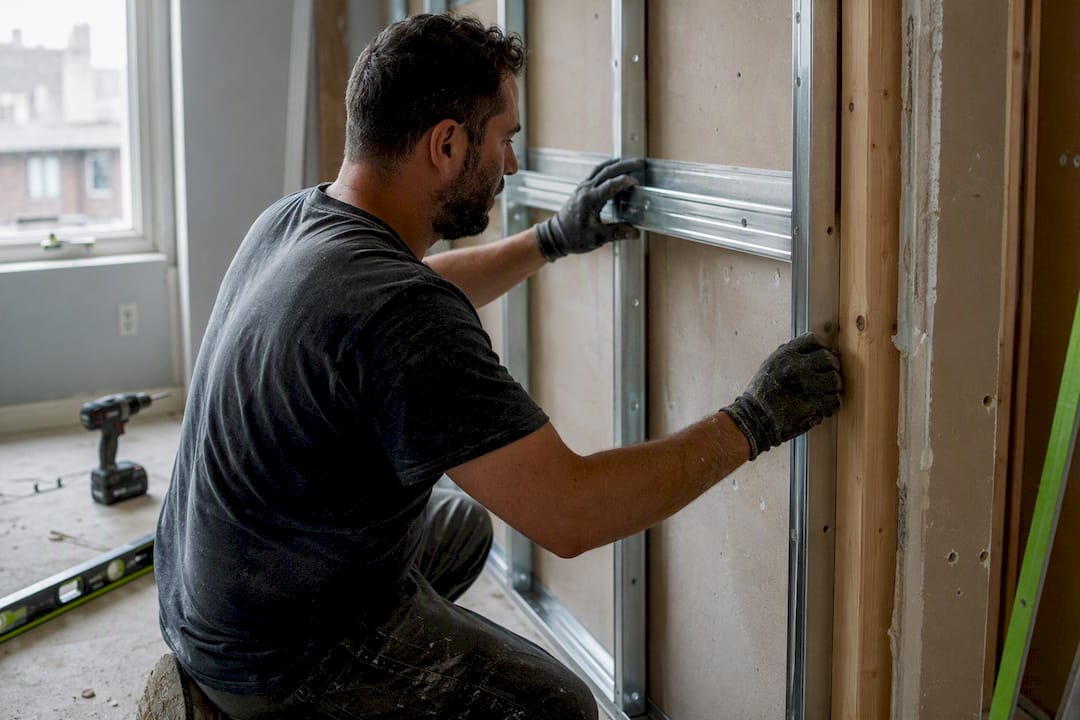
Permanent upgrades matter when reversible fixes aren’t enough and you own the unit or have landlord approval. Resilient channels decouple new drywall from the existing wall studs, breaking the vibration path. Adding a layer of mass loaded vinyl (MLV) sandwiched between two layers of drywall, with mineral wool insulation filling the cavity, is a standard contractor approach. This combination follows the same principle acoustics engineers rely on: adding mass, decoupling, damping, and cavity absorption together outperforms any single method alone.
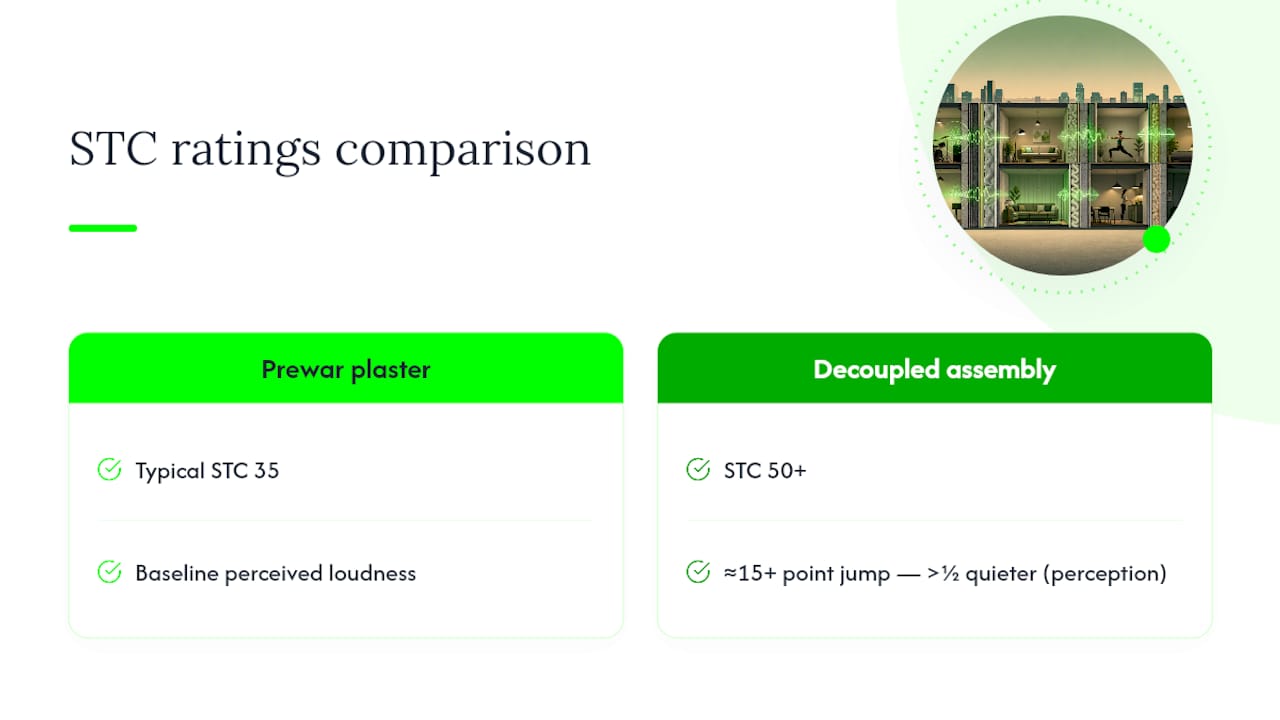
Sound Transmission Class, or STC, rates how well a wall assembly blocks airborne sound. A typical NYC prewar plaster wall often sits around STC 35, while a properly decoupled double-drywall assembly with insulation can reach STC 50 or higher. A 10-point STC jump roughly halves how loud noise sounds to the human ear, so going from 35 to 45 is a genuinely noticeable change, not a marginal one.
Pro Tip: Check outlet boxes and light switches on shared walls first. They’re rarely sealed properly during original construction and often account for more leakage than the drywall itself.
Renters should stick to reversible options unless the lease and landlord explicitly permit wall modifications. Owners planning resilient channel or double-stud work should budget for permitting review, since altering a wall assembly in a multifamily building can trigger NYC building code requirements around fire separation and party-wall rules.
How Do You Stop Noise From Upstairs Neighbors?
Footstep noise is impact noise, not airborne noise, and that distinction changes everything about the fix. A rug on your ceiling does nothing; the vibration has to be stopped at the source, which is the floor above you.
The cheapest real fix is a conversation. On your side, acoustic ceiling panels or fabric clouds reduce echo and reverberation in your own room, which makes the space feel calmer, but they won’t isolate impact vibration coming through the joists.
When the upstairs neighbor won’t cooperate or the noise is a building-wide construction issue, a contractor-installed decoupled ceiling assembly is the real answer: resilient isolation clips, a new layer of drywall, and mineral wool in the cavity, all installed without touching the existing structure directly.
Rug + dense pad in the unit above (cheapest, most effective for footsteps)
Fabric acoustic panels on your ceiling (helps echo, not impact)
Resilient clips and decoupled drywall (contractor-level, addresses structure-borne noise)
Pro Tip: Before spending money on your ceiling, ask the upstairs neighbor if they’d add a rug. It costs them $100 and often solves the entire problem.
How Do You Reduce Street Noise Through Windows?
Windows are usually the single biggest source of exterior noise in an NYC apartment, more than walls or doors combined. Start with the cheapest fix: weatherstripping and acoustic caulk around every window frame, since even a hairline gap lets in disproportionate noise.
From there, effectiveness scales with cost and invasiveness. Heavy, floor-length curtains with a dense liner cut noticeable high-frequency noise for under $150. Removable acoustic window inserts, essentially a secondary pane of glass or acrylic sealed into the existing frame, are the standard renter-friendly upgrade because they install without permanent changes and typically run $300 to $800 per window. Full window replacement with laminated or double-pane glass is the most effective option but is realistically an owner-only project given cost and building approval requirements.
Weatherstripping and caulk: cheapest, tackles air leaks first
Heavy curtains with acoustic liner: helps but limited on low-frequency traffic rumble
Removable window inserts: strong mid and high-frequency reduction, fully reversible
Full replacement: best overall, owner-only, requires building approval
Renters should confirm with their landlord before installing inserts, though most are designed to leave zero marks on the frame.
Making Doors Quieter Without a Full Replacement
A door is only as good as its perimeter seal. A solid slab door with gaps around the frame performs worse than a hollow door that’s properly sealed, so start with the edges, not the door itself.
Install a door sweep at the bottom, add adhesive-backed weatherstripping around the frame, and place a draft stopper or rolled towel at the threshold overnight. These reversible steps run under $40 total. Owners chasing a bigger improvement should consider a solid-core door replacement paired with an acoustic threshold, which meaningfully outperforms a hollow-core door.
Door sweep and perimeter weatherstripping (reversible, works immediately)
Solid-core door plus acoustic threshold (owner-level upgrade)
Never seal or modify a door in a way that compromises fire rating or emergency egress. Hallway and stairwell doors in particular are often fire-rated by code and shouldn’t be altered without a licensed contractor’s input.
Reducing Floor Noise Between Units
A dense area rug with a quality pad is the highest-value floor fix available, and it costs a fraction of any contractor treatment. Start there before considering anything more invasive.
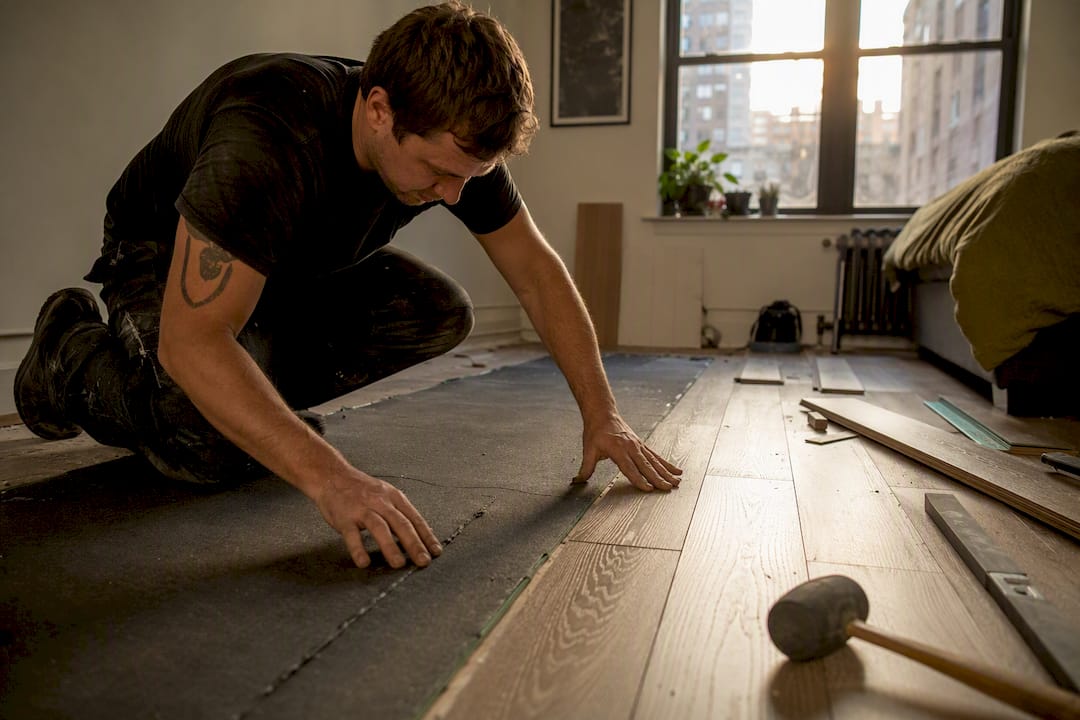
For deeper investment, interlocking foam or cork floor mats add a layer of impact absorption under furniture and in high-traffic areas. Contractor-level solutions include high-density acoustic underlayment beneath a floating subfloor, or localized neoprene isolation pads under equipment and furniture legs. These techniques for isolating impact noise in wood flooring apply directly to NYC apartments dealing with footstep transmission.
Area rug with dense pad: cheapest, most effective starting point
Interlocking foam or cork mats: moderate upgrade, no construction
Floating subfloor with underlayment: contractor-level, addresses structure-borne noise directly
Wood-joist buildings (common in prewar walk-ups) transmit impact noise differently than concrete-slab towers, where sound travels further through the slab itself. If you’re upstairs, loop in building management before installing anything permanent, since floor modifications in multifamily buildings can affect shared systems below.
Fast, Low-Cost Fixes You Can Try This Weekend
None of these require a contractor, and most can be done in an afternoon.
Seal outlet gaps, baseboards, and window frames with acoustic caulk ($15 to $25, one hour)
Hang heavy curtains with an acoustic liner over street-facing windows ($80 to $150, 30 minutes)
Place dense rugs with pads in high-noise rooms ($100 to $400, 20 minutes per room)
Push a packed bookcase against a shared wall ($0 if you already own one)
Install removable acoustic panels on a reflective wall ($150 to $400, one afternoon)
Add door sweeps and threshold seals ($10 to $40 per door, 15 minutes each)
These fixes handle airborne noise and reverberation well. They won’t touch low-frequency bass, HVAC rumble, or structure-borne footstep vibration. If those are your actual problem, you’re looking at contractor-level work.
What Does Soundproofing Cost in NYC and How Long Does It Take?
Budget realistically before you start. DIY weekend fixes cost a moderate amount. A single contractor-installed room assembly (one wall or ceiling) typically costs in the mid-thousands. Full reconstruction across multiple rooms, including permitted structural work, can be a significant investment, and site conditions in prewar versus modern buildings affect costs.
Treatment | Typical NYC Price Range | Typical Install Time |
Window inserts (per window) | Moderate cost | Half day |
Acoustic panels (per room) | Moderate cost | Same day |
Decoupled wall assembly | Moderate to substantial cost | 2 to several days |
Decoupled ceiling assembly | More substantial cost | Several days |
Floating subfloor system | Significant cost | About one to two weeks |
Any work that alters a wall or ceiling assembly, adds structural framing, or affects fire separation between units can trigger a Department of Buildings permit review, which adds time before installation even begins. Ask your contractor upfront whether your scope requires filing.
When Should You Hire a Soundproofing Contractor in NYC?
Hire a professional when the noise is low-frequency (bass, HVAC, traffic rumble), when the fix requires structural changes, or when your building’s condo or co-op board requires permitted work. DIY methods rarely touch these problems no matter how much money you throw at rugs and curtains.
Before signing anything, confirm the following:
Ask whether they’ve handled Department of Buildings filings for similar apartment work.
Request proof of contractor licensing and active insurance coverage.
Ask how they measure baseline noise and what STC improvement they’re targeting.
Request references and before-and-after documentation from comparable NYC apartments.
Get a written warranty on installed assemblies.
Walk away from anyone who guarantees results without measuring your space first, refuses to put scope in writing, can’t produce proof of insurance, or offers to skip permits on structural work. That last one is a legal liability you’ll inherit, not them.
A solid estimate should include baseline decibel readings, a proposed STC gain, a line-item scope of materials and labor, and a clear statement on whether permits are required.
How DJ Custom Contracting Approaches Apartment Soundproofing
DJ Custom Contracting starts every soundproofing job with an on-site assessment to identify the dominant noise path before recommending any assembly, because guessing wrong wastes the client’s money.
The process typically runs:
Initial intake and walkthrough to identify airborne, impact, or flanking noise sources
Baseline measurement and documentation of the problem area
Proposed assembly scope with realistic STC targets
Department of Buildings coordination and permit filing when structural work is involved
Installation, followed by verification and a walkthrough with the client
DJ Custom Contracting also handles related DOB or DOT violation issues that sometimes surface during a full interior renovation scope, and provides before-and-after documentation and references on request.
Pro Tip: Ask for the baseline measurement in writing before work starts. It’s the only way to know objectively whether the finished assembly actually delivered the STC improvement you paid for.
A Local Perspective on What Actually Works
Start with sealing and rugs, and escalate to a contractor the moment low-frequency noise or structural work is involved; there’s no in-between that saves you money in the long run. Prewar buildings in Manhattan and Brooklyn behave differently than 1970s concrete towers, and that construction era should drive every material choice, not a generic checklist pulled from someone else’s building. A contractor who can show you references and explain the local code angle is worth more than one who just quotes a price.
Get a Scoped Soundproofing Assessment From DJ Custom Contracting
DJ Custom Contracting gives NYC apartment owners a fixed, documented scope instead of a guess, because the estimate starts with an actual on-site measurement rather than a sales pitch.

If you’ve tried the sealing, rugs, and window inserts covered above and the noise is still a problem, that’s the point where a scoped assessment pays for itself. Request an on-site visit or virtual consult and ask for baseline decibel readings, a proposed STC gain, a detailed line-item scope, and clear language on whether the work needs Department of Buildings permitting. DJ Custom Contracting offers both renter-friendly reversible options and owner-permanent assemblies, so the scope matches what your lease or building actually allows. Reach out through the interior renovation contractor page to request your assessment and get a written quote before any work begins.
Useful Resources for NYC Noise Issues
NYC 311 complaint tracking tool: report persistent neighbor noise with a documented trail.
Soundproofing STC overview: plain explanation of how sound ratings work.
Apartment soundproofing tips: renter-friendly tactics for common NYC layouts.
Frequently Asked Questions
What’s the fastest way to reduce apartment noise in NYC? Seal gaps around outlets, windows, and door frames with acoustic caulk. It’s the cheapest fix and often delivers the most noticeable improvement per dollar spent.
Does apartment soundproofing NYC work require a permit? Only when it alters a structural wall or ceiling assembly or affects fire separation between units. Rugs, curtains, panels, and window inserts don’t require permits.
How much does professional soundproofing cost in a NYC apartment? A single room assembly, like a wall or ceiling, typically runs $1,500 to $5,000. Full multi-room jobs with permitted structural work can reach $20,000 or more.
Can renters soundproof an apartment without violating their lease? Yes. Rugs, curtains, removable window inserts, door sweeps, and acoustic panels are all reversible and generally don’t require landlord approval, though it’s worth confirming for window treatments.
What should I report through 311 for persistent neighbor noise? Document the time, duration, and type of noise, then file through the city’s noise complaint system, which now includes public complaint-tracking data for accountability.
Sources
Recommended


Comments