


Change Order Process in Construction: A Practical Guide


A construction change order is a written amendment to a contract that adjusts the scope of work, the contract price, or the schedule (sometimes all three). The moment a change surfaces on site, take three actions in order: document the condition with photos and notes, give written notice per your contract’s notice clause, and stop any work beyond the original scope until you have authorization. Skipping these steps is how contractors end up doing free work.
Document the condition, RFI, or instruction the moment you spot it.
Notify the owner or architect in writing, referencing the contract clause that requires it.
Pause non-authorized work until pricing and approval are settled, unless directed otherwise in writing.
Pro Tip: Federal data shows agencies frequently delay change-order approvals and payments, which strains contractor cash flow. Fast, written documentation is what protects your position when review drags on, according to the Government Accountability Office.
Key Takeaways
A defensible change order process runs on written notice, itemized pricing, and a signed record before work proceeds, not after.
Point | Details |
Notice comes first | Written notice within your contract’s window preserves payment rights when a change surfaces. |
Match pricing to scope | Lump sum, T&M, and unit price each fit different levels of scope certainty. |
Documentation wins disputes | Photos, RFIs, and cost build-ups tied to the change order create an auditable trail. |
CCDs need extra caution | Work directed before agreement must be tracked separately and reconciled later. |
Djcustomcontracting’s approach | Handles change orders with document-first pricing and fast turnaround on renovation and addition projects. |
Table of Contents
What Is a Change Order in Construction?
A change order is a signed contract amendment. It records the changed work, any adjustment to the contract sum, and any adjustment to contract time. According to the American Institute of Architects, the standard executed change order is a written instrument signed by the owner, contractor, and architect, and most commercial contracts point to AIA’s own forms as the reference standard.
AIA G701 is the industry-standard change order form, used once scope, price, and time are agreed.
AIA A201 is the General Conditions document that defines the notice and approval process the G701 sits inside.
A request is a proposal. A directive is an instruction to proceed before agreement. Only a signed change order is a finished contractual record.
Confusing these three is one of the most common causes of payment disputes on commercial jobs.
What Types of Change Orders Exist?
Not every change is priced the same way, and picking the wrong pricing model early costs you time later. Change orders generally fall into three categories, according to a breakdown from Wikipedia’s overview of change orders: additions (new work), omissions (work removed), and substitutions or alterations (work modified from the original design).
Lump sum: a fixed price for defined, well-understood scope. Fastest to approve, riskiest if scope is vague.
Time and materials (T&M): billed on actual labor hours and material costs plus markup. Best for unclear or emergency scope, but it shifts cost-control burden onto documentation.
Unit price: a pre-agreed rate per unit (per square foot, per linear foot) multiplied by verified quantity. Common for earthwork and demolition.
Zero-cost/neutral: a documented scope swap with no net price change, still requires a signed change order to protect both parties.
The pricing model you choose determines what backup documentation you’ll need and how fast the change order can move through approval.
What Triggers Most Construction Change Orders?
Most change orders trace back to a short list of recurring causes, and recognizing which one you’re facing tells you how to route it.
Differing site conditions (unknown utilities, soil conditions, hidden damage) usually affect both cost and schedule and require immediate written notice to preserve claim rights.
Owner-directed scope changes are cost-driven and rarely urgent, but still need a signed change order before you proceed.
RFIs that reveal design gaps often shift both price and time, especially on renovation work.
Code or regulation changes mid-project can force redesign and typically justify a time extension.
Material unavailability or substitutions tend to be cost-only issues unless lead times threaten the schedule.
Site conditions and code changes are the two triggers most likely to require notice within days, not weeks.
How Does the Change Order Process Work Step by Step?
A defensible change order process construction teams can rely on runs through nine linked steps. Skipping any one of them is usually what turns a routine change into a dispute months later.
Identify the change. Someone in the field or design team flags a condition, error, or request that falls outside the current contract scope.
Give notice per the contract. Most contracts require written notice within a set window, often 3 to 10 days. Miss it, and you may forfeit the right to be paid.
Define the scope. Attach drawings, photos, and specification references so the change is unambiguous.
Price the change. Build a cost breakdown by labor, materials, subcontractor quotes, equipment, and indirect costs rather than a single lump number, a practice ProjectManager’s guidance on change orders recommends specifically because it holds up better in disputes.
Submit the Change Order Request (COR). This is the proposal stage, not yet binding.
Negotiate and approve. Owner or architect reviews cost and schedule impact against the contract.
Execute the signed change order. All parties sign, typically on an AIA G701 or equivalent form.
Implement the work. Field crews proceed only once the signed document exists, or under a documented directive if urgency requires it.
Update records and close out. Log the change, update the schedule, and tie it to the next payment application.
Pro Tip: Photograph the condition with geotagged, timestamped images and log it in your daily report the same day. That single habit does more to win a disputed change order than any amount of after-the-fact paperwork.
When time is critical, provisional pricing (an agreed placeholder value subject to true-up) keeps work moving without waiving your right to full payment later.
What Must a Change Order Include?
A change order missing even one required field slows down approval and weakens your payment position. Procore’s guidance on how change orders work lists six core elements every change order needs, and field experience adds a few more worth locking in.
Project name, address, and contact details for owner, contractor, and architect.
Change order number, date of discovery, date of notice, and date of submission.
A clear description of the changed work, referencing specific drawing and spec sections.
Attachments: photos, RFIs, submittals, and subcontractor quotes.
Cost breakdown and updated contract sum, plus schedule impact in calendar days.
Assumptions, exclusions, measurement basis, and signature lines with title and authority level.
File every executed change order in the same folder as its supporting RFI and photo record, and cross-reference it on the next payment application so reviewers can trace the money.
Field | Why it matters |
CO number and dates | Establishes the notice timeline your contract requires. |
Scope description | Prevents disputes over what was actually authorized. |
Cost and schedule impact | Ties the change to payment applications and updated milestones. |
Signatures and authority | Confirms the person signing actually has approval power. |

How Should You Price and Negotiate a Change Order?
Choosing a pricing model is a negotiation decision as much as a math problem. Lump sum gives owners price certainty but shifts risk to the contractor if scope grows. T&M protects the contractor on unclear scope but gives owners less cost predictability. Unit pricing splits the risk cleanly when quantities are the main unknown.
Pricing model | Best for | Main risk |
Lump sum | Well-defined scope | Contractor absorbs scope creep |
Time and materials | Unclear or emergency work | Owner absorbs cost overrun risk |
Unit price | Quantity-driven work (excavation, demo) | Disputes over quantity verification |
Present a transparent cost build-up, not a single number, separating direct labor, materials, subcontractor quotes, and indirect costs.
State every assumption and exclusion in writing before pricing goes to the owner.
Bill approved changes on the next payment application rather than waiting for project close-out.
Who pays usually depends on the trigger. Owner-requested scope changes are billed to the owner outright. Differing site conditions are typically owner-paid if your contract has a standard changes clause. Design errors are usually the architect’s or owner’s responsibility, not the contractor’s, though the contract language controls the outcome.
What Is a Change Directive and How Is It Different?
A Construction Change Directive (CCD) lets work proceed before price or time is agreed, issued unilaterally by the owner or architect. It must later be reconciled into a signed change order, and AIA’s guidance on change order fundamentals treats strict documentation of a CCD as essential to preserving payment rights.
Confirm every verbal directive in writing within 24 hours, referencing the specific instruction given.
Track costs separately under “work under directive” until a final price is agreed.
Keep daily logs and schedule records so any time extension claim has a paper trail.
Federal projects carry particular risk here. The GAO’s review of federal change-order practices found that many agencies lack adequate data on processing times, and slow reviews routinely disrupt contractor cash flow. Document interim costs and request partial payment whenever a CCD drags past a few weeks.
How Do You Track and Store Change Orders?
A change-order register is the single tool that prevents lost paperwork from becoming a lost payment. At minimum, track: CO number, originator, date submitted, current status, cost impact, schedule impact, linked RFIs or CCDs, attachments, signatories, and the related payment application reference.
Store the register and every attachment in one shared project folder or document management system, never scattered across email threads.
Version every draft clearly (Rev 0, Rev 1) so negotiation history stays intact.
Platforms like Procore link RFIs, submittals, and photos directly to the change order record, which the Deltek guide to managing change orders points to as the main reason software-based tracking cuts approval time and improves auditability compared to spreadsheet-only systems.
What Best Practices Reduce Change Order Disputes?
The gap between a smooth change order and a six-month dispute usually comes down to habits, not contract language.
Do train field staff to flag scope deviations the day they happen, not at the next progress meeting.
Do require written notice within your contract’s specified window, every time, no exceptions.
Do attach photos with metadata and keep a running T&M log for provisional work.
Don’t start substantial changed work on a verbal go-ahead alone.
Don’t omit assumptions and exclusions from your price, even for small changes.
Pro Tip: Add a clause reserving your right to suspend work for non-payment on approved change orders past 30 days. It rarely gets used, but its presence alone speeds up owner review.
Which Standard Forms Should You Use for Change Orders?
Reach for AIA G701 once price and time are agreed and you need a signed, formal record; pair it with the A201 General Conditions it’s built to work within. ConsensusDocs offers a comparable alternative some owners specify by contract. For quick internal tracking before formal issuance, a simple COR template works, but always label draft revisions clearly to avoid confusion with the final signed document.
A contractor’s field-tested habit
Requiring same-day photo documentation before any change order request goes out cut our average approval time noticeably, because reviewers stopped asking for backup we’d already attached.
How Djcustomcontracting Handles Change Orders
Djcustomcontracting is the alternative to a slow, paperwork-heavy change order process for renovation and addition projects, because pricing and documentation happen the same week a change surfaces, not weeks later. Every change order Djcustomcontracting issues on a project is document-first: photos, scope references, and a transparent cost build-up go out together, so owners aren’t left guessing what they’re approving.

That approach applies whether the change comes up during a kitchen gut renovation or mid-build on an addition or alteration project. If you’re planning interior renovation work and want a contractor who treats change orders as a routine, well-documented part of the process rather than a source of disputes, request a project consultation and see how scope changes get priced and approved before work stalls.
Frequently Asked Questions
What is a change order in construction? It’s a signed contract amendment adjusting scope, cost, or schedule, executed once the owner, contractor, and architect agree on the terms.
What’s the difference between a change order and an addendum? An addendum modifies contract documents before signing; a change order modifies an already-executed contract during construction.
Time and materials vs. fixed price: which is better for a change order? Fixed price suits well-defined scope with predictable costs. Time and materials suits unclear or urgent scope, though it requires tighter daily documentation to control cost.
Who typically pays for a change order? It depends on the trigger. Owner-requested changes are owner-paid; differing site conditions are usually owner-paid under standard changes clauses; design errors typically fall on the architect or owner.
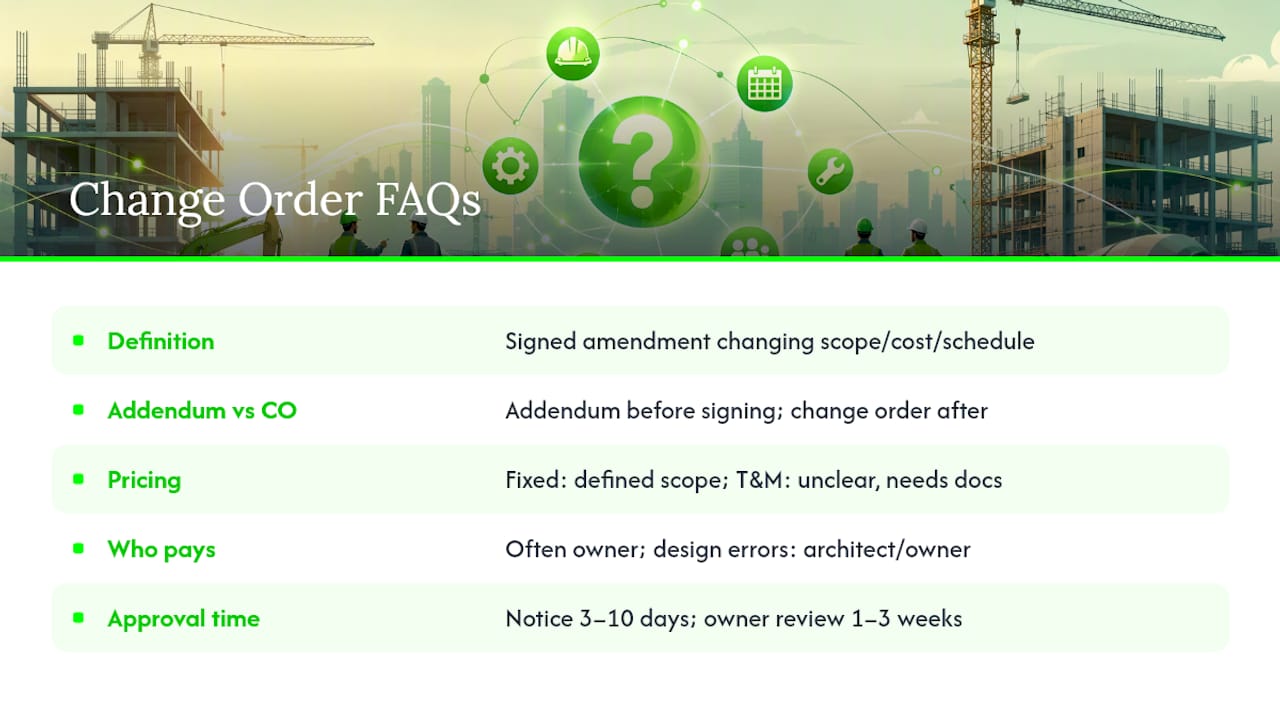
How long does change order approval usually take? It varies by contract, but notice windows of 3 to 10 days are common, with owner review periods adding another one to three weeks on private projects, longer on federal work.
Sources
Recommended


Comments