


Facility Maintenance Cost per Square Foot: What to Budget

There is no single price per square foot for facility maintenance. Published benchmarks for the same building type can differ several times over, because each source counts different things: some include only repairs and preventive work, others add cleaning, salaries and engineering. The useful number is your own cost per square foot, built from your own invoices on a definition you fix once, and then compared with a benchmark that uses the same definition.
This guide shows what published data says, how to calculate your figure, and what moves it for owners and managers of buildings in New York City, Long Island, Westchester and northern New Jersey. If you want a licensed contractor to put a preventive program on your building, our building and facility maintenance service covers that work.
TL;DR
Benchmarks are only comparable when the definition matches. ASHRAE’s public database shows a median of $0.248 per square foot for maintenance alone, while BOMA’s office figures for the New York area run far higher because they bundle in cleaning, salaries and engineering.
Your own number is total annual maintenance spend divided by gross square footage, using 12 to 24 months of invoices.
Keep capital replacements and tenant fit-outs out of the figure, or the number hides how the building is really being maintained.
Planned, scheduled work is the main lever on cost. Reactive repairs are the most expensive way to fix the same equipment.
Set the budget by building type, age and systems, then review it each year against actual invoices.
Table of Contents
What the published benchmarks actually show
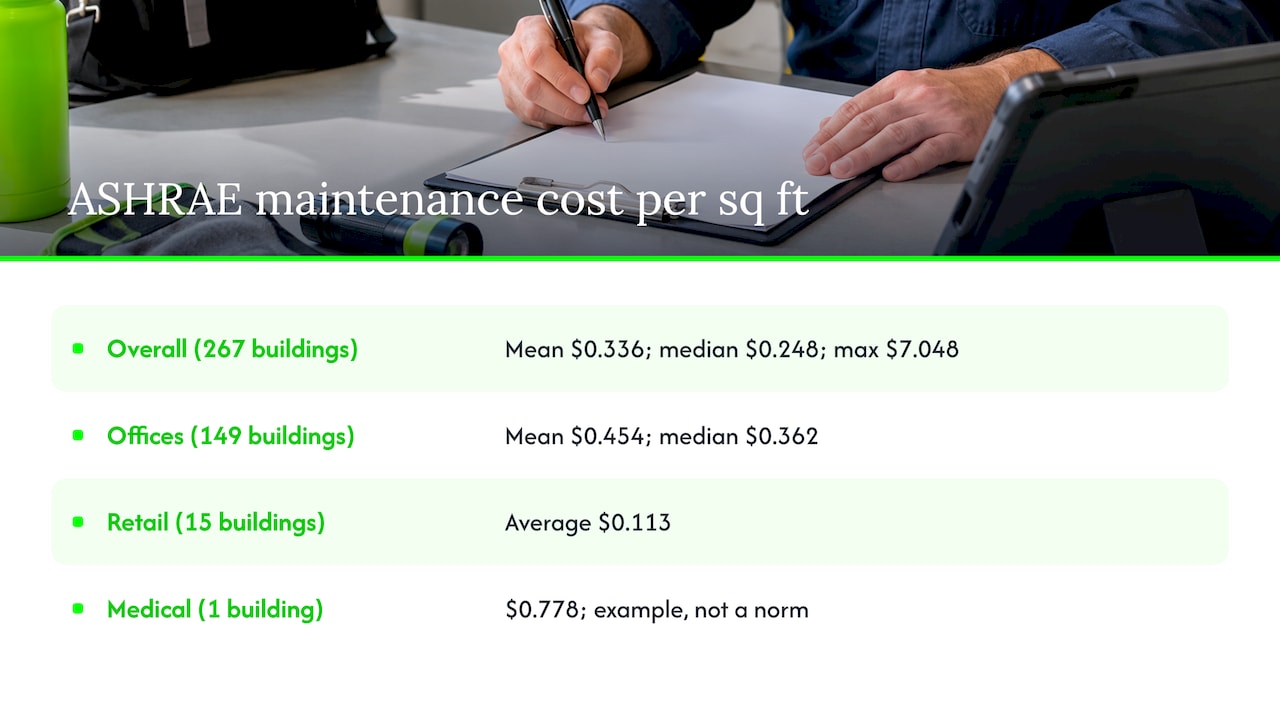
The most transparent public dataset is ASHRAE’s Maintenance Cost Data Query. It covers 267 buildings, with a mean of $0.336 and a median of $0.248 per square foot, and a maximum of $7.048. The gap between the median and the maximum tells you how wide the spread is before you even separate building types.
By type, the same database shows offices at a $0.454 mean and $0.362 median across 149 buildings. Retail averages $0.113 across 15 buildings, and the medical figure of $0.778 rests on a single building, so treat it as an example, not a norm.
You will see higher numbers elsewhere, often in the $1.50 to $3 range or above. Those usually come from broader definitions, and they are not wrong. They simply measure a bigger bucket of spending than ASHRAE does. Before you adopt any number as your target, ask what is inside it.
Why the number depends on what you count
Two professional bodies show how much the definition matters.
The IFMA benchmarking sample report defines annual maintenance cost as repair and preventive work, including materials, direct labor and contract costs. Its categories include exterior building, interior systems, roads and grounds, utility and central systems, and process or environmental systems.
BOMA’s 2022 Office Market Study is a different measure. Its maintenance line, based on the NCREIF definition, includes materials and labor, maintenance salaries, cleaning and janitorial, and engineering costs. A figure built that way will always be larger than one limited to repair and preventive work.
In practice, decide on four buckets and write them down:
Cost bucket | Usually counted in maintenance? | Note |
Routine and preventive work (filters, inspections, servicing) | Yes | The core of the figure |
Corrective repairs (a failed pump, a leaking joint) | Yes | Track separately so you can see reactive spend |
Janitorial and cleaning | Depends on the benchmark | Allocate it out if it sits inside a bundled services contract |
Utilities | No | Budget as a separate operating line |
Capital replacements (new roof, new boiler) | No | Belongs in a capital plan |
Tenant fit-outs | No | Project cost, not upkeep |
The point of the table is consistency. If last year’s figure included a boiler replacement and this year’s does not, the comparison tells you nothing.
What New York and New Jersey data says
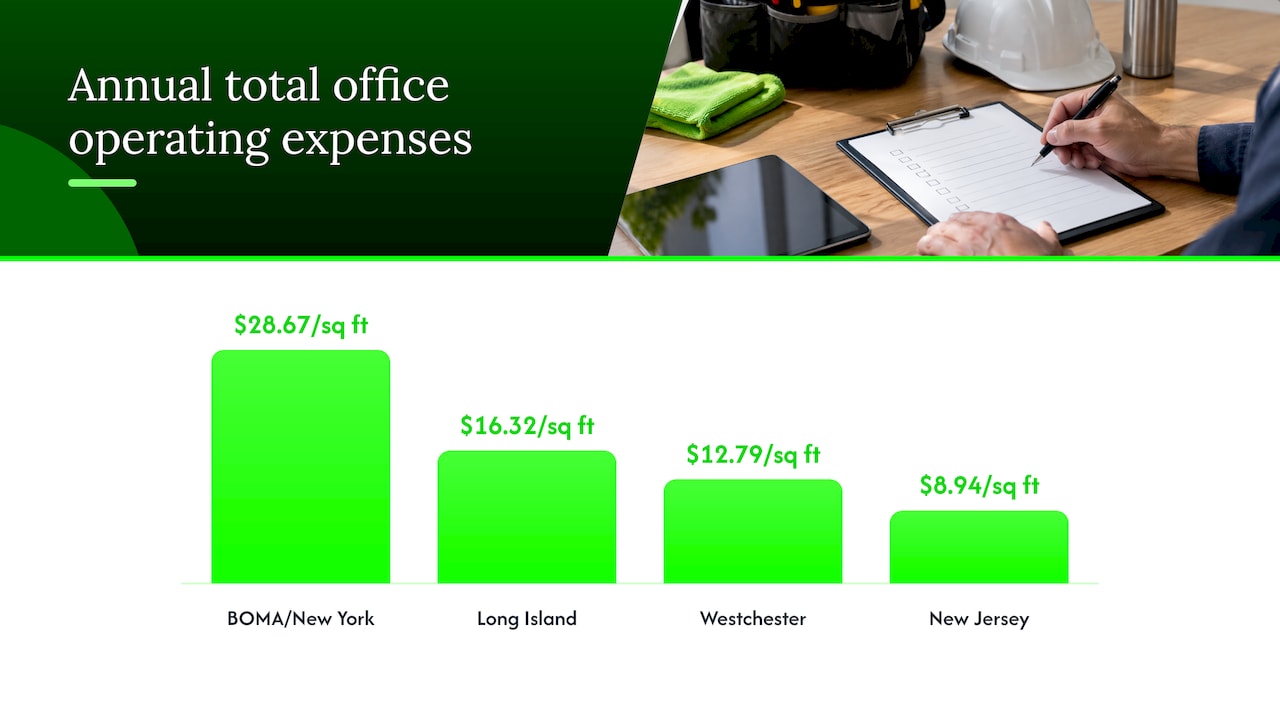
Regional data for our service area comes from BOMA’s 2022 Office Market Study. It reports annual total office operating expenses of $28.67 per square foot for BOMA/New York, $16.32 for Long Island, $12.79 for Westchester and $8.94 for New Jersey.
Two cautions apply when you read those numbers:
They are total operating expenses, not maintenance alone. Maintenance is one line inside them, next to items such as utilities and administration.
The territories are defined by the association. BOMA/New York is the five boroughs, Long Island is Nassau and Suffolk, and the Westchester association also takes in Putnam, Dutchess, Rockland and Orange counties.
What the numbers do show is direction: operating costs in New York City sit well above the suburbs, and Westchester and Long Island sit above northern New Jersey in this dataset. Labor rates, access constraints in dense blocks, and building age all push in the same direction when you budget maintenance in the five boroughs. A building in Queens or Manhattan should not be budgeted from a suburban or national average.
How to calculate your own cost per square foot
The formula is simple. Total annual maintenance spend divided by the building’s square footage gives your annual cost per square foot. Divide by 12 for a monthly figure. The work is in getting the inputs right.
1. Gather 12 to 24 months of records
Pull vendor invoices, work orders, payroll for any in-house maintenance staff and contract statements. Twelve months gives you one cycle of seasonal work. Twenty-four months lets you spot a one-off.
2. Sort every line into a bucket
Use the buckets in the table above. Mark each line as routine, preventive, corrective or capital. Where a single contract bundles several services, such as maintenance and cleaning, split it by the share each service represents.
3. Remove what does not belong
Take out capital replacements, tenant build-outs and utilities. If you are unsure whether a job is a repair or an improvement, our guide to capital improvements versus repairs explains how to tell them apart and keep the paper trail.
4. Confirm the square footage
Use one consistent measure. Gross area is common for benchmarking, but your lease or management agreement may use rentable area. Pick one and keep it.
5. Divide and record
Here is an illustrative example. A 25,000 square foot mixed-use building has $62,500 in qualifying maintenance spend over the year. That is $2.50 per square foot annually, or about $0.21 per square foot per month. These numbers are made up to show the arithmetic, not a benchmark for your building.
Run the same calculation each year and keep the buckets identical. After two years you have a trend, which is more useful than any outside average.
What pushes the cost up or down
The benchmarks above are averages across many buildings. Your cost moves with a handful of factors you can see and, in most cases, influence.
Building type and use. Offices, retail, restaurants, medical space and light industrial all carry different system loads. A restaurant front-of-house has more wear and more code-related upkeep than a quiet office floor.
Age and condition of systems. Roofs, facades, boilers, rooftop units and plumbing risers cost more to keep running as they age. Deferred work does not disappear. It returns as a larger repair.
Exterior envelope. In the Northeast, freeze-thaw cycles, water entry and masonry deterioration drive a large share of repair spend. Sealing and waterproofing work protect the interior finishes beneath.
Preventive versus reactive maintenance. Preventive work follows a schedule. Reactive work happens after something fails. A Schneider Electric and BGE report citing 2010 US Department of Energy data says about 55% of US building owners and operators rely on reactive maintenance, which it links to higher repair costs and service interruptions. Moving routine equipment onto a written schedule is the most direct way to take emergency calls out of your budget.
Contract structure. In-house staff, a single outsourced provider and a patchwork of one-off vendors each produce a different cost profile. A single accountable provider makes the invoices easier to sort, which makes your cost per square foot easier to trust.
Compliance work. Violations from the Department of Buildings or the Department of Transportation add corrective cost. Regular inspections catch most of the conditions behind them before they are written up.
Building a budget from the benchmarks
Use the benchmarks as a reasonableness check, not a target.
Start from your own history. Your last 12 to 24 months, cleaned into the buckets above, are the base.
Pick the matching benchmark. If your definition is repair and preventive work only, compare with a maintenance-only dataset such as ASHRAE. If it includes cleaning and engineering, compare with an operating-expense study such as BOMA.
Adjust for your location. In the five boroughs expect to sit above national and suburban figures.
Split planned from unplanned. Set a preventive budget and a smaller contingency for reactive repairs. If the contingency keeps being exceeded, the preventive scope is too thin.
Keep capital separate. Build a multi-year plan for roofs, mechanical equipment and facade work so these items do not distort the annual maintenance figure.
For a deeper look at the process around the numbers, see our facility maintenance guide for managers and the commercial facility maintenance workflow.
Staffing and square footage
Managers often ask how many maintenance staff a building needs. No single ratio fits every property. Staffing depends on the number and complexity of systems, building age, operating hours and how much work is handled by outside contractors. A 30,000 square foot building with a boiler plant, elevators and a restaurant tenant needs far more coverage than a same-size storage space.
The practical approach is to list the systems, the inspections each one needs and how often, and then decide which tasks need a person on site and which are better covered by a scheduled visit from a contractor. Labor is a major part of any maintenance budget, so the answer feeds straight into your cost per square foot.
Perspective
Owners ask us for a number per square foot, and the honest answer starts with a question: what is in your number? A figure that mixes repairs, cleaning and a replaced boiler cannot be compared with anything. Our view is that a building is cheapest to maintain when the work is planned, documented and done by one accountable team. A scheduled program covers inspection, servicing and small repairs before they grow. It also gives you clean invoices, which is what makes your own cost per square foot meaningful. We work across residential and commercial properties in New York City, Long Island and northern New Jersey. We are licensed and insured, and we follow local codes and licensing requirements. Our building and facility maintenance work includes a comprehensive preventative maintenance program and exterior envelope repair and waterproofing, and we back our labor and materials with warranties. If you manage a building in the five boroughs, budget from your own records and keep capital work out of the maintenance line. The rest follows from a schedule you keep. DJ
Putting a maintenance program in place
Our Building and Facility Maintenance service is built for owners, property managers and facility managers who want planned upkeep on their buildings. It includes a Comprehensive Preventative Maintenance Program and Exterior Envelope Repair and Waterproofing. We also handle the renovation and code-compliance work that tends to follow an inspection, including DOB and DOT violation removal, so one contractor can take the building from findings to completed repairs.

We do not publish prices, because scope, building age and systems set the cost. To get a quote for your property, book through our online booking page or see the full list of our services. For a related read on outsourcing, see how outsourced facility maintenance affects total cost of ownership.
FAQ
How do I calculate maintenance cost per square foot?
Add up 12 to 24 months of qualifying maintenance spend, remove capital replacements, utilities and tenant fit-outs, and divide by the building’s square footage. Divide the annual result by 12 for a monthly figure. Use the same definition every year so the trend is meaningful.
What is included in facility maintenance?
It typically covers repair and preventive work, with materials, direct labor and contract costs. IFMA’s categories include exterior building, interior systems, roads and grounds, and utility and central systems. Some studies also include cleaning, salaries and engineering, so check the definition before comparing numbers. Our overview of what commercial maintenance covers goes into more detail.
Is the cost per square foot higher in New York City than in New Jersey?
In BOMA’s 2022 office data, total operating expenses were $28.67 per square foot in New York City against $8.94 in New Jersey. That is total operating cost, not maintenance alone, but it indicates that city buildings should be budgeted higher than suburban or national averages.
How many maintenance staff does a building need?
There is no fixed ratio. It depends on the systems in the building, its age, its hours of use and how much work is outsourced. List each system and its inspection schedule, then decide what needs a person on site and what a scheduled contractor visit can cover.
Should capital repairs be in the maintenance budget?
No. Roof replacements, new boilers and similar projects belong in a separate capital plan. Keeping them out of the maintenance line makes your cost per square foot a clear picture of day-to-day upkeep.
Sources
Recommended


Comments