


Why Remove Code Violations: A Property Owner's Guide
- DJ Custom Contracting

- Jul 20
- 9 min read

Why removing code violations is crucial for property owners
Removing code violations protects your property, your finances, and your legal standing. When a violation goes unresolved, the consequences compound quickly: fines escalate, government agencies can step in to remediate the problem at your expense, and the violation attaches itself to your property’s title. Addressing violations promptly is one of the most direct ways to preserve what you’ve invested in a building.
Here is a clear summary of the core reasons to act:
Avoid penalties and government action. Unresolved violations can trigger fines, administrative fees, and government abatement actions that cost far more than voluntary correction.
Protect property value and marketability. Outstanding violations identified during title searches can stall sales and reduce buyer confidence.
Improve insurance eligibility. Code compliance is directly linked to better insurance terms and fewer claim disputes.
Maintain a safe, legally compliant building. Building codes exist to protect occupants from structural failures, fire hazards, and health risks.
Prevent costly long-term repairs. Violations left unaddressed often worsen over time, turning a minor correction into a major reconstruction project.
Common types of code violations property owners face
Property owners encounter a wide range of violations, and knowing the most common categories helps you spot problems before an inspector does. Violations generally fall into a few predictable groups, whether the property is residential or commercial.
Unpermitted construction and alterations. Work done without a permit, such as a finished basement or an added bathroom, creates a paper trail problem that surfaces during any future sale or renovation.
Fire safety deficiencies. Missing or non-functional smoke detectors, blocked egress paths, and outdated fire suppression systems are among the most frequently cited issues.
Structural and maintenance violations. Overgrown vegetation encroaching on neighboring properties, accumulated debris, and deteriorating facades all qualify as code violations in most jurisdictions.
Plumbing, electrical, and HVAC noncompliance. Outdated wiring, improper venting, and unlicensed plumbing work are common findings during inspections of older buildings.
Nuisance violations. Abandoned vehicles, junk accumulation, and similar conditions are treated as public nuisance violations and can draw enforcement attention quickly.
Understanding which category your violation falls into helps you identify the right contractor or specialist and set a realistic timeline for correction.
What are the legal and financial risks of ignoring violations?
The financial exposure from unresolved violations grows the longer a property owner waits. Fines often start at a fixed daily rate and increase with each inspection cycle. Administrative costs pile on top, and if the city or municipality steps in to abate the condition directly, enforcement costs and legal fees frequently become a tax lien on the property. That lien can block refinancing and must be cleared before any sale can close.
Escalating fines and administrative fees. Daily fines accumulate fast, and many jurisdictions add administrative processing fees to every notice cycle.
Government abatement and tax liens. When authorities remediate a violation themselves, they bill the owner at emergency contractor rates, and the total often becomes a lien against the title.
Stalled sales and financing. Title searches reveal outstanding violations, which can halt a sale or prevent a lender from approving a refinance.
Insurance consequences. Unresolved violations can lead to denied claims when damage is tied to a non-compliant condition, and some insurers raise premiums or decline coverage altogether.
Heightened permit scrutiny. A property with a history of violations can receive a flagged status in permit systems, leading to longer approval timelines and repeated inspections on future renovation projects.
How code enforcement agencies operate and manage violations
Code enforcement agencies prioritize inspections based on safety risk, focusing first on conditions that pose an immediate threat to occupants or the public. The goal of most enforcement programs is voluntary compliance, not punishment. Agencies would rather see an owner fix a problem than spend resources on litigation or emergency remediation.
The typical enforcement workflow moves through several defined steps:
Violation identification. A complaint, routine inspection, or permit review triggers an initial site visit.
Notice of violation issuance. The property owner receives a written notice specifying the violation, the applicable code section, and a compliance deadline.
Compliance period. The owner has a set window, often 30 to 90 days depending on the jurisdiction and severity, to correct the condition.
Re-inspection. An inspector returns to verify the correction. If the work is complete, the violation is closed.
Punitive follow-up. If the owner has not acted, the agency may issue fines, schedule a hearing, or initiate government abatement.
Abatement and cost recovery. In serious cases, the municipality contracts the remediation work and recovers costs through a tax lien on the property.
Throughout this process, building officials maintain records of permits, inspections, notices, and issued orders. Those records follow the property indefinitely.
Key benefits of removing code violations proactively
Proactive compliance pays off in ways that go beyond simply avoiding a fine. Buildings upgraded to meet current code standards are more resilient to natural disasters, and that resilience translates directly into lower repair costs and better insurance terms. The National Institute of Building Sciences has documented that adherence to updated codes significantly cuts long-term maintenance costs and financial risks during fire, flood, or storm events.
Jurisdictions that fail to adopt and enforce current codes put themselves at a competitive disadvantage. Codes uphold a democratically derived minimum level of quality and public health that a new building should not fall below. Failure to stay current signals a willingness to accept sub-quality standards compared to the rest of the nation. — Environmental and Energy Study Institute
The benefits of resolving violations extend across several dimensions:
Lower long-term costs. Correcting a violation now prevents the deferred maintenance cycle that turns a $2,000 repair into a $20,000 reconstruction. Buildings that meet current codes also tend to have lower operating costs because energy and mechanical systems perform as designed.
Better insurance outcomes. Removing violations aligns a building with modern safety and energy performance standards, which insurers reward with better coverage terms and fewer claim disputes. A compliant property is simply a lower-risk asset in an underwriter’s eyes.
Sustained property value. Buyers, tenants, and lenders all factor compliance into their decisions. A property with a clean violation record signals quality and reduces the risk premium that investors and lenders attach to their offers. Properties with lax enforcement histories face competitive disadvantages and deter investment.
Disaster resilience. Buildings constructed or renovated to current code standards withstand fire, flood, and wind events better than those built to older standards. That resilience shortens recovery time and reduces the financial shock of a major weather event.
Positive signals to the market. A code-compliant property communicates to prospective tenants and buyers that the owner takes maintenance seriously. That perception supports stronger lease terms and faster sales.
Practical steps to successfully remove code violations
Addressing a violation efficiently requires a clear process. Rushing without understanding the specific requirement often leads to re-inspection failures and additional delays.
Read the violation notice carefully. Identify the exact code section cited, the required correction, and the compliance deadline. Misreading the notice is one of the most common reasons owners miss deadlines.
Review the applicable building code. Most jurisdictions publish their adopted codes online. Understanding what the code actually requires prevents over-building the fix or under-correcting the condition.
Engage a qualified contractor or legal advisor. For structural, electrical, plumbing, or fire safety violations, licensed professionals are typically required. For complex or disputed violations, a code compliance attorney can clarify your rights and options. Learning how to remove building code violations in your specific jurisdiction is worth the time before work begins.
Pull the necessary permits. Most corrective work requires a permit. Completing the work without one creates a new violation on top of the original.
Schedule inspections proactively. Do not wait for the agency to schedule a re-inspection. Contact the enforcement office once the work is complete and request a sign-off as soon as possible.
Communicate with the code enforcement officer. If you need more time, request an extension in writing before the deadline passes. Most agencies grant reasonable extensions to owners who demonstrate good-faith progress.
Obtain final clearance documentation. Once the violation is resolved, get written confirmation from the agency and keep it with your property records. That documentation protects you if the violation is ever questioned during a future sale or permit application.
Pro Tip: Keep a dedicated folder, physical or digital, for every violation notice, permit, inspection report, and clearance letter. A complete paper trail is your best defense if a resolved violation resurfaces during a title search or insurance claim.
What are code violations, exactly?
A code violation is a condition on a property that does not meet the minimum standards set by an adopted building, property maintenance, or zoning code. Building codes protect occupants and investments by preventing structural failures and fire hazards, establishing a consistent framework for legal, safe, and durable construction. They are adopted by state, local, tribal, and territorial authorities and become enforceable law once formally enacted by the jurisdiction.
Violations can arise from construction that was never permitted, from deterioration over time, or from changes in the code that make a previously acceptable condition non-compliant. Not every violation involves active wrongdoing. An aging electrical panel that met code when it was installed may now fall short of current standards, creating a violation even though nothing was changed. The main purpose of building codes is to protect public health, safety, and general welfare in the construction and occupancy of buildings, and violations represent a departure from that baseline.
Property owners are responsible for maintaining compliance regardless of when the condition originated. That responsibility does not transfer to a previous owner, a tenant, or a contractor who performed the original work.
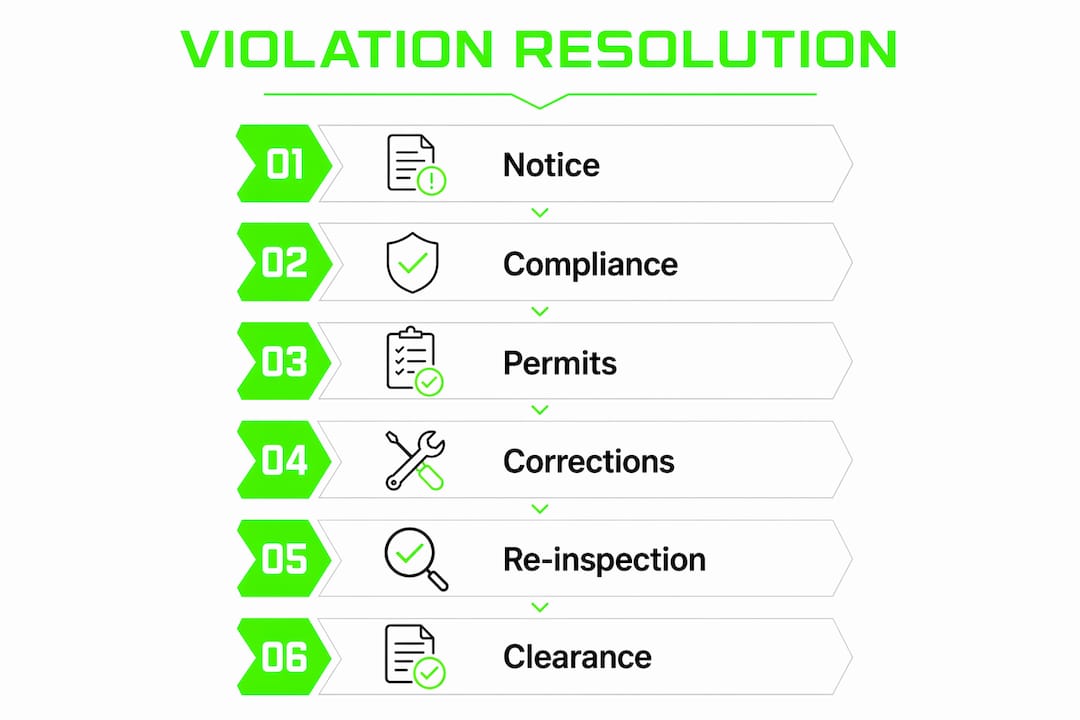
How long does it take to resolve a code violation from notice to clearance?
The timeline for resolving a code violation varies by jurisdiction, violation type, and the complexity of the required correction. Most processes follow a predictable sequence, though the duration at each stage depends on local enforcement schedules and the scope of work involved.

Stage 1: Notice issuance (Day 1). The property owner receives a written notice of violation. The notice specifies the violation, the code section, and the initial compliance deadline.
Stage 2: Compliance period (Days 1–30 to 90). The owner has a set window to correct the condition. Minor violations, such as debris removal or a missing smoke detector, may carry a short deadline. Structural or construction-related violations often allow a longer correction period, with some jurisdictions granting even more time for complex work.
Stage 3: Permit application and approval (1–4 weeks, if required). Work requiring a permit adds time before construction can begin. Permit review timelines vary widely by jurisdiction and workload. Properties with a flagged status from prior violations may face longer review periods.
Stage 4: Corrective work (1 day to several weeks). The actual repair or construction depends on the scope. A smoke detector installation takes an hour. Bringing an unpermitted addition into compliance can take weeks of licensed contractor work.
Stage 5: Re-inspection (1–2 weeks after work completion). The owner requests a re-inspection. The inspector verifies the correction against the cited code section. If the work passes, the violation is closed. If it does not, the cycle restarts with a new deadline.
Stage 6: Final clearance documentation (1–5 business days). Once the violation is closed, the agency issues written confirmation. Building officials maintain records of all permits, inspections, and corrections, so the clearance becomes part of the property’s permanent file.
A straightforward violation with no permit requirement can move from notice to clearance in under 30 days. A complex construction violation requiring permits, licensed contractors, and multiple inspections can take three to six months. Starting immediately after receiving a notice is the single most effective way to stay within the compliance window and avoid escalating consequences. Reviewing a project compliance workflow before beginning corrective work helps owners sequence the steps correctly and avoid common delays.
Ready to resolve your violations? Djcustomcontracting can help.

Djcustomcontracting has been handling DOB and DOT violation removal, interior renovation work, and full-scale compliance projects for residential and commercial property owners since 2018. Every project is completed in accordance with applicable local laws, licensing requirements, building codes, and insurance regulations. Whether you are dealing with a single outstanding notice or a property with multiple open violations, Djcustomcontracting has the experience and trade knowledge to bring your building into compliance efficiently. No job is too big or too small.
Key Takeaways
Removing code violations protects property value, prevents escalating fines, and keeps buildings legally compliant and insurable.
Point | Details |
Act before enforcement escalates | Government abatement costs far more than voluntary correction and can result in a tax lien on the property. |
Violations block sales and financing | Outstanding violations identified in title searches can stall closings and prevent lenders from approving refinancing. |
Compliance improves insurance outcomes | Aligning a building with current safety standards leads to better coverage terms and fewer denied claims. |
Flagged properties face longer permit timelines | A prior violation history creates a flagged status that extends future permit reviews and triggers repeated inspections. |
Start the resolution process immediately | Moving quickly after receiving a notice keeps the timeline manageable and prevents fines from compounding. |
Recommended


Comments