


2026 Construction Industry Trends: A Professional Guide

The construction industry in 2026 is defined by uneven growth, concentrated sector demand, and a technology shift that is changing how projects get built. Total U.S. construction spending is forecast at $2.27 trillion, representing a 5.1% year-on-year increase. That growth is not distributed evenly. Data centers and private office construction are driving the headline number, while large portions of the commercial sector are contracting. For construction professionals and stakeholders, the 2026 construction industry trends signal a market that rewards specialization, early planning, and technology adoption over broad-based expansion.
What are the major sector trends impacting construction in 2026?
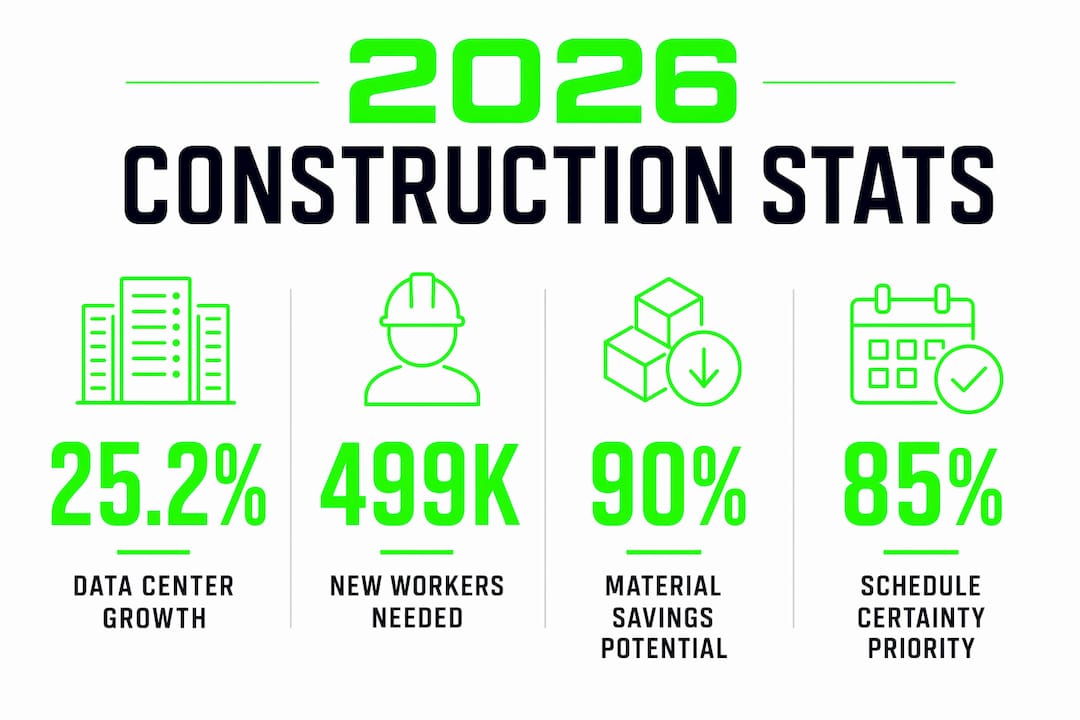
The 2026 construction market is a story of two industries running at different speeds. Private office and data center construction posted 25.2% sector growth year-on-year. That figure reflects surging demand for digital infrastructure, AI computing facilities, and corporate campus consolidation. Meanwhile, non-residential construction excluding data centers is projected to contract by roughly 9%. That contraction signals a real reallocation of capital, not a temporary slowdown.
The sectors attracting the most investment in 2026 include:
Data centers and hyperscale facilities: Driven by AI infrastructure buildout and cloud expansion
Power generation and grid infrastructure: Utility-scale projects are accelerating to meet energy demand from data centers
Public infrastructure: Federal funding programs continue to support roads, bridges, and transit
Healthcare and life sciences: Steady demand from aging demographics and post-pandemic facility upgrades
Sectors showing stagnation or contraction include retail, hospitality, and general commercial office space outside the tech corridor markets. This concentration of demand creates real pressure on specialized subcontractors, electrical capacity, and structural steel supply chains. Firms that have positioned themselves in high-demand sectors are seeing full order books. Those still focused on general commercial work are competing harder for fewer projects.
Sector | 2026 Direction |
Data centers and private office | Strong growth (25.2% YoY) |
Power and grid infrastructure | Growing |
Public infrastructure | Stable to growing |
General commercial (retail, hospitality) | Stagnant or contracting |
Non-residential excluding data centers | Projected ~9% contraction |
The practical implication for project teams is clear. Resource allocation, subcontractor relationships, and procurement strategies need to reflect where demand actually lives, not where it was three years ago.
How is advancing technology transforming construction workflows?
AI and automation are no longer pilot programs in 2026. They are production tools deployed on active job sites and in design offices. AI-driven BIM platforms now generate coordinated construction drawings in hours rather than weeks. That speed compresses design schedules and reduces the coordination errors that historically caused expensive field rework.

On the documentation side, AI tools like the Cortex platform focus specifically on revision management and change detection in construction drawings. The platform identifies design changes that fall outside standard revision clouds, catching unmarked modifications before they reach the field. That capability directly reduces downstream rework, which remains one of the largest cost drivers on complex projects.
Autonomous equipment is also moving from demonstration to commercial deployment. Autonomous excavators like the Real-X crawler are operating on active sites, addressing labor shortages in earthwork operations. These machines do not replace skilled operators entirely. They handle repetitive, high-volume tasks, freeing experienced operators for precision work.
Key technology shifts reshaping project delivery in 2026:
AI-generated BIM documentation: Coordinated drawings produced in hours, reducing design phase duration
Automated change detection: AI platforms catching unmarked drawing revisions before field execution
Autonomous earthmoving equipment: Commercially deployed machines reducing dependence on scarce equipment operators
Digital twin integration: Real-time site data feeding project management systems for schedule and cost tracking
Pro Tip: Adopt AI documentation tools before procurement, not after. Catching design conflicts at the drawing stage costs a fraction of resolving them during construction.
MIT research has shown that advanced optimization tools could theoretically reduce material usage by up to 90% on structural applications. The gap between that potential and current field practice remains wide. Moving algorithmic research into buildable workflows is the real challenge for the next phase of construction technology adoption.
What workforce and labor market changes are defining 2026?
The construction labor market in 2026 presents a paradox. The industry faces demand for over 499,000 new workers through 2031, yet current hiring and layoff rates are both historically low. That stability sounds positive, but it actually signals a frozen market. Firms are holding onto experienced workers tightly, making it difficult for competitors to recruit and for new entrants to find positions.
The workforce transformation in 2026 is not just about headcount. It is about skill composition. Industrialized construction processes now require project managers who can operate in both traditional field environments and complex digital workflows. A foreman who cannot read a BIM model or interpret a digital schedule is less effective than one who can. That reality is reshaping hiring criteria across general contractors and specialty trades.
Firms responding effectively to these shifts are taking the following steps:
Developing hybrid roles: Combining craft skills with technology proficiency in a single job description
Investing in internal training: Upskilling existing workers on BIM platforms, drone operation, and digital reporting tools
Partnering with trade schools: Building pipelines for workers who enter the trades with baseline digital literacy
Adopting flexible staffing models: Using technology-augmented teams that accomplish more with fewer people on site
Pro Tip: When evaluating candidates for field supervisor roles, test for digital tool proficiency alongside trade knowledge. The commercial project checklist approach works well for identifying skill gaps before a project starts.
The firms that treat workforce development as a capital investment, not an HR function, are building a durable advantage. Waiting for the labor market to normalize is not a viable strategy when the structural shortage runs through 2031.
How are supply chain and execution challenges evolving in 2026?
Supply chain volatility in 2026 has shifted character. The material scarcity problems of 2021 through 2023 have largely resolved. The new constraints are logistical and capacity-based. Power availability, permitting timelines, and skilled trades capacity now shape project delivery schedules more than raw material lead times. That shift requires a different planning response.
Engineering innovation is addressing some execution challenges directly. A steel-pipe cross-beam construction method has demonstrated the ability to reduce high-altitude work time by up to 87% on specific structural applications. That reduction improves both worker safety and schedule predictability on tall structures. Methods like this represent the practical side of construction industrialization, where process redesign delivers measurable gains without waiting for technology to mature.
Challenge Type | 2023 Focus | 2026 Focus |
Primary constraint | Material availability | Logistics and capacity |
Key bottleneck | Steel, lumber, concrete supply | Power, permitting, skilled trades |
Planning response | Procurement lead time buffers | Early cross-disciplinary engagement |
Risk mitigation | Supplier diversification | Integrated delivery and utility planning |
Hidden bottlenecks in utility connections and permitting often surface after feasibility studies are complete. By that point, schedule adjustments are expensive. Early utility planning, initiated before procurement phases begin, is the single most effective way to protect schedule predictability on data center and infrastructure projects. Teams that treat utility engagement as a design-phase activity rather than a construction-phase task consistently outperform those that do not.
For teams managing damage restoration projects or complex phased renovations, the same principle applies. Identifying permitting and inspection bottlenecks at the planning stage prevents the cascading delays that compress schedules and inflate costs at the back end of a project.
Key Takeaways
The 2026 construction market rewards firms that commit to early planning, technology adoption, and workforce development before projects reach the field, not after.
Point | Details |
Sector growth is concentrated | Data centers and power infrastructure are growing; general commercial is contracting by roughly 9%. |
AI tools are production-ready | BIM automation and AI change detection reduce rework and compress design schedules on active projects. |
Labor shortage runs through 2031 | Demand for over 499,000 workers requires hybrid staffing models, not traditional hiring alone. |
Supply chain risk has shifted | Power, permitting, and trades capacity now drive schedule risk more than material availability. |
Early planning is the top lever | Addressing utility and permitting bottlenecks before procurement protects schedule certainty on complex projects. |
What I’ve learned from watching the 2026 market take shape
The single biggest mistake I see firms make right now is treating technology adoption and workforce development as separate budgets. They are the same investment. An AI-powered BIM platform is only as useful as the project manager who can interpret its output and act on it. Buying the tool without training the team produces expensive shelf software, not better projects.
Schedule certainty has replaced speed as the defining metric for project success in 2026. That shift matters more than most firms realize. Owners are no longer impressed by aggressive timelines that collapse in execution. They want reliable commitments backed by integrated delivery models and early stakeholder alignment. The firms winning the best work right now are the ones who can demonstrate that reliability before the contract is signed.
The hidden compliance risk in 2026 is permitting. Power infrastructure projects, data center builds, and even mid-scale commercial renovations are hitting utility and zoning bottlenecks that were not visible at the feasibility stage. Getting your project stages mapped with utility engagement built into the design phase is not optional anymore. It is the difference between a project that delivers on schedule and one that explains delays to an owner for six months.
My practical advice: pick two technology tools, implement them fully, and measure the outcome before adding more. Firms that chase every new platform end up with fragmented workflows and frustrated teams. Depth of adoption beats breadth every time.
— DJ
Djcustomcontracting’s approach to 2026 construction projects
The trends shaping 2026 require a contractor who understands both the technical demands of complex projects and the planning discipline needed to execute them reliably.

Djcustomcontracting has delivered residential and commercial projects since 2018, with direct experience in interior and exterior renovations, additions, alterations, and commercial maintenance across demanding regulatory environments. For professionals navigating data center buildouts, office conversions, or infrastructure-adjacent commercial work, Djcustomcontracting brings the field knowledge and compliance expertise those projects require. The team’s commercial renovation services are built for the complexity that defines the 2026 market. Contact Djcustomcontracting to discuss your project requirements and get a plan that reflects current market realities.
FAQ
What is driving U.S. construction spending growth in 2026?
Data center and private office construction are the primary growth drivers, posting 25.2% year-on-year growth. Total U.S. construction spending is forecast at $2.27 trillion for 2026.
How is AI changing construction documentation workflows?
AI platforms now generate coordinated BIM drawings in hours and detect unmarked design changes in existing drawings. Both capabilities reduce rework costs and improve accuracy before work reaches the field.
What is the biggest workforce challenge in construction for 2026?
The industry needs over 499,000 new workers through 2031, but hiring and layoff rates are both historically low. Firms are responding with hybrid staffing models that combine craft skills and digital tool proficiency.
Why is schedule certainty more important than speed in 2026?
Owners now prioritize reliable delivery over aggressive timelines that fail in execution. Integrated delivery models and early utility planning are the primary tools for achieving schedule certainty on complex projects.
What supply chain risks should construction teams plan for in 2026?
Power availability, permitting timelines, and skilled trades capacity are the dominant constraints in 2026. Teams that engage utilities and permitting authorities during the design phase consistently protect their schedules better than those that wait until procurement.
Recommended


Comments