


Alteration Work NYC: Permits, Costs & Compliance


Alteration work in NYC is defined as any construction, renovation, or modification to an existing building that requires a permit from the New York City Department of Buildings. The NYC DOB classifies these projects under three permit types: Alt-1, Alt-2, and Alt-3. Each type defines the legal scope, documentation requirements, and fee structure for your project. Whether you own a brownstone in Brooklyn or manage a commercial space in Manhattan, understanding which classification applies to your renovation is the first decision that shapes everything else.
What is alteration work NYC? the three DOB permit types
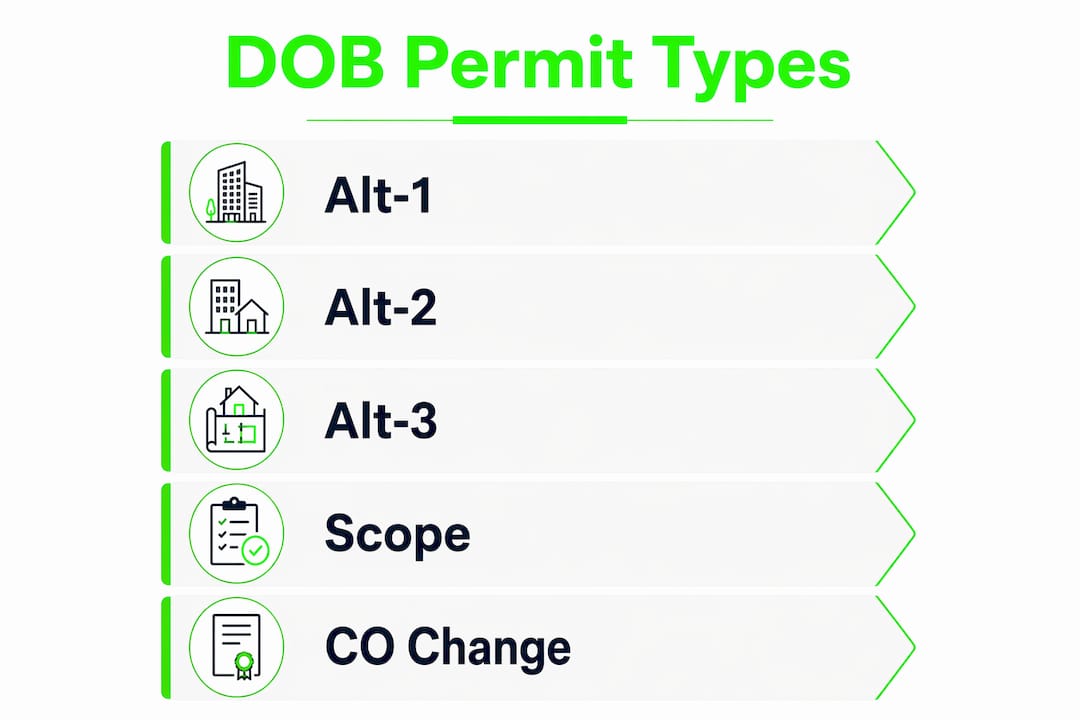
The NYC DOB uses three alteration classifications to regulate building renovations. Choosing the wrong one delays your project and can trigger compliance issues that cost far more than the permit itself.
Alt-1: Major Alterations

Alt-1 covers major alterations that result in a new or amended Certificate of Occupancy. This applies when you change the building’s use, occupancy group, egress configuration, or occupancy load. Common examples include converting a two-family home into a three-family dwelling, combining two apartments into one, or changing a residential floor to commercial use. Alt-1 requires stamped drawings from a licensed architect or engineer, full plan review by the DOB, and a new or amended CO before the space can be legally occupied.
Alt-2: The Standard Interior Renovation Permit
Alt-2 is the most common permit for multi-trade interior renovations that do not change the building’s Certificate of Occupancy. It covers work involving two or more trades, such as plumbing, electrical, and structural work done together during a kitchen or bathroom remodel. Most residential gut renovations and commercial tenant fit-outs fall under Alt-2. The permit does not change the building’s legal use or occupancy, which keeps the filing process more manageable than Alt-1.
Alt-3: Minor Single-Trade Work
Alt-3 covers minor, single-trade work that does not affect the Certificate of Occupancy or structural integrity. Examples include replacing a water heater, installing a new HVAC unit, or making minor electrical repairs. The filing path is lighter, and in many cases the property owner can file directly without a registered design professional. Structural work rarely qualifies for Alt-3 and typically requires Alt-1 or Alt-2 with professionally stamped drawings.
Permit Type | Scope | CO Change | Design Professional Required |
Alt-1 | Major multi-trade, use/occupancy change | Yes | Always |
Alt-2 | Multi-trade interior work, no CO change | No | Yes |
Alt-3 | Minor single-trade work | No | Usually not |
Pro Tip: If your renovation touches plumbing AND electrical, you are almost certainly in Alt-2 territory, even if the project feels small. Confirm the classification with an architect before breaking ground.
How does the NYC DOB permit filing process work?
Filing for an alteration permit in NYC follows a structured process through the DOB NOW online platform. Here is how it works in practice.
Determine your alteration type. Confirm whether your project is Alt-1, Alt-2, or Alt-3 based on scope, trades involved, and whether the CO changes.
Engage a registered design professional. For Alt-1 and Alt-2, a licensed architect or engineer must prepare and stamp the drawings. They serve as the applicant of record with the DOB.
Submit the PW1 application through DOB NOW. The PW1 plan/work application is the primary filing document for most Alt-2 projects. It is submitted digitally through DOB NOW along with plans, specifications, and supporting documents.
Pay filing fees. Fees are calculated based on declared project cost and scope. The DOB reviews the submission and may issue comments requiring revisions.
Receive permit approval. Once approved, permits are issued for each trade. Work can begin only after permits are in hand.
Manage amendments as needed. DOB NOW allows online submissions but projects frequently require amendments when scope changes during construction. Budget time for this step.
Schedule inspections and close out. Final inspections confirm the work matches approved plans. For Alt-1, a new CO is issued at closeout.
DOB review for a standard Alt-2 filing typically takes one to two weeks for straightforward projects. Complex filings or those flagged for full plan examination take longer.
Many property owners hire a DOB expeditor to manage the paperwork, track comments, and coordinate between the design professional and the DOB. Expeditors do not replace architects or engineers, but they reduce delays caused by administrative errors and missed deadlines.
Pro Tip: Never start construction before permits are issued. A stop-work order mid-project costs far more in delays and fines than waiting the extra week for approval.
What costs should NYC property owners expect?
Permit fees for alteration work in NYC are calculated based on declared project cost, scope, and the number of trades involved.
The minimum filing fee is $130 for most alteration permit types. That baseline applies to the simplest filings. For Alt-2 projects involving plumbing and electrical work, typical DOB fees range from $1,200 to $3,800 depending on the declared construction cost. Larger declared costs push fees higher.
Beyond DOB permit fees, your total project budget should account for:
Architect or engineer fees. Design professionals charge for drawings, specifications, and DOB filing coordination. Fees vary widely by project complexity and firm.
Expeditor fees. Professional expeditors typically charge a flat fee or hourly rate to manage DOB submissions and track approvals.
Amendment fees. If the project scope changes after filing, amendments require additional submissions and fees.
Inspection fees. Some inspections carry separate charges depending on trade and project type.
Alt-1 projects carry higher total costs because they require more extensive documentation, full plan review, and a new or amended CO. Alt-3 projects sit at the low end of the fee range given their limited scope.
Budget for DOB fees early in your planning process. Property owners who treat permit costs as an afterthought often face cash flow problems when fees arrive mid-project.
What are the legal risks of unpermitted alteration work?
Performing alteration work without required NYC DOB permits is a serious legal and financial risk. The consequences extend well beyond a fine.
“DOB can issue fines and enforcement actions for unpermitted alterations under the NYC Administrative Code, with penalties reaching up to $25,000 per violation.”
The DOB also issues stop-work orders, which halt all construction immediately. If the violation is severe, the DOB can issue a vacate order, forcing occupants out of the building until the issue is resolved. Both outcomes create significant delays and costs that far exceed the original permit fees.
Unpermitted work also creates problems at resale. Title searches and buyer inspections frequently uncover open permits or unpermitted work. Buyers either walk away or demand price reductions. Lenders may refuse to finance properties with unresolved DOB violations.
For commercial properties, unpermitted alterations can affect your Certificate of Occupancy and your ability to legally operate the space. Tenants and landlords both face exposure when work is done outside the permit process.
The right approach is to remove building code violations proactively rather than waiting for enforcement. Working with a qualified contractor and design professional from the start is the most reliable way to stay compliant.
How to choose the right permit type and work with professionals
Misclassifying an alteration project is one of the most common and costly mistakes property owners make. Confusing DOB alteration types with building code alteration levels is a recognized practitioner pitfall. The two systems are related but distinct, and getting them mixed up can trigger unintended upgrade requirements.
Follow this decision process to classify your project correctly:
Define the full scope of work. List every trade involved: structural, plumbing, electrical, mechanical, and architectural.
Determine if the CO changes. If the building’s use, occupancy group, or egress configuration changes, you need Alt-1.
Count the trades. Two or more trades with no CO change means Alt-2. A single minor trade with no structural impact means Alt-3.
Engage a licensed architect or engineer early. For Alt-1 and Alt-2, a design professional is required. Engaging one at the planning stage prevents misclassification and scope creep.
Consider an expeditor. For complex filings or tight timelines, an expeditor reduces administrative friction and keeps the process moving.
Property owners can sometimes file Alt-3 applications themselves, but this is only appropriate for genuinely minor, single-trade work. Attempting to self-file an Alt-2 project without a design professional will result in rejection.
For residential additions and larger remodels, the step-by-step workflow for residential additions in NYC provides a practical reference for understanding how permit pathways connect to construction phases.
Pro Tip: When in doubt, classify up. Filing an Alt-2 when you might qualify for Alt-3 adds cost but protects you from enforcement. Filing an Alt-3 when you need Alt-2 creates violations.
Key takeaways
Alteration work in NYC requires the correct DOB permit classification from the start, because misclassification triggers compliance failures, financial penalties, and project delays.
Point | Details |
Three permit types govern NYC alterations | Alt-1, Alt-2, and Alt-3 each define scope, CO impact, and professional requirements. |
Alt-2 is the most common residential permit | Multi-trade interior renovations without a CO change almost always require Alt-2 filing. |
Permit fees start at $130 but scale quickly | Alt-2 projects with plumbing and electrical typically cost $1,200–$3,800 in DOB fees alone. |
Unpermitted work carries up to $25,000 in fines | Stop-work orders and vacate orders add delays and costs that far exceed permit fees. |
Design professionals are required for Alt-1 and Alt-2 | A licensed architect or engineer must prepare and stamp drawings for most renovation filings. |
What i’ve learned after years of NYC alteration projects
The single biggest mistake I see property owners make is treating the permit process as a formality rather than a planning tool. They finalize their contractor, order materials, and then ask about permits. By that point, the scope is locked in and any classification issue becomes a crisis instead of a correction.
The DOB filing process is iterative by design. Even well-prepared submissions often come back with comments. That is not a failure. It is how the system works. The property owners who handle it best are the ones who build amendment time into their schedules from day one.
I have also seen projects where the owner and contractor disagreed on whether work was Alt-2 or Alt-3. That disagreement, left unresolved, led to unpermitted work and a stop-work order six weeks into construction. The cost to remediate was three times what the correct permit would have cost upfront.
My advice is straightforward. Engage your architect before you finalize your budget. Confirm your alteration type before you sign a construction contract. And if your project involves pre-war construction, read up on renovating a pre-war NYC building before you start, because those structures carry additional compliance considerations that can shift your permit type entirely.
The DOB process is not the enemy. It is the framework that protects your investment and your building’s legal standing. Work with it, not around it.
— DJ
How Djcustomcontracting handles NYC alteration projects
Djcustomcontracting has been managing residential and commercial alteration projects in New York City since 2018. The team understands the Alt-1, Alt-2, and Alt-3 permit process from the inside, and coordinates directly with design professionals and DOB filing representatives to keep your project on track and in compliance.
Whether you are planning a full interior gut renovation or a targeted commercial fit-out, Djcustomcontracting delivers work that meets NYC building codes and local licensing requirements. The team handles projects of every scale, from single-trade repairs to multi-floor interior renovation work. If your project also involves the building envelope, Djcustomcontracting’s exterior renovation services cover facades, roofing, and structural repairs under the same compliance-first approach. Contact Djcustomcontracting to discuss your project scope and get a clear picture of what your alteration permit will require.
FAQ
What is alteration work in NYC?
Alteration work in NYC is any renovation or modification to an existing building regulated by the NYC Department of Buildings under three permit types: Alt-1, Alt-2, and Alt-3. Each type defines the legal scope, required documentation, and fee structure for the project.
Do all NYC renovations require a DOB permit?
Most renovations require a permit, but the type depends on scope. Minor single-trade work may qualify for Alt-3, while multi-trade interior remodels require Alt-2 and major occupancy changes require Alt-1.
How much does an NYC alteration permit cost?
The minimum filing fee is $130, but Alt-2 projects involving plumbing and electrical typically generate DOB fees of $1,200–$3,800 depending on declared project cost and complexity.
What happens if you do alteration work without a permit in NYC?
The DOB can issue fines up to $25,000 per violation, stop-work orders, and in serious cases, vacate orders. Unpermitted work also creates legal and financial complications at resale.
Do i need an architect for an NYC alteration permit?
Alt-1 and Alt-2 filings require a licensed architect or engineer as the applicant of record. Alt-3 filings for minor single-trade work may not require a design professional, but confirm with the DOB before filing independently.
Recommended


Comments