


Commercial Renovation Explained for Property Owners


Commercial renovation is defined as the alteration or upgrade of an existing commercial structure without changing its footprint or primary load-bearing systems. The industry also uses terms like “tenant improvement” and “commercial remodel,” but these are not interchangeable. Understanding commercial renovation explained in full means knowing the difference between a cosmetic refresh, a functional reconfiguration, and a structural alteration. Property owners and business managers who grasp these distinctions make better decisions about scope, budget, and contractor selection before a single wall is touched.
What commercial renovation actually means
Commercial renovation covers alteration or upgrade of existing commercial buildings without changing the footprint or load-bearing structure. That definition separates it from ground-up construction and from demolition. Tenant improvements are a specific subset focused on leased spaces within multi-tenant buildings, and the scope of work directly affects which permits are required and how contracts must be structured.
The confusion between “renovation,” “remodel,” and “tenant improvement” is not just semantic. Misclassifying the project scope leads to permit disputes and cost overruns that could have been avoided with clear definitions at the outset. A retail fit-out in a strip mall is a tenant improvement. A full floor reconfiguration in an office building that touches structural elements is a capital renovation. Each carries different regulatory, financial, and contractual obligations.
Common project types include office build-outs, retail store refreshes, restaurant conversions, industrial facility upgrades, and medical office reconfigurations. For a deeper look at how these distinctions apply specifically in the New York and New Jersey market, the NY and NJ owners guide from Djcustomcontracting breaks down local nuances in detail.
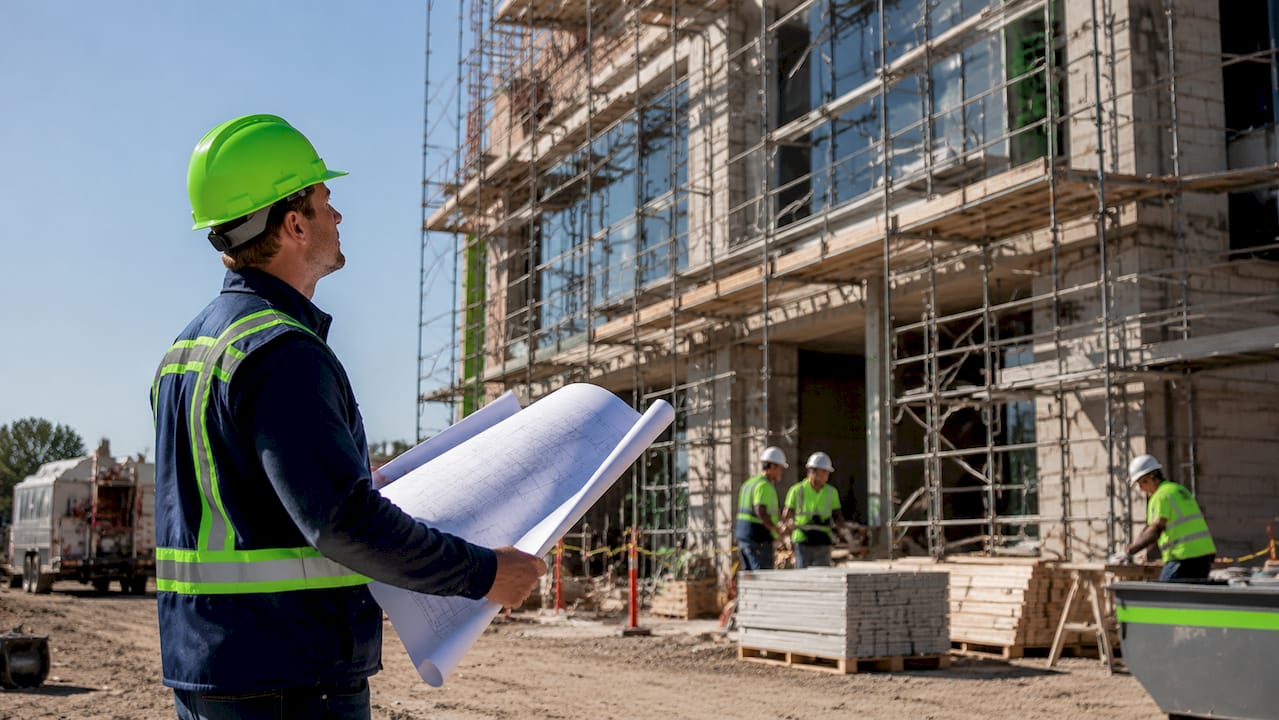
What are the main types of commercial renovation projects?
Commercial renovations fall into three broad categories based on scope and complexity. Knowing which category your project falls into shapes every decision that follows.
Cosmetic renovations address surface-level changes that improve appearance without touching building systems or structure:
Repainting walls, ceilings, and trim
Replacing flooring with carpet, LVT, polished concrete, or tile
Updating lighting fixtures and switching to LED systems
Refreshing storefronts with new signage, glass, or cladding
Functional renovations go deeper, reconfiguring how space is used and often requiring trades work:
Demolishing or adding non-load-bearing partition walls
Upgrading mechanical, electrical, and plumbing (MEP) systems
Installing new HVAC zones for open-plan offices
Adding accessible restrooms or ADA-compliant entries
Structural renovations involve modifications to load-bearing elements and require licensed engineers and more rigorous permitting:
Removing or adding structural walls and columns
Modifying steel framing to create larger open spans
Adding mezzanines or interior floor levels
Reinforcing foundations or floor systems for new equipment loads
The distinction between functional and structural is where many property owners underestimate their project. A seemingly simple wall removal can cross into structural territory the moment it involves a beam or a load path. Getting a structural engineer involved early prevents costly redesigns mid-construction.
What permits and regulatory requirements must be addressed first?
All commercial renovation work requires obtaining building, trade, and in some cases land use permits before work begins. Permits must be accompanied by sealed architectural or engineering plans that detail dimensions, materials, accessibility provisions, and code compliance measures. Skipping this step does not save time. It creates stop-work orders, fines, and the cost of undoing completed work.
The International Existing Building Code (IEBC) governs most commercial renovation projects in the United States. The 50% rule under IEBC is a critical threshold. When the work area exceeds 50% of the building’s total floor area, the project is classified as a Level 3 alteration, triggering more stringent requirements for fire protection, egress, structural compliance, and accessibility. Many experienced contractors phase projects specifically to stay under this threshold and manage compliance costs.
The permit process typically follows these steps:
Pre-application meeting with the local building department to confirm project classification and submittal requirements
Preparation of construction documents by a licensed architect or engineer, including life safety, accessibility, and structural drawings
Permit application submittal with all required plans, fee payments, and supporting documentation
Plan review by the building department, fire marshal, and any other applicable agencies
Permit issuance and posting on site before work begins
Inspections at required milestones (framing, rough MEP, insulation, final)
Certificate of Occupancy issued upon successful final inspection
The City of Grand Rapids, Michigan, for example, requires that commercial renovation permits include sealed plans covering all dimensions, materials, and code compliance details before any approval is granted. Most jurisdictions follow a similar process, though timelines and fee structures vary.
Pro Tip: Request a pre-application meeting with your local building department before finalizing your design. Departments often flag issues at this stage that would otherwise cause costly plan revisions after submittal.
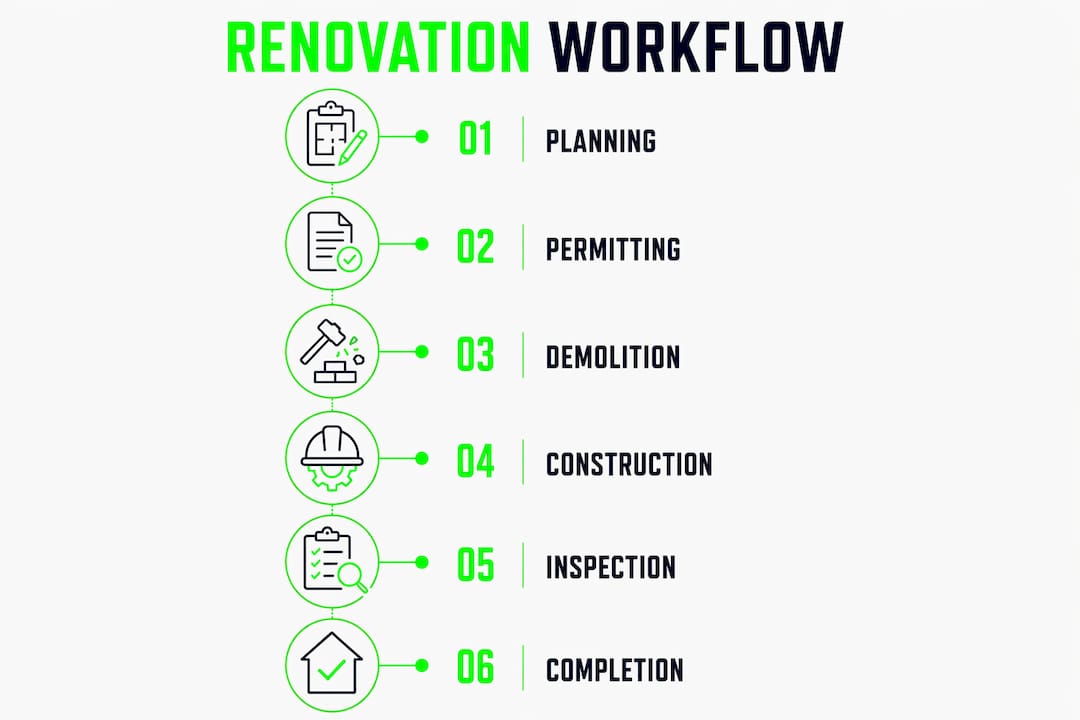
How does the commercial renovation workflow typically proceed?
The commercial renovation process follows a defined sequence. Deviating from it is the single most common cause of budget overruns and schedule delays.
Property Condition Assessment (PCA): Before scope is defined, a PCA governed by ASTM E2018 standards reveals deferred maintenance, hidden deficiencies, and compliance gaps. Proper inspection includes document review, a physical walkthrough, and cost-to-remedy opinions that transform unknown conditions into a clear negotiation and planning instrument.
Programming and scope definition: Define exactly what the space needs to accomplish. Square footage requirements, occupancy loads, operational workflows, and brand standards all feed into this stage. Vague scope at this point becomes expensive change orders later.
Design development and construction documents: An architect or engineer translates the program into permit-ready drawings. This includes floor plans, reflected ceiling plans, MEP coordination drawings, and specifications.
Permit application and approval: Submit documents to the relevant jurisdiction and manage the review process. Plan for a review period of two to eight weeks depending on project complexity and local department workload.
Contractor selection and bidding: Issue bid documents to qualified general contractors. Evaluate bids on scope coverage, qualifications, schedule, and price. The lowest bid is rarely the best value when hidden conditions are likely.
Construction and phased coordination: Execute the work according to the approved plans. For occupied buildings, phasing work by floor or zone keeps operations running. Tenant coordination meetings prevent conflicts between construction activity and business operations.
Inspections, punch list, and closeout: Schedule required inspections at each milestone. After substantial completion, the punch list documents remaining items. The project closes with a Certificate of Occupancy and final lien waivers from all contractors and suppliers.
Pro Tip: Build a commercial renovation checklist that tracks permit status, inspection milestones, and subcontractor submittals in a single shared document. This one habit prevents the most common coordination failures on multi-trade projects.
What materials and construction methods are used in commercial renovations?
Material selection in commercial renovation directly affects cost, schedule, fire code compliance, and long-term durability. Steel framing is the dominant structural and partition framing material in commercial work for good reason.
Material | Strength-to-weight | Prefabrication potential | Fire resistance | Typical use |
Steel framing | High | High | Requires fireproofing | Structural frames, partition systems, mezzanines |
Concrete masonry | Very high | Low | Inherent | Exterior walls, fire-rated partitions |
Wood framing | Moderate | Moderate | Requires treatment | Low-rise commercial, interior partitions |
Light gauge steel | Moderate | High | Requires fireproofing | Interior partitions, ceiling systems |
Steel framing offers a high strength-to-weight ratio, prefabrication possibilities, and reduced site disruption compared to concrete or masonry alternatives. Prefabricated steel components accelerate schedules and reduce waste, which supports both cost control and sustainability goals. For property owners with ESG or LEED certification targets, steel’s recyclability and improving sustainability credentials make it a preferred structural choice.
Fireproofing is non-negotiable for exposed structural steel in commercial buildings. Intumescent coatings, spray-applied fireproofing (SFRM), and fire-rated enclosures are the three primary methods. The choice depends on the required fire rating, aesthetic requirements, and budget.
Early fabricator engagement during the design phase is the most underused schedule management tool in commercial renovation. When fabricators are brought in during design development rather than after permit approval, prefabrication begins weeks earlier, and onsite assembly time compresses significantly. Delaying fabricator involvement eliminates this advantage entirely.
Pro Tip: If your project includes any structural steel work, loop in the steel fabricator during design development, not after permit approval. The schedule compression this creates can shave weeks off your construction timeline.
What are typical cost considerations and risk factors?
Commercial renovation budgets have two layers: the planned budget and the risk-adjusted budget. Most project problems occur when owners plan only for the first layer.
Key cost drivers include:
Tenant improvement allowances (TIAs): Landlords often provide TIAs for leased spaces, but these rarely cover full build-out costs. Understanding the gap between the TIA and your actual scope is the starting point for any budget.
Hidden conditions: Older buildings routinely conceal asbestos-containing materials, outdated electrical panels, undersized plumbing, and undocumented structural modifications. Renovation budgets that do not account for hidden conditions routinely exceed planned amounts once walls are opened.
Permit classification and code compliance costs: A project that crosses the IEBC Level 3 threshold triggers full code compliance for fire protection, accessibility, and structural systems. This can add 15% to 30% to a project budget that was scoped as a Level 1 or Level 2 alteration.
Scope creep: Undefined or loosely defined scope is the most controllable cost risk. Scope clarity directly impacts contract structure and contractor qualification requirements.
Standard practice uses quantitative cost-to-remedy tables with quantities and unit cost assumptions to convert inspection findings into a clear negotiation instrument. This approach lets you enter contractor negotiations with documented evidence rather than estimates, which protects your budget from the start.
Pro Tip: Before signing any construction contract, require a line-item breakdown that separates base scope from allowances. Allowances are placeholders for unknown costs. The fewer allowances in your contract, the more predictable your final cost.
Key takeaways
A successful commercial renovation requires clear scope definition, permit compliance, and phased coordination before construction begins.
Point | Details |
Define scope precisely | Distinguish between cosmetic, functional, and structural work before engaging any contractor or designer. |
Permit compliance is non-negotiable | All commercial renovation work requires building and trade permits with sealed plans before work starts. |
IEBC thresholds drive cost | Exceeding 50% of work area triggers Level 3 alteration requirements, adding significant compliance costs. |
PCA before budgeting | A Property Condition Assessment reveals hidden conditions that routinely push budgets beyond planned amounts. |
Engage fabricators early | Bringing steel fabricators into design development compresses schedules and reduces coordination overhead. |
What I’ve learned from years of commercial renovation work
The most expensive mistake I see property owners make is treating the permit process as an obstacle rather than a planning tool. When you engage the building department early, you get clarity on code requirements before your architect finalizes drawings. That clarity saves real money. I have watched projects lose weeks and tens of thousands of dollars because a plan reviewer flagged a fire egress issue that a pre-application meeting would have caught in fifteen minutes.
The second pattern I see constantly is scope misclassification. A business owner calls a project a “tenant improvement” because it sounds simpler and cheaper. But the moment structural walls are involved, or MEP systems are being fully replaced, the project is a capital renovation with different permit requirements, different contractor qualifications, and a different contract structure. Getting this wrong at the start creates disputes that are painful and expensive to resolve mid-project.
I also want to push back on the idea that a thorough Property Condition Assessment is an optional expense. It is not. The inspection findings that come out of a proper PCA are the single best tool you have for negotiating contracts, setting contingency budgets, and avoiding the kind of surprises that derail projects. Skipping it to save a few thousand dollars upfront routinely costs ten times that amount once construction is underway.
The property owners who have the best outcomes are the ones who stay engaged throughout the process, ask direct questions, and insist on documentation at every stage. This is not a process you hand off entirely and check back on at the end.
— DJ
Ready to start your commercial renovation project?
Djcustomcontracting has been delivering full-service commercial renovation solutions since 2018, working with property owners and business managers across New York and New Jersey on projects ranging from interior fit-outs to structural alterations and exterior upgrades. The team manages permit applications, code compliance, phased construction scheduling, and subcontractor coordination so your operations stay running while the work gets done.

Whether you need an interior renovation contractor for a full office reconfiguration or a commercial renovation contractor for a larger capital project, Djcustomcontracting brings the experience, licensing, and trade knowledge to deliver on scope, schedule, and budget. Contact the team today to discuss your project requirements and get a clear plan in place before work begins.
FAQ
What is the difference between commercial renovation and tenant improvement?
Commercial renovation covers alterations to any commercial building, including structural and capital work, while tenant improvements are a subset focused specifically on leased spaces within multi-tenant buildings. The distinction affects permits, contracts, and who bears the cost.
How long does a typical commercial renovation take?
Timeline depends on project scope, permit review periods, and whether the building is occupied during construction. A cosmetic renovation may take four to eight weeks, while a full structural reconfiguration can run six months or longer including design and permitting.
What triggers more stringent code compliance in a commercial renovation?
The IEBC 50% rule is the primary trigger. When the work area exceeds 50% of the building’s total floor area, the project becomes a Level 3 alteration requiring full compliance with current fire protection, egress, accessibility, and structural codes.
Do I need an architect for a commercial renovation permit?
Most jurisdictions require sealed architectural or engineering drawings for any commercial renovation permit. A licensed architect or structural engineer must prepare and stamp the construction documents before the building department will accept the application.
How can I control costs on a commercial renovation project?
Conduct a Property Condition Assessment before finalizing your budget, define scope precisely to avoid change orders, and require line-item contract breakdowns that separate base scope from cost allowances. Phasing work to stay under IEBC thresholds also controls compliance-related cost increases.
Recommended


Comments