


Construction Project Stages: A Guide for Owners
Construction project stages are the sequential phases every building project follows to move from an initial idea through design, permitting, construction, and final handover. Understanding these phases of construction gives homeowners and business owners a clear framework for managing timelines, controlling costs, and avoiding the surprises that derail projects. Industry tools like Building Information Modeling (BIM) and the RIBA Plan of Work have formalized these stages into repeatable systems that reduce errors and improve coordination. Whether you are planning a home addition or a commercial renovation, knowing what happens at each stage puts you in a stronger position to make decisions and hold your team accountable.
What are the most common construction project stages?
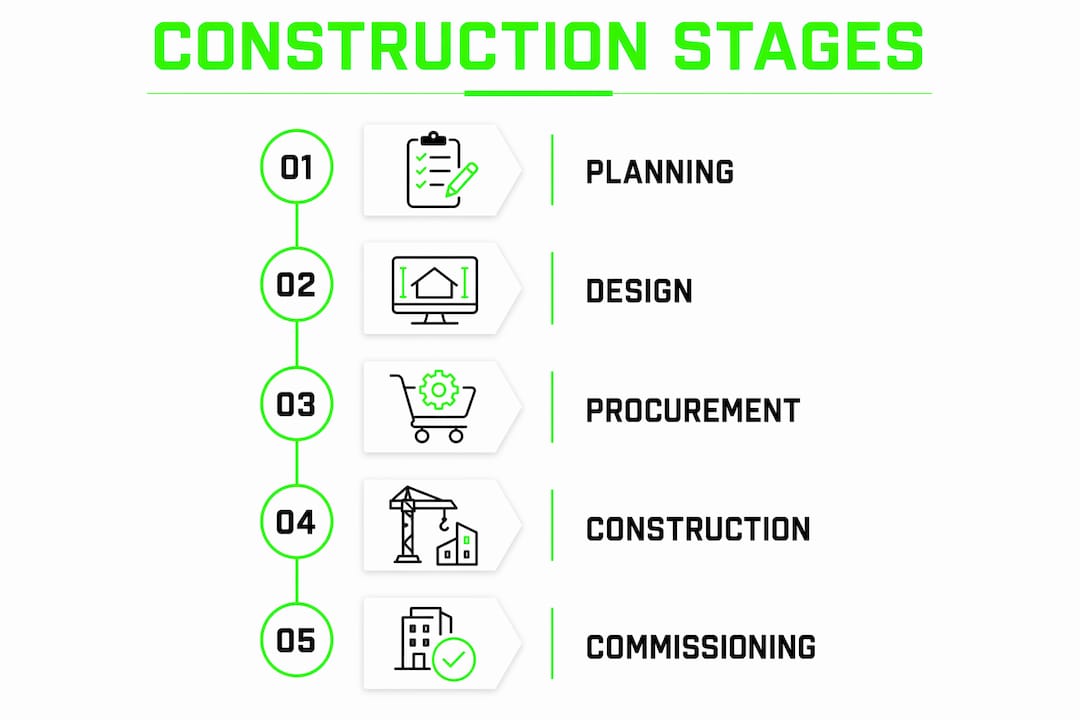
Construction project stages, also called construction development phases in formal project management, typically follow a sequence of six to eight defined steps. The exact number varies by framework, but the core logic is consistent across residential and commercial projects.
Here is how the standard stages of building projects break down:
Initiation and planning: The project concept is defined, a budget range is established, and a project charter or brief is created. This stage sets the scope that every later decision depends on.
Design and pre-construction: Architects and engineers produce schematic drawings, construction documents, and specifications. Permits are applied for during this phase.
Procurement: Contractors, subcontractors, and material suppliers are selected. Contracts are signed and purchase orders are issued.
Construction and execution: Physical work begins on site. This is the longest phase and includes site preparation, foundation work, framing, MEP (mechanical, electrical, plumbing) rough-ins, and finishes.
Commissioning: Building systems like HVAC and electrical are tested to confirm they operate as designed. Commissioning ensures systems function correctly before the owner takes occupancy.
Closeout: Punch list items are resolved, final inspections are completed, and the certificate of occupancy is issued.
Each phase produces data including scope documents, cost estimates, purchase orders, and actual expenditures that the next phase depends on directly. When one phase is rushed or skipped, the data gap creates budget and schedule problems downstream.
Pro Tip: Request a written deliverable list for each stage before signing any contract. Knowing what documents, drawings, or approvals are due at each milestone gives you a concrete way to measure progress.
The design and pre-construction phase deserves special attention. Decisions made here, such as material selections, structural systems, and layout changes, cost a fraction of what the same decisions cost once construction begins. Late design changes during active construction can push timelines by weeks or months and inflate budgets significantly. Locking in your scope early is the single most cost-effective thing you can do as an owner.

How do RIBA and BIM shape construction timeline phases?
Two frameworks have become the most widely referenced tools for structuring construction timeline phases: the RIBA Plan of Work and Building Information Modeling.
The RIBA Plan of Work divides a construction project into eight stages numbered 0 through 7, with stages 1 through 6 representing the core delivery sequence from strategic definition through handover. This framework originated in the UK but is widely used as a reference model by architects and project managers in the US because it provides clear stage gates, defined outputs, and assigned responsibilities at every step. For a homeowner or business owner, the practical value is that it gives you a checklist of what your design and construction team should be producing at each milestone.
BIM takes a different approach. Rather than organizing people and responsibilities, BIM organizes information. It creates a shared digital model of the building that all project stakeholders, including architects, structural engineers, MEP contractors, and owners, can access and update throughout the construction process steps.
Framework | Primary focus | Key benefit for owners |
RIBA Plan of Work | Stage gates and team responsibilities | Clear deliverables at each phase |
BIM (Building Information Modeling) | Coordinated digital project model | Fewer clashes, less rework |
Traditional CPM scheduling | Timeline and task sequencing | Milestone tracking and deadline management |
The numbers behind BIM adoption are significant. BIM reduces rework by 25 to 30 percent and cuts Requests for Information by up to 30 percent on projects where it is fully implemented. Rework is one of the largest hidden costs in construction, so a 25 percent reduction translates directly into faster timelines and lower final costs for the owner.
Digital workflows improve communication across all project stages by reducing information loss between teams. When an architect updates a wall dimension in the BIM model, the structural engineer and MEP contractor see that change immediately rather than receiving a revised drawing days later. That coordination speed is what prevents the costly clashes that show up as change orders during construction. For owners reviewing contractor proposals, asking whether a team uses BIM or a comparable digital coordination tool is a reasonable and revealing question.
What regulatory and safety requirements affect key project phases?
Regulatory compliance is not a single event at the end of a project. It runs through every phase of construction, and missing a requirement at one stage can halt work at a later one.
The most critical compliance checkpoints include:
Excavation safety: OSHA requires protective systems for all excavations deeper than five feet. This applies during site preparation and foundation work and is non-negotiable on any project with below-grade work.
Stormwater management: The EPA mandates a Stormwater Pollution Prevention Plan for any construction site disturbing one or more acres. This plan must be in place before grading or excavation begins.
Permitting milestones: Building permits must be approved before construction starts, and inspections are required at specific stages including foundation, framing, rough MEP, and final. Failing an inspection stops work until corrections are made.
Substantial vs. final completion: Substantial completion is the point at which the project is usable by the owner, even if minor items remain. Final completion is when all punch list items are resolved and final payment is released. These two milestones trigger different contractual obligations, including lien waivers and warranty start dates.
Understanding the difference between substantial and final completion protects you financially. Many owners release final payment too early, before all punch list items are closed, which reduces their leverage to get outstanding work completed. Holding final payment until the certificate of occupancy is issued and all systems are verified is standard practice for a reason.
Pro Tip: Review your construction insurance requirements before the project starts. Coverage gaps during excavation or structural work can expose you to significant liability that standard homeowner or commercial property policies do not address.
For projects in New York and New Jersey, DOB and DOT violation compliance adds another layer of regulatory coordination. Permits, inspections, and violation clearances must align with each construction phase, or the project timeline gets extended by the approval process rather than by the work itself.
How can owners plan and manage their projects through each stage?
Active owner engagement at every phase of construction is the clearest predictor of a smooth project. Owners who treat construction as something that happens to them rather than something they manage consistently face more change orders, longer timelines, and higher final costs.
Here is a practical approach to managing your project through each stage:
Define scope and budget before hiring anyone. A clear written scope prevents scope creep, which is the gradual addition of work that inflates costs without formal approval. Set a contingency of 10 to 15 percent of your total budget for unforeseen conditions.
Select contractors based on documented experience, not just price. Request references from projects of similar type and scale. Verify licensing, insurance, and any required certifications before signing a contract.
Establish a communication protocol at the start. Decide how often you will receive progress updates, who your primary point of contact is, and how change orders will be submitted and approved. Put this in writing.
Review and approve change orders before work proceeds. Every change order is a scope and cost modification. Approving work verbally without a written change order is one of the most common sources of billing disputes.
Attend key inspection milestones. You do not need to be on site every day, but being present for foundation, framing, and final inspections gives you direct visibility into the quality of work before it is covered up or finalized.
Well-managed pre-design phases reduce friction during execution and correlate strongly with overall project success. The planning investment you make before a shovel hits the ground pays dividends through every subsequent phase. A commercial project checklist reviewed during the planning stage can prevent the most common oversights before they become expensive corrections.
Pro Tip: Ask your contractor for a schedule of values at the start of construction. This document breaks the contract price into line items tied to specific work phases, so you can verify that payment requests match actual progress on site.
Key takeaways
Successful construction projects depend on respecting each stage’s purpose, from early planning through commissioning and closeout, without compressing or skipping phases.
Point | Details |
Define scope early | Scope and design decisions made before construction cost far less to change than those made during active work. |
Use structured frameworks | RIBA and BIM provide stage gates and coordinated models that reduce rework by up to 30 percent. |
Know your compliance milestones | OSHA, EPA, and local permitting requirements apply at specific phases and must be met before work can advance. |
Distinguish completion types | Substantial completion and final completion trigger different payment and contractual obligations for owners. |
Engage actively at every phase | Owners who monitor progress, review change orders, and attend inspections consistently achieve better outcomes. |
Why rushing any construction stage is a decision you will regret
I have worked on projects across residential and commercial sectors since 2018, and the pattern I see most often is not bad contractors or bad designs. It is owners and teams who compress the phases they find inconvenient, usually pre-construction and commissioning, and then wonder why the project costs more and finishes late.
Pre-construction is where the real work of a project happens. When a client skips detailed design review to save a few weeks, they almost always spend those weeks back at the drawing board during construction, when changes cost exponentially more. Skipping or compressing phases creates compounding problems that follow the project all the way to closeout. I have seen a single unresolved design question in the framing phase generate four separate change orders before the project reached drywall.
The other stage that gets undervalued is commissioning. Owners see a finished building and assume the project is done. But a building where the HVAC zones are not calibrated or the electrical panels are not labeled correctly is not a finished building. It is a liability. Commissioning is the quality assurance step that confirms everything works as designed, and skipping it is the kind of shortcut that shows up as a problem six months after move-in.
My advice to every owner is this: treat each stage as a gate, not a formality. The deliverables from each phase are not paperwork for the sake of paperwork. They are the foundation the next phase builds on. Respect that logic and your project will reflect it.
— DJ
Work with Djcustomcontracting on your next project

Djcustomcontracting has managed residential and commercial projects through every construction stage since 2018, from initial planning and permitting through final inspections and closeout. The team handles DOB and DOT compliance, coordinates with inspectors at every milestone, and uses current project management practices to keep timelines and budgets on track. Whether you are planning an interior renovation or a full commercial build-out, Djcustomcontracting brings the experience to manage each phase correctly the first time. Explore commercial renovation services or interior renovation options to get started with a team that knows every stage of the process.
FAQ
What are the main construction project stages?
Most construction projects follow six core stages: planning and initiation, design and pre-construction, procurement, construction and execution, commissioning, and closeout. The exact number varies by framework, but these phases cover every step from concept to certificate of occupancy.
How long does each phase of construction take?
Timeline varies significantly by project size and complexity. Design and permitting alone can take two to six months on commercial projects, while construction execution typically represents 50 to 70 percent of the total project schedule.
What is the difference between substantial and final completion?
Substantial completion is when the project is usable by the owner, even if minor items remain. Final completion is when all punch list items are resolved and final payment is due, along with lien waivers and warranty documentation.
Why does BIM matter for construction stages?
BIM creates a shared digital model that all project teams update in real time, which reduces rework by 25 to 30 percent and cuts information requests by up to 30 percent. For owners, this means fewer change orders and more predictable timelines.
When should an owner get involved in the construction process?
Owner involvement should start at the planning stage, before any design work begins. Decisions made during pre-construction cost a fraction of the same decisions made during active construction, making early engagement the highest-value time investment an owner can make.
Recommended


Comments