


Facility Maintenance Guide 2026: What Managers Need

Facility maintenance is defined as a planned, proactive process of inspecting, servicing, and repairing building systems and assets to prevent failures, control costs, and meet compliance requirements. The industry term is “facilities management,” and this facility maintenance guide 2026 covers what that looks like in practice today. Tools like Computerized Maintenance Management Systems (CMMS), Building Management Systems (BMS), and AI-assisted scheduling have moved the field far beyond clipboard checklists. Proactive maintenance planning can reduce annual operational costs by 20% compared to reactive repairs. That gap makes the difference between a facility that runs well and one that drains your budget.
What are the essential components of a 2026 facility maintenance plan?
A modern facility maintenance plan is a structured document that covers assets, schedules, budgets, vendors, and compliance in one place. Without all five components, the plan has gaps that lead to unplanned failures and cost overruns.
The core components every plan needs:
Asset inventory with criticality classification. List every asset and rank it by how much its failure would disrupt operations or safety. Tier 1 assets (HVAC, electrical panels, elevators) get the most attention and resources.
Preventive maintenance schedules. These should use multi-trigger logic, meaning they fire based on calendar intervals, usage hours, or condition signals, whichever comes first.
Vendor management and service level agreements (SLAs). Define response times, scope of work, and performance benchmarks for every contracted service.
Budget planning. Break the budget into three buckets: routine preventive maintenance, reactive repair reserves, and capital expenditure (CapEx) forecasting for asset replacement.
Emergency response protocols. Document step-by-step responses for system failures, including who to call, what to isolate, and how to restore operations.
Compliance documentation. Track inspection records, certifications, and audit trails for fire safety, OSHA, and local building codes.
2026 facility management standards now expand plans to include ESG reporting, smart building and BMS integration, hybrid occupancy management, and AI-assisted analytics. That is a significant shift from plans written even three years ago.
Plan Component | 2023 Standard | 2026 Standard |
Maintenance scheduling | Calendar-based | Multi-trigger (time, usage, condition) |
Occupancy management | Fixed occupancy models | Hybrid occupancy with flexible space protocols |
Reporting | Cost and compliance | Cost, compliance, and ESG metrics |
Technology integration | Basic CMMS | CMMS + BMS + IoT sensors + AI analytics |
Pro Tip: Build your asset inventory before writing any schedules. A schedule without a complete asset list will always miss critical equipment.
How do you build an effective preventive maintenance program?
Preventive maintenance (PM) is the practice of servicing assets on a defined schedule before they fail, rather than after. A well-built PM program is the single most effective tool for reducing unplanned downtime.
Follow these steps to build yours:
Inventory all assets and classify by criticality. Use a simple three-tier system: critical (failure stops operations), important (failure degrades operations), and standard (failure is an inconvenience). This classification drives every scheduling decision.
Select the right PM strategy for each asset tier. Critical assets warrant condition-based monitoring. Condition-based monitoring is best reserved for 10–20% of high-criticality or high-cost assets. The majority of assets are better managed with time-based or usage-based schedules.
Set PM intervals using OEM specs as a starting point. Do not treat manufacturer intervals as permanent. Refine intervals based on your actual operating history within 6–12 months of launch.
Load schedules into a CMMS. Platforms like Oxmaint support multi-trigger scheduling that blends time, usage, and condition data automatically.
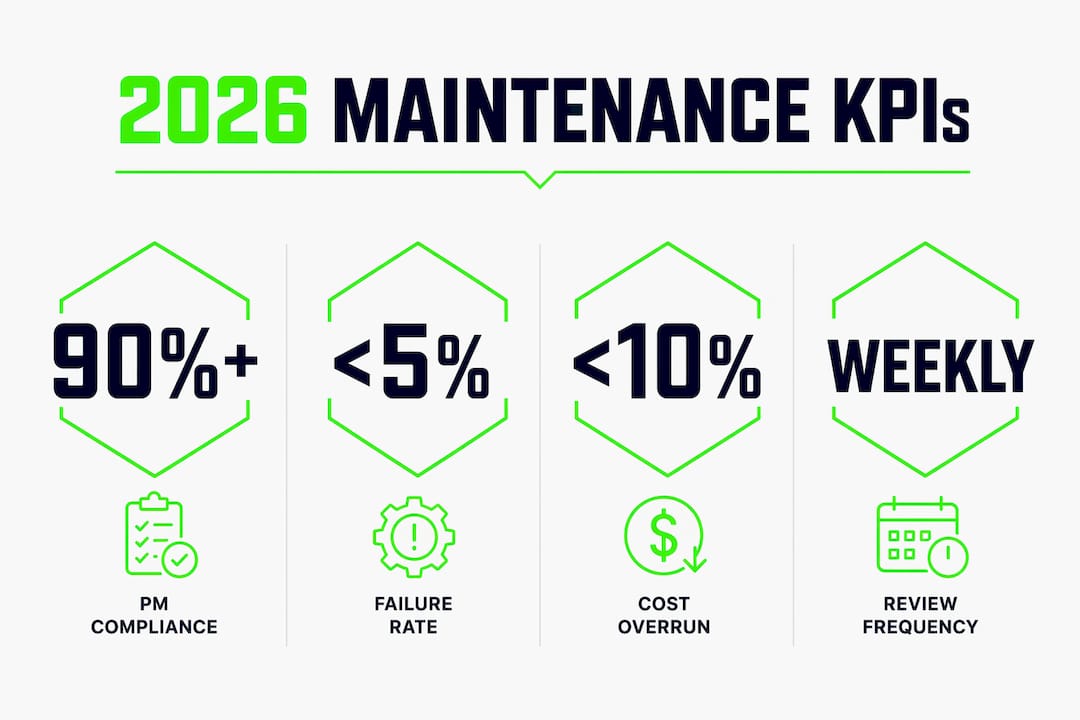
Set a PM compliance target above 90%. Optimized multi-trigger scheduling reduces unplanned failures by 30–40% and pushes PM compliance above 90%.
Review and adjust quarterly. Use work order completion data and failure logs to identify which intervals are too frequent or too infrequent.
The most common mistake at this stage is treating PM as a compliance checkbox. PM programs built around compliance rather than reliability consistently underperform. Every task on your PM list should prevent a specific, predictable failure mode. If you cannot name the failure mode a task prevents, remove the task or redesign it.
Pro Tip: Run a 90-day pilot on your Tier 1 assets before rolling out the full program. You will catch scheduling conflicts and resource gaps before they affect the whole portfolio.

What technology tools improve facility maintenance efficiency?
Technology does not replace good maintenance planning. It executes that plan faster, more accurately, and with better data than manual systems can manage.
The core technology stack for 2026:
CMMS (Computerized Maintenance Management System). The operational backbone. A CMMS stores asset records, generates work orders, tracks completion, and produces compliance reports. Full PM automation is typically achieved within 21 days of deploying a unified CMMS for civic or commercial portfolios.
BMS (Building Management System). Controls and monitors HVAC, lighting, access control, and fire systems from a central interface. BMS integration with your CMMS means sensor alerts can automatically trigger work orders.
IoT sensors. Vibration sensors on motors, temperature sensors on electrical panels, and flow sensors on plumbing systems feed real-time condition data into your CMMS or BMS.
AI-assisted analytics. AI tools analyze failure history, usage patterns, and condition data to recommend optimal PM intervals and flag assets approaching failure.
Mobile work order apps. Technicians receive, update, and close work orders from the field in real time. This eliminates paper logs and reduces data entry errors.
One risk that facility managers underestimate is system dependency. Neglecting cyber-physical failure protocols in smart buildings can cause operational paralysis when a network or sensor failure occurs. Every technology-dependent maintenance plan needs a manual fallback procedure.
For a detailed look at how these tools fit together in practice, the commercial facility maintenance workflow guide covers the full operational picture.
What are the most common facility maintenance mistakes?
Most maintenance programs fail not because of poor intent but because of predictable, avoidable errors. Knowing these pitfalls in advance puts you ahead of the majority of facility managers.
Treating PM as a compliance task. When the goal is to check a box rather than prevent a failure, tasks get done on paper but not in practice. Reliability-focused programs consistently outperform compliance-only approaches.
Blindly following OEM intervals. Manufacturer recommendations are starting points, not permanent rules. Over-maintenance causes iatrogenic damage, meaning the maintenance itself introduces failures by disturbing components that were functioning correctly.
Ignoring asset criticality. Applying the same schedule to a critical chiller and a standard interior door wastes resources and leaves high-risk assets under-maintained.
Skipping cyber-physical failure protocols. Smart building systems create new failure modes. A sensor outage or network disruption can disable automated work order generation, leaving critical assets unmonitored.
No PM compliance tracking. Without measuring completion rates, you cannot tell whether your program is working. Set a target, measure weekly, and investigate every missed task.
Pro Tip: When a PM task gets skipped repeatedly, that is a signal the interval is wrong or the task is unclear. Fix the root cause rather than just rescheduling.
For a side-by-side view of planned versus reactive approaches, the planned vs. reactive maintenance guide from UpKeep offers a useful external perspective on choosing the right strategy for critical assets.
How do you measure and improve your maintenance strategy over time?
A maintenance program that does not evolve will degrade. Assets age, usage patterns change, and new compliance requirements emerge. Continuous improvement is not optional.
Follow this annual review cycle:
Track three core KPIs monthly. PM compliance rate (target above 90%), unplanned failure rate per asset class, and maintenance cost per asset. These three numbers tell you whether your program is working.
Analyze failure history every quarter. Pull work order data and identify which assets fail most often and why. Use that data to adjust PM intervals and task content.
Benchmark against ISO 55000 and IFMA standards. ISO 55000 sets the framework for asset management systems. The International Facility Management Association (IFMA) publishes annual benchmarks for cost per square foot and PM compliance rates across property types.
Update your CapEx forecast annually. Use asset condition data and deferred maintenance estimates to project replacement costs 3–5 years out. This prevents budget surprises and supports capital renewal planning.
Run team feedback sessions twice a year. Technicians who execute PM tasks see problems that data does not capture. Their input on task clarity, tool availability, and scheduling conflicts improves execution quality.
KPI | Target | Review Frequency |
PM compliance rate | Above 90% | Weekly |
Unplanned failure rate | Declining year over year | Monthly |
Maintenance cost per asset | Within budget forecast | Quarterly |
Deferred maintenance backlog | Below 5% of asset replacement value | Annually |
Balanced PM programs, as recognized by IFMA, distinguish assets by criticality and cost to optimize both maintenance overhead and reliability outcomes. That principle should drive every interval adjustment you make.
Key takeaways
A facility maintenance program built on preventive strategies, multi-trigger scheduling, and continuous KPI review reduces unplanned failures, controls costs, and keeps your building compliant in 2026.
Point | Details |
Start with asset criticality | Classify every asset before writing a single maintenance schedule. |
Use multi-trigger PM scheduling | Blend time, usage, and condition data to hit above 90% PM compliance. |
Integrate technology with a fallback | Deploy CMMS and BMS tools but document manual procedures for system failures. |
Avoid over-maintenance | Refine OEM intervals using real operating data within 6–12 months. |
Measure and adjust continuously | Track PM compliance, failure rates, and cost per asset on a monthly basis. |
What I have learned running facility maintenance programs
The biggest shift I have seen in facility maintenance over the past several years is not the technology. It is the mindset. Facilities teams that used to wait for something to break now build programs around preventing specific failure modes. That change in thinking is what separates high-performing operations from ones that are always in crisis mode.
Technology is a genuine multiplier, but only when the underlying program is sound. I have seen CMMS platforms deployed at significant cost into organizations that had no asset inventory and no criticality classification. The software ran, but the outputs were meaningless. The tool is only as good as the data and the thinking behind it.
The area where I see the most room for improvement is interval refinement. Most teams set PM intervals at launch and never revisit them. Iatrogenic over-maintenance is a real and underappreciated problem. Touching equipment too often introduces failure risk. The fix is straightforward: review your failure history at six months and adjust. Most teams never do it.
Sustainability and ESG targets are now a real part of facility planning, not a future consideration. If your maintenance plan does not include energy consumption tracking and emissions-related compliance, it is already behind the current standard. Build those metrics in now rather than retrofitting them later.
— DJ
How Djcustomcontracting supports your facility maintenance needs
Djcustomcontracting has delivered building and facility maintenance services to residential and commercial clients since 2018. The team brings hands-on experience across interior renovations, exterior renovations, DOB and DOT violation removal, damage restoration, and commercial maintenance, all performed in compliance with local building codes and insurance regulations.

Whether you need a one-time repair or a long-term building maintenance partner, Djcustomcontracting handles projects of every scale. The team also supports interior renovation work and exterior renovation services that complement a complete facility upkeep strategy. Contact Djcustomcontracting through the website to request a quote and discuss your specific maintenance needs.
FAQ
What is the most effective preventive maintenance scheduling method?
Multi-trigger scheduling, which combines time intervals, usage data, and condition signals, is the most effective method. It consistently achieves PM compliance above 90% and reduces unplanned failures by 30–40%.
How long does it take to implement a CMMS?
Full PM automation through a unified CMMS is typically achieved within 21 days for commercial and civic portfolios. The timeline depends on the completeness of your asset inventory at the start.
What KPIs should facility managers track in 2026?
The three core KPIs are PM compliance rate (target above 90%), unplanned failure rate per asset class, and maintenance cost per asset. Review PM compliance weekly and cost metrics quarterly.
What does a 2026 facility management plan include beyond maintenance?
Modern plans now include ESG reporting, smart building and BMS integration, hybrid occupancy management, and AI-assisted analytics. These additions reflect both regulatory changes and post-pandemic shifts in how buildings are used.
How do you avoid over-maintaining assets?
Start with OEM intervals, then refine them using your actual failure history within 6–12 months of program launch. Over-maintenance introduces iatrogenic damage by disturbing components that were functioning correctly.
Recommended


Comments