


Public Work Projects Explained for NY and NJ Owners


A public work project is defined as any construction, alteration, or repair funded by a government entity and intended for public use. Understanding public work projects matters whether you are a contractor bidding on a government contract, a business owner near a major infrastructure site, or a community member trying to make sense of a local road or school renovation. In New York and New Jersey, these projects carry specific regulatory requirements, wage obligations, and funding structures that differ from private construction. This guide covers public work projects explained from the ground up, including what qualifies, how bidding works, and what these projects mean for your community.
What qualifies as a public work project in New York and New Jersey?
Public works, the recognized industry term for government-funded construction, covers a wide range of project types. Roads, bridges, public schools, water treatment facilities, transit stations, and government office buildings all qualify. The defining factors are government ownership, public funding, and public benefit.
At the federal level, prevailing wage requirements apply to contracts exceeding $2,000 under the Davis-Bacon Act. That threshold is low by design. It means that even small repair jobs on a federally funded building trigger wage and compliance obligations. For contracts over $100,000, mandatory bonding also applies.
State rules add another layer. New York and New Jersey each maintain their own prevailing wage laws, bidding thresholds, and oversight agencies. New York’s Department of Labor enforces prevailing wage schedules on public work contracts, while New Jersey operates under the New Jersey Prevailing Wage Act. Both states require contractors to pay workers the locally established wage rate for each trade classification on covered projects.
One detail that catches many organizations off guard: indirect public funding can classify a project as public work even when the owner is a private entity. Tax increment financing, below-market land transfers from a government agency, and certain grant structures can all trigger public work obligations. A developer receiving a city-owned lot at a discounted price may find their project subject to prevailing wage laws they did not anticipate.
Roads, highways, and bridges funded by state or federal transportation agencies
Public school buildings, libraries, and government offices
Water and sewer infrastructure owned by municipal utilities
Transit facilities operated by agencies like the MTA or NJ Transit
Public parks and recreational facilities
Pro Tip: If your project receives any form of government financial assistance, verify its public work status with a labor attorney before signing contracts. Classification can happen retroactively, and the penalties for non-compliance are significant.
How do public work projects differ from private construction?
The differences between public and private construction go well beyond who signs the check. Ownership, legal obligations, procurement rules, and contractor requirements all shift substantially when public funds are involved.
Factor | Public work projects | Private construction |
Ownership | Government entity or public agency | Private individual or company |
Funding source | Taxpayer funds, bonds, federal grants | Private capital, loans, investor equity |
Wage requirements | Prevailing wage laws apply (Davis-Bacon, state acts) | Market wages, no mandated rate |
Bidding process | Competitive public bidding required | Owner selects contractor directly |
Bonding | Required above federal and state thresholds | Negotiated between parties |
Transparency | Public records, open procurement | Confidential between parties |
Regulatory oversight | Multi-agency review and approval | Primarily local building department |
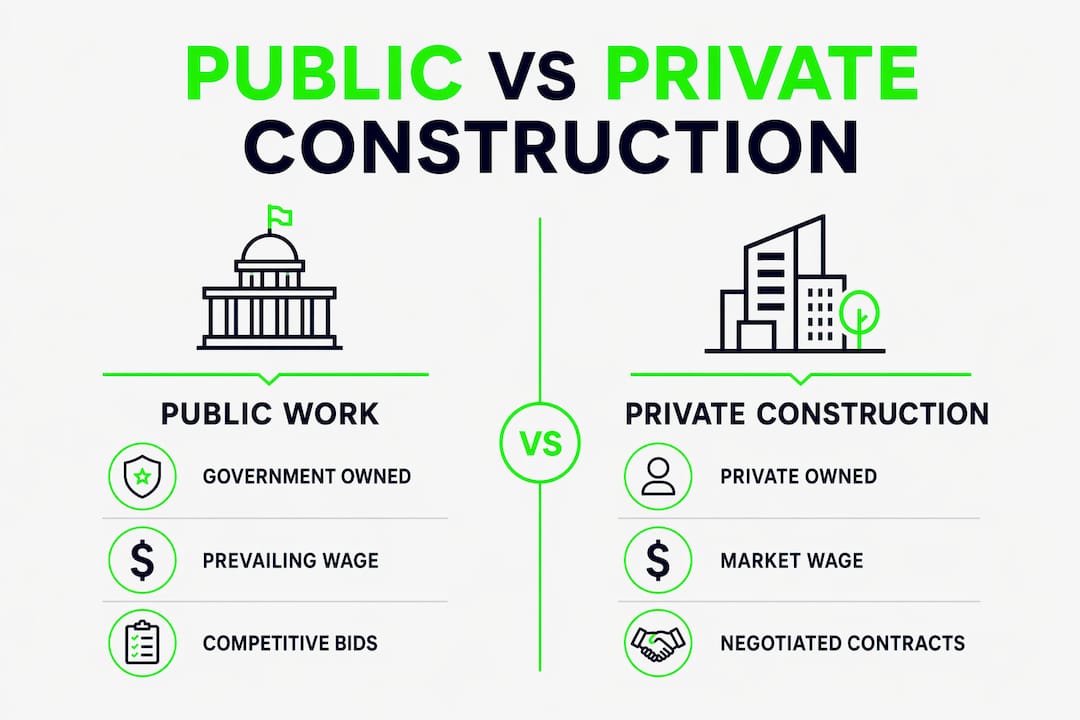
The bidding process is the most visible difference. Public agencies must solicit competitive bids and award contracts to the lowest qualified bidder in most cases. Private owners can negotiate directly with any contractor they choose. This open bidding structure protects taxpayer investment but also creates a more complex entry process for contractors.
Contractor certification requirements are also stricter on public work. Bonding, insurance minimums, safety records, and financial statements all factor into whether a contractor can even submit a bid. Prequalification evaluations are a common barrier to entry, requiring demonstration of financial, safety, and technical capabilities. Failing prequalification disqualifies an otherwise competitive bid entirely.
The American Public Works Association notes that modern public works increasingly involve hybrid delivery models, including private sector delivery under public oversight. These arrangements complicate classification and require careful legal review before work begins.
What is the process for bidding and completing public work projects?
Public work projects follow a structured lifecycle that differs significantly from private construction. Each phase carries specific compliance requirements, and skipping steps creates legal exposure.
Register with the appropriate procurement systems. Federal projects require registration on SAM.gov. New York and New Jersey state projects use their own vendor portals. Without active registration, a contractor cannot receive payment on federal contracts.
Complete prequalification. Most public agencies require contractors to submit financial statements, safety records, bonding capacity, and references before they can bid. This step alone can take weeks. Prequalification is often the biggest hurdle contractors face, and overcoming it requires focused preparation beyond just pricing.
Respond to the solicitation. Public agencies issue Invitations to Bid (ITB) or Requests for Proposals (RFP). Bids must follow exact formatting and submission requirements. A single missing document can result in disqualification.
Secure bonding. Bid bonds, performance bonds, and payment bonds are required at different stages. For federal contracts over $100,000, bonding is mandatory. New York and New Jersey have similar state-level requirements.
Obtain permits and complete environmental review. Multi-level permitting and environmental review protect taxpayer investments and are regulatory necessities, not inefficiencies. In New York City, this often involves the Department of Buildings, the Department of Environmental Protection, and sometimes the Army Corps of Engineers for projects near waterways.
Manage the project under public oversight. Public owners assign inspectors and project managers who review work at defined milestones. Change orders require formal approval, and design changes triggered by unforeseen site conditions go through a regulated administrative process that takes longer than on private jobs.
Pro Tip: Post the required wage determination posters at your job site from day one. Absence of wage posters is a red flag for prevailing wage violations and can trigger audits that delay project completion.
Understanding the construction bidding process for public contracts helps contractors avoid costly mistakes at the submission stage.
How do public work projects impact communities in New York and New Jersey?
Public works construction contracts represent over $400 billion in annual U.S. spending across all government levels. That figure reflects the scale of investment flowing into communities through roads, schools, transit systems, and public facilities. In New York and New Jersey, that investment is especially concentrated given the density of infrastructure and the age of existing systems.
The community benefits of public infrastructure projects extend well beyond the construction phase.
Job creation. Construction phases generate direct employment for tradespeople, engineers, project managers, and suppliers. Prevailing wage requirements mean these jobs pay competitive rates, supporting local household incomes.
Transportation improvements. Road and bridge projects reduce commute times, lower vehicle operating costs, and improve freight movement for businesses throughout the region.
Public safety. Upgraded water systems, modernized schools, and repaired bridges directly reduce safety risks for residents. Aging infrastructure left unaddressed creates liability for municipalities and danger for the public.
Economic growth. Public works projects stimulate job creation during construction and improve community infrastructure, safety, and economic growth over the long term. Better infrastructure attracts private investment and supports business expansion.
Accountability to taxpayers. Public procurement rules require open bidding, published contracts, and documented spending. This transparency holds agencies and contractors accountable in ways that private projects are not.
New York and New Jersey have both seen major public works shape their regions. The Gateway Program, which includes rebuilding the Hudson River rail tunnel between New Jersey and New York, represents one of the most significant public infrastructure investments on the East Coast. Projects at this scale demonstrate how public works reshape regional economies and quality of life for decades.
Key takeaways
Public work projects are government-funded construction initiatives that carry specific wage, bonding, and compliance obligations under federal and state law in New York and New Jersey.
Point | Details |
Federal threshold is low | Davis-Bacon Act prevailing wage rules apply to contracts starting at just $2,000. |
Indirect funding triggers compliance | Tax financing and land transfers can classify private projects as public work retroactively. |
Prequalification is the first barrier | Contractors must prove financial, safety, and technical capacity before bidding. |
Permitting takes time by design | Multi-level environmental and regulatory review is mandatory, not optional. |
Community impact is long-term | Public works create jobs, improve safety, and support economic growth well beyond construction. |
What I’ve learned working public work projects in NY and NJ
Public work is not simply private construction with more paperwork. The compliance requirements, the wage obligations, and the multi-agency oversight create a fundamentally different operating environment. I’ve seen contractors with strong private sector track records struggle on their first public work job because they underestimated the administrative load.
The biggest mistake I see is treating prequalification as a formality. Agencies in New York and New Jersey review financial statements closely. A contractor with thin bonding capacity or a spotty safety record will not make the cut, regardless of how competitive their pricing is. Preparation for prequalification should start months before a solicitation appears.
The evolving delivery models in public works also create classification traps. A project that starts as private can shift to public work status mid-stream if a government agency steps in with financing. Knowing this risk upfront protects everyone involved. The role of public work contractors in managing these obligations is more demanding than most people outside the industry realize.
My honest advice: if you are entering public work for the first time in New York or New Jersey, partner with a contractor who has already navigated the local agency relationships, the DOB processes, and the prevailing wage compliance requirements. The learning curve is real, and the penalties for getting it wrong are not small.
— DJ
Djcustomcontracting: public work and renovation services in NY and NJ
Djcustomcontracting has been delivering residential and commercial construction services across New York and New Jersey since 2018, with direct experience in public work, renovations, and regulatory compliance.
Whether your project involves interior renovation work on a public facility or exterior renovation services on a commercial building, Djcustomcontracting brings the licensing, bonding, and trade knowledge to get it done right. The team also handles building and facility maintenance for long-term infrastructure support. No job is too large or too small. Contact Djcustomcontracting to discuss your project and get a competitive assessment from a contractor who knows the NY and NJ market.
FAQ
What is the definition of a public work project?
A public work project is any construction, alteration, or repair funded by a government entity and intended for public use. Federal law defines coverage starting at contract values as low as $2,000 under the Davis-Bacon Act.
Do prevailing wage laws apply to all public work in New York and New Jersey?
Yes. Both New York and New Jersey have state prevailing wage laws that apply to public work contracts, requiring contractors to pay workers the established wage rate for each trade classification on covered projects.
Can a private project become a public work project?
Yes. Indirect public funding such as tax increment financing or below-market land transfers from a government agency can classify a private project as public work, triggering wage and bonding obligations retroactively.
What bonding is required for public work contracts?
Federal contracts over $100,000 require mandatory bonding, including bid bonds, performance bonds, and payment bonds. New York and New Jersey have comparable state-level bonding requirements for public work contracts.
How long does a public work project typically take?
Public work projects take longer than comparable private jobs because of mandatory multi-level permitting, environmental review, and administrative approval processes. These steps are regulatory requirements, not delays, and their duration depends on project size and agency workload.
Recommended


Comments