


How to Plan a Home Renovation in 2026


Knowing how to plan a home renovation before you swing a single hammer can mean the difference between a project that finishes on time and one that bleeds your budget dry for months. Most homeowners underestimate the preparation involved, and that gap is where costly delays and decision fatigue live. Budget overruns, contractor miscommunications, and permit surprises are all predictable problems with predictable solutions. This guide walks you through every major stage of home improvement planning, from clarifying your goals and building a realistic budget to managing your timeline and keeping contractors accountable.
Table of Contents
Key takeaways
Point | Details |
Start with a clear brief | Define needs vs. wants before spending a dollar to prevent scope creep later. |
Protect your contingency fund | Reserve 10 to 20 percent of your total budget specifically for unexpected costs, not upgrades. |
Plan your timeline early | Major renovations need 6 to 12 months of lead time to account for permits and materials. |
Order materials at permit submission | Place long-lead orders for cabinets and windows the same week you submit permits to avoid idle crews. |
Vet contractors thoroughly | Verify licenses, insurance, and references before signing any contract. |
How to plan a home renovation from the start
Every successful renovation starts with a clear picture of what you actually want to accomplish. Before you call a single contractor or browse tile samples, you need a renovation brief. Think of it as a written document that separates your pain points from your wish list.
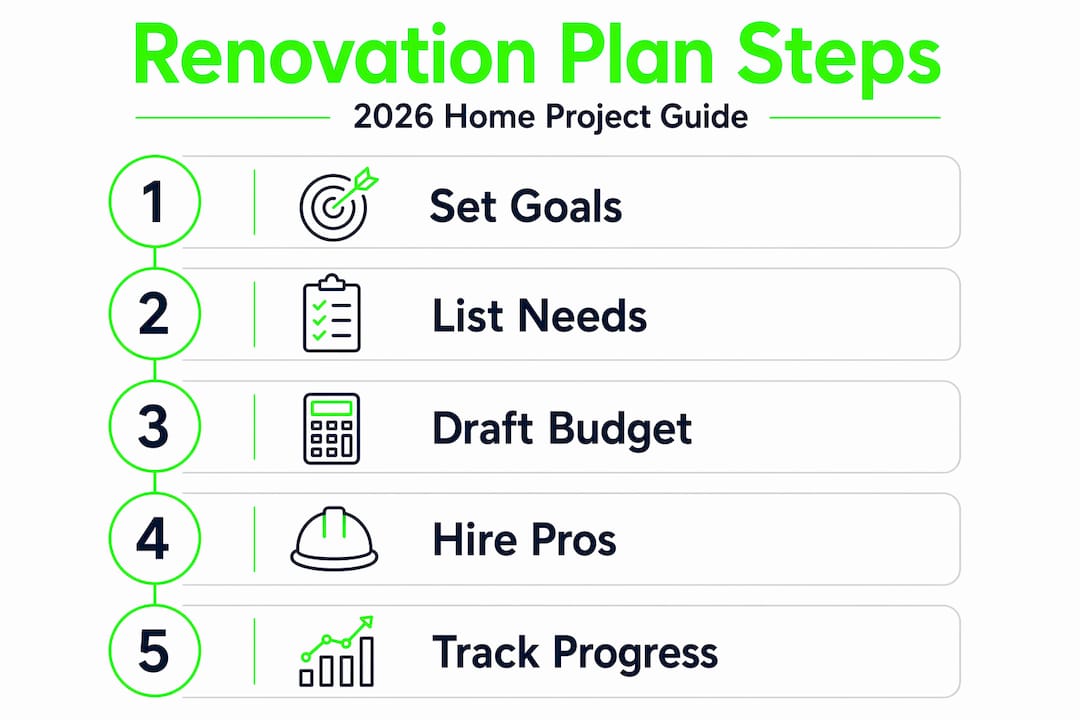
Two-list method: write down what bothers you most about your current space on one side, and what your ideal version looks like on the other. That contrast reveals your true priorities and keeps your scope honest when budget pressure arrives.
Your renovation goals also determine whether you need a design professional. A cosmetic refresh rarely needs an architect. A structural addition or a full kitchen gut almost always benefits from one. Hiring a designer early costs money upfront but typically saves more in avoided mistakes and rework.
Here is what to cover in your initial preparation:
Photograph every room and surface before work begins. These photos protect you if disputes arise over pre-existing conditions.
Identify which spaces will be off-limits during construction and plan temporary living arrangements accordingly.
Establish a single point of contact in your household for all contractor communications to avoid conflicting instructions.
Research local permit requirements early, since some municipalities require architectural drawings before issuing any permit.
Consider whether your renovation goals are tied to resale. If you are renovating to sell, the numbers matter more than personal preference. Steel front doors recover nearly 100% of their cost at resale, while major kitchen overhauls typically return only 50 to 60 cents on the dollar. Knowing your motivation shapes every decision downstream.
Pro Tip: Walk through your home with your phone and record a narrated video documenting existing damage, current finishes, and anything the contractor will need to work around. A 10-minute video at the start saves hours of argument later.
Building a realistic renovation budget
The hard truth about renovation budgets is this: 75% of homeowners set one, but only 34% actually stick to it, with a median spend of $24,000. The problem is not that people spend too much. The problem is that they plan too little.

A well-built renovation budget has three cost layers.
Direct costs cover all labor and materials tied directly to construction. This is the number most people think of when they say “the renovation cost.”
Soft costs include design fees, permit fees, engineering reports, and inspection costs. These often run 10 to 15 percent of direct costs and get forgotten entirely in early estimates.
Financing costs apply if you are funding the project through a home equity loan or line of credit. Interest payments during a 6-month renovation add up faster than most homeowners expect.
Here is how to budget across all three layers and avoid the most common overruns:
Get at least three competitive bids from licensed contractors before committing. Wide bid spreads signal either scope misunderstandings or pricing issues worth investigating.
Check local cost benchmarks through contractor associations or renovation budget guides to calibrate whether bids are reasonable.
Separate your finishes budget from your construction budget. Homeowners frequently under-budget fixtures and finishes, then pull from contingency to cover them.
Sizing your contingency fund correctly
This is where most budgets fail. Experts recommend 10 to 20 percent contingency depending on project complexity, and that range matters. A cosmetic renovation in a newer home can often get away with 10 percent. A full gut renovation in a pre-1980 home with unknown wall conditions warrants 15 to 20 percent, sometimes more.
Older homes frequently hide surprises like asbestos insulation, lead paint, or rotted subfloor framing. These are not upgrade decisions. They are mandatory remediation costs that will come out of your contingency whether you planned for them or not.
Project type | Recommended contingency | Notes |
Cosmetic refresh | 10% | Paint, flooring, fixtures in newer homes |
Mid-range kitchen or bath | 15% | Partial demo, plumbing or electrical updates |
Full gut renovation | 15 to 20% | Complete demo, structural work |
Pre-1980 home, any scope | 20 to 25% | Hidden hazards, structural unknowns |
Pro Tip: Treat your contingency fund as untouchable until a contractor hands you a documented surprise. If a mid-project upgrade tempts you, it must come from a separate discretionary fund, not from your contingency reserve.
Developing your renovation timeline
Major renovations need 6 to 12 months of planning before the first crew shows up. That window covers design iterations, permit submission, permit approval, and materials procurement. Compressing it creates the exact bottlenecks homeowners complain about most.
Here is a practical sequence for building your renovation timeline:
Define scope and finalize design. Lock all design decisions before permit submission. Changes after submission restart the clock.
Submit permits and order long-lead materials simultaneously. Cabinetry lead times run 6 to 12 weeks and windows 8 to 14 weeks. Order them the week you submit permits so they arrive when the crew is ready for them.
Build in a permit buffer. Permit approval typically takes 4 to 6 weeks in most jurisdictions. Do not schedule demo before the permit is in hand.
Sequence subcontractors correctly. Rough plumbing and electrical must be done and inspected before drywall goes up. Tile cannot go in before cement board. Sequence errors cause expensive rework.
Add 20 to 30 percent time buffers to each phase. If framing is estimated at two weeks, schedule three. This is not pessimism. It is math that accounts for inspection delays and crew scheduling conflicts.
Conduct weekly check-ins. Weekly site meetings and photo logs are among the most recommended practices for keeping projects on schedule.
The most common delays in renovations do not come from slow work. Permit timing and material lead times cause the majority of schedule slippage. Decision bottlenecks come in close behind. If you have not chosen your tile by the time the floor prep is done, your crew stands idle and your schedule drifts.
Pro Tip: Use a simple shared spreadsheet or a free Gantt chart tool to give every phase a start date, an end date, and a buffer. Review it every Friday. Schedule drift caught early takes a day to fix. Drift caught in week six takes a month.
Selecting and working with contractors
Finding a reliable contractor is not about luck. It is about a structured vetting process that filters out risk before any contract is signed.
When evaluating contractors, check these points without exception:
Verify the contractor holds a current license for your state and municipality. Licensing requirements vary widely, so confirm what your jurisdiction requires.
Request proof of general liability insurance and workers’ compensation coverage. Ask for certificates of insurance naming you as an additional insured.
Call at least three references from projects completed in the last 12 months. Ask specifically about communication, schedule adherence, and how surprises were handled.
Review the contractor’s history for any active complaints through your state licensing board or the Better Business Bureau.
Your contract is your primary protection. A well-written contract specifies scope, materials, schedule milestones, and payment terms. Milestone-based payment schedules tied to completed and inspected phases are standard practice for a reason. They align your payment flow with actual progress and give you leverage if work stalls.
Scope creep is the quiet budget killer in most renovations. It usually starts with small verbal additions, “while you’re at it” requests that compound into thousands of dollars of unbudgeted work. The fix is simple but requires discipline. Every change to the original scope must go through a written change order that specifies the added cost and schedule impact before any work begins.
Understanding why professional oversight matters goes beyond skill. Licensed professionals carry accountability that unlicensed workers do not. If something is built incorrectly by a licensed contractor, you have recourse through their bond, their insurance, and the licensing board.
Pro Tip: Put a written change order requirement in your contract before signing. A clause stating that no scope additions will be performed without a signed change order gives you full documentation and cost control throughout the project.
My take on why renovations go sideways
I have worked through enough renovation projects to say with confidence that the planning phase is where most projects are won or lost. Not the construction phase.
The pattern I see most often is a homeowner who has spent months thinking about what they want but less than two weeks actually planning how to get it done. The vision is clear. The roadmap is not. That gap shows up as budget shock when the permit fees arrive, as schedule panic when cabinets are backordered, and as communication breakdowns when the contractor starts making decisions the homeowner did not authorize.
What I have learned is that contingency funds are where the real conversation happens. Homeowners resist allocating 15 or 20 percent to contingency because it feels like spending money on nothing. But that money is not for upgrades you decide on mid-project. It is for the load-bearing wall the architect was not expecting, or the knob-and-tube wiring that has to come out before insulation can go in. The contingency fund is your evidence that you planned seriously.
The homeowners who manage renovations well share one trait: they treat their renovation like a project with a manager, a schedule, and a written record. They document decisions, confirm changes in writing, and review the timeline weekly. You do not need construction experience to do any of that. You need discipline and a good checklist.
Renovations are genuinely complex projects. But they are manageable when you respect what the planning process is asking of you.
— DJ
Ready to start your renovation project?
Planning a renovation is complex work, and having the right contractor beside you from day one changes the outcome significantly.

Djcustomcontracting has been delivering full-service residential and commercial renovations since 2018, covering everything from interior gut renovations to additions, alterations, and code compliance work. Whether you are planning a kitchen overhaul, a bathroom remodel, or a full home addition, the team manages every phase of the project with clear communication and structured project oversight. Explore interior renovation services to see how Djcustomcontracting handles projects of every scale, or review general contracting options if your project spans multiple trades. No job too big, no job too small.
FAQ
How far in advance should I plan a home renovation?
For major renovations, start planning 6 to 12 months before your target start date to allow time for design, permits, and material procurement. Smaller cosmetic projects can often be planned in 4 to 8 weeks.
What percentage of my renovation budget should go to contingency?
Reserve 10 to 20 percent of your total budget as a contingency fund. Older homes or projects with structural work warrant the higher end of that range, and homes built before 1980 may need up to 25 percent.
What causes the most renovation delays?
Permit approval timelines and long material lead times cause the most delays in most renovation projects, not slow contractors. Ordering cabinets and windows during the permit submission period significantly reduces idle time.
How do I avoid renovation scope creep?
Require a signed written change order for every addition or modification to the original scope before any work begins. This single practice prevents most unplanned budget overruns tied to mid-project changes.
When should I hire a general contractor versus managing the project myself?
Hire a general contractor when your project involves multiple trades, permits, or structural work. Self-managing works for single-trade cosmetic projects but creates real risk when sequencing, inspections, and code compliance are involved.
Recommended


Comments