


File Local Law 97 Reports by May 1: NYC Owners' Contractor Playbook
- DJ Custom Contracting

- 1 day ago
- 8 min read
If your building is over 25,000 gross square feet, or your buildings share a tax lot totaling more than 50,000 gross square feet, you almost certainly owe an annual emissions report by May 1. Start with three moves: pull your building’s Covered Buildings List record to confirm your CBL and BIN status, register in BEAM, ESPM, and DOB NOW, and line up a Registered Design Professional (RDP) or Registered Commissioning Agent (RCxA) to certify your filing.
TL;DR:
Buildings on the same lot that together exceed 50,000 gross square feet must file emissions reports, even if no individual structure surpasses 25,000 square feet.
Missing the May 1 reporting deadline results in monthly penalties, and exceeding emissions limits triggers separate fines; options include adjustments, offsets, and good faith efforts for mitigation.
Most buildings follow Article 320, but affordable housing or worship buildings can choose between performance-based or prescriptive PECM pathways, which require different documentation and certification.
Early registration, utility data linking, and proper RDP or RCxA certification streamline the BEAM filing process, reducing errors that can delay submissions or cause penalties.
Focus on operational and medium-term retrofits like HVAC electrification and envelope upgrades, timing large projects with upcoming reporting cycles for maximum impact on emissions reduction.
Table of Contents
Which Buildings Fall Under Local Law 97 Compliance
Local Law 97 compliance hinges on square footage and lot structure, not building age or use. A single building over 25,000 gross square feet is covered. So is a group of buildings on the same tax lot that together exceed 50,000 gross square feet, even if no individual building crosses the 25,000 threshold on its own. The Department of Buildings tracks these thresholds through the Covered Buildings List, but the lot-level BBL number does not tell the whole story.
Every individual building carries its own BIN, and pathway eligibility gets decided at the BIN level, not the BBL level. Owners who assume their whole lot is on one uniform track sometimes discover mid-filing that one building qualifies for Article 321 while its neighbor on the same lot does not.
A few things trip owners up here:
City-owned buildings follow a separate compliance track, not the private-owner deadlines.
Rent-regulated housing may have different phase-in timelines depending on unit mix.
If your CBL listing looks wrong, DOB accepts dispute tickets to correct gross floor area or property classification errors.
Confirming your CBL record early saves you from filing against the wrong emissions limit months later.
Local Law 97 Reporting Deadlines You Cannot Miss
Every covered building owes its annual report by May 1 for the prior calendar year’s emissions. DOB extends a grace period through the end of June, but once that window closes, penalties accrue per month for every month the report stays unfiled. The DOB’s own guidance sets this timeline, and it applies whether your building emits well under its limit or blows past it.
Certification requirements depend on your pathway. An RDP signs off on Article 320 reports. For Article 321 buildings using the Prescriptive Pathway, an RCxA may certify certain Prescriptive Energy Conservation Measure (PECM) attestations instead.
Ninety days out, start gathering:
Twelve months of utility data for every fuel source feeding the building.
Your prior year’s LL84 benchmarking submission for cross-reference.
Any PECM documentation or attestations your pathway requires.
Contact information and license verification for your RDP or RCxA.
Records of any capital work completed during the reporting year that could affect emissions.
Buildings that keep LL84 benchmarking data current year-round tend to file LL97 reports with far less scrambling, since much of the utility data overlaps.
Article 320 vs Article 321: Picking Your Compliance Pathway
Most covered buildings fall under Article 320, the standard annual reporting pathway. You calculate your building’s actual emissions, compare them to your emissions limit, and file every year. The Article 320 Info Guide also lays out delayed compliance pathways for certain residential categories, plus rules allowing owners to file a single combined report when multiple buildings share an owner, lot, and pathway.
Article 321 exists for a narrower group: qualifying affordable housing and houses of worship. These buildings choose between two routes:
A Performance-based Pathway, which mirrors Article 320’s approach and requires RDP certification.
A Prescriptive Pathway, built around 13 specific PECMs covering measures like lighting upgrades, building envelope sealing, and HVAC maintenance.
Under the Prescriptive Pathway, you either complete each PECM or document why it does not apply to your building. Some PECMs need uploaded documentation, like invoices or inspection reports; others only require a signed attestation from your RCxA, according to the Article 321 Filing Guide.
Pro Tip: Don’t assume eligibility for Article 321 carries over automatically year to year. Confirm your building’s affordable housing or house of worship status still qualifies before you commit to the Prescriptive Pathway, since a change in unit mix or use can push you back to Article 320.
Choosing the wrong pathway early costs you time later. Owners who qualify for Article 321 but have already invested in Article 320-style monitoring should weigh whether switching actually reduces their paperwork or just adds a new set of PECM documentation on top of what they already track.
How BEAM Filing Actually Works, Step by Step
BEAM is the DOB portal where every LL97 report ultimately lands, and it runs on the same SEED engine DOB uses for other filing systems. Getting there requires a few connected steps that catch a lot of owners off guard the first time through.
Register your building in DOB NOW and pay the applicable filing fee.
Set up or update your building’s Energy Star Portfolio Manager (ESPM) profile, linking it to your utility accounts so consumption data flows through automatically.
Log into BEAM, where much of your building’s basic profile data auto-populates from ESPM once the link is active.
Upload your RDP or RCxA attestation, floor area diagrams if requested, and any PECM templates your pathway requires.
Submit and retain a copy of everything, since DOB guidance requires supporting documentation stay on file for six years.
The most common submission errors are mundane but costly: gross floor area figures in BEAM that don’t match your CBL record, ESPM accounts that were never properly linked to utility data, or credential mismatches where the RDP listed on the filing doesn’t match the one who actually signed the attestation. Any one of these can bounce a submission back and eat into your grace period.
Beginning in 2026, DOB has shifted emissions limit calculations to ESPM property types rather than the older classification system, so double-check that your ESPM property type matches your building’s actual use before you file.
What Happens If You Miss a Deadline or Exceed Your Limit
Penalties for LL97 noncompliance come in two flavors: missing your filing deadline, and filing on time but exceeding your emissions limit. Late filings accrue penalties per square foot for every month the report remains outstanding after the June 30 grace period. Exceeding your limit triggers a separate penalty calculated against the excess emissions.
You have options before penalties become the final word:
Adjustment applications under Article 320.8 cover excessive emissions from special circumstances or unusual building uses; Article 320.9 addresses not-for-profit hospitals specifically. Both routes require prior-year reports and supporting documentation, and financial adjustments sometimes need formal accounting attestations.
Offsets, including Alternative Compliance Payments and renewable energy credit purchases, can bring a building into compliance on paper, though DOB caps how much of your limit these offsets can cover.
Good Faith Effort documentation and mediated resolution give owners who made real progress toward compliance a path to reduce penalties rather than eliminate them outright.
Adjustment paperwork often requires documentation coordinated through NYC Accelerator, the city’s free technical assistance program for compliance projects.
Retrofit Priorities That Actually Move the Needle
The fastest path to compliance rarely starts with a major capital project. Start with the cheap fixes: recalibrating building automation controls, repairing steam traps that leak heat and money simultaneously, swapping remaining fluorescent fixtures for LEDs, and adjusting HVAC schedules to match actual occupancy rather than a decade-old default setting. These operational tweaks can shave meaningful emissions off a building’s baseline within a single budget cycle, often for a few thousand dollars rather than a few hundred thousand.
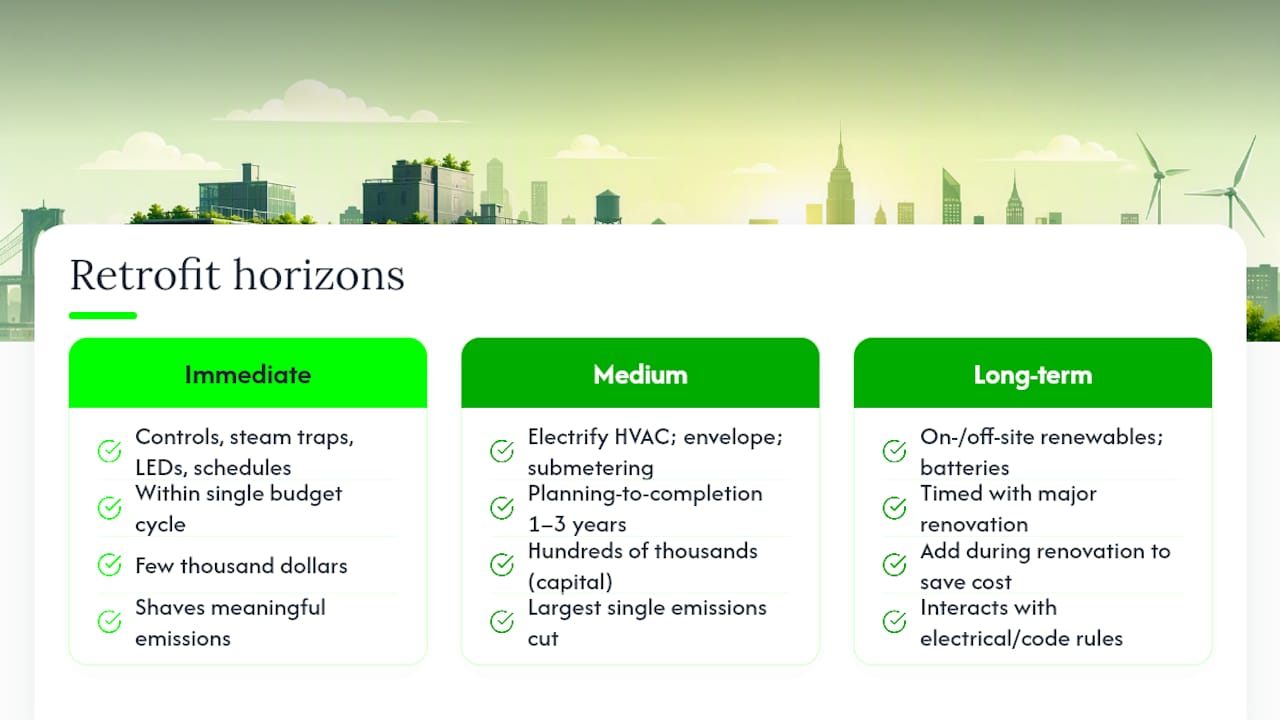
Medium-term capital work takes longer to plan and pay for. Electrifying HVAC systems, particularly replacing oil or gas boilers with heat pumps, delivers the largest single emissions cut most buildings can make, but expect a planning-to-completion timeline measured in one to three years depending on building size and electrical capacity. Envelope improvements (window replacement, insulation upgrades) and submetering to identify which floors or systems drive the highest usage both fall into this same medium-term bucket.
Long-term strategies, including on-site or off-site renewable generation and battery storage, interact directly with the NYC Energy Conservation Code and other building codes governing new electrical infrastructure. These projects make the most sense for buildings already planning a major renovation, since the incremental cost of adding renewable-ready infrastructure during other work is far lower than retrofitting it in isolation.
Prioritize based on emissions intensity and cost-per-ton reduced, not on which project sounds most impressive. A steam trap repair program that costs $15,000 and cuts real tonnage often beats a solar installation that costs ten times as much for a smaller emissions dent. NYC Accelerator can help owners find financing and incentive programs that offset capital costs, and pairing a retrofit plan with your commercial renovation project phasing keeps the work from disrupting building operations more than necessary.
Pro Tip: Run your retrofit priorities against your next required filing year, not just your current one. A boiler electrification project started this year might not show its full emissions benefit until the following reporting cycle, so time capital work to land before the reporting period where you need the reduction most.
What We See on the Ground Filing These Reports
Working directly with NYC building owners on compliance and retrofit projects, the pattern that shows up most often isn’t a lack of effort. It’s owners who wait until March to figure out their pathway, then scramble to find an RDP with availability before May 1. The buildings that file smoothly are the ones who treated their Local Law compliance strategy as a year-round task, not an annual fire drill.
Before hiring anyone, ask for proof of prior BEAM and ESPM submissions and confirm their RDP or RCxA credentials directly with DOB. Inexperienced vendors, not complicated buildings, cause most of the delays we see during DOB review. A solid contractor checklist covers documentation retention, PECM verification, and a realistic retrofit timeline tied to your actual filing year, not a generic template.
— DJ
Get Retrofit and Filing Support From a Contractor Who Knows the Codes
Djcustomcontracting handles the retrofit work Local Law 97 compliance actually requires, not just the paperwork around it. Where a compliance consultant hands you a report and a to-do list, Djcustomcontracting executes the HVAC upgrades, lighting retrofits, and envelope work your building needs, then coordinates directly with your RDP or RCxA so the documentation lines up with what actually got built.

An initial engagement starts with a site visit to assess your building’s current systems against its emissions limit, followed by a written estimate and a recommended scope of work sequenced around your filing deadline. Djcustomcontracting has handled DOB-related remediation and commercial renovation work across New York, and that means the crew showing up at your building already understands how DOB documentation requirements shape a project timeline. For interior upgrades that hit lighting, controls, or HVAC support without a full capital overhaul, the interior renovation contractor team can scope a faster, lower-cost path to compliance.
If your building needs a retrofit assessment before your next filing deadline, request a commercial renovation estimate and get a scope and timeline built around your actual reporting year.
Sources
Recommended


Comments