


NYC Building Codes Guide for Homeowners and Owners


NYC building codes are defined as the legally binding construction standards that govern every renovation, addition, and new build across the city’s 1.1 million buildings. This guide to NYC building codes covers the full regulatory picture: the four sub-codes under Title 28 of the NYC Administrative Code, the 2026 Existing Building Code, permit requirements, zoning rules, and the most common compliance mistakes property owners make. Whether you are planning a kitchen remodel or a full commercial fit-out, understanding these rules before you break ground protects your investment and keeps your project legal.
What are the main components of the NYC Construction Code?
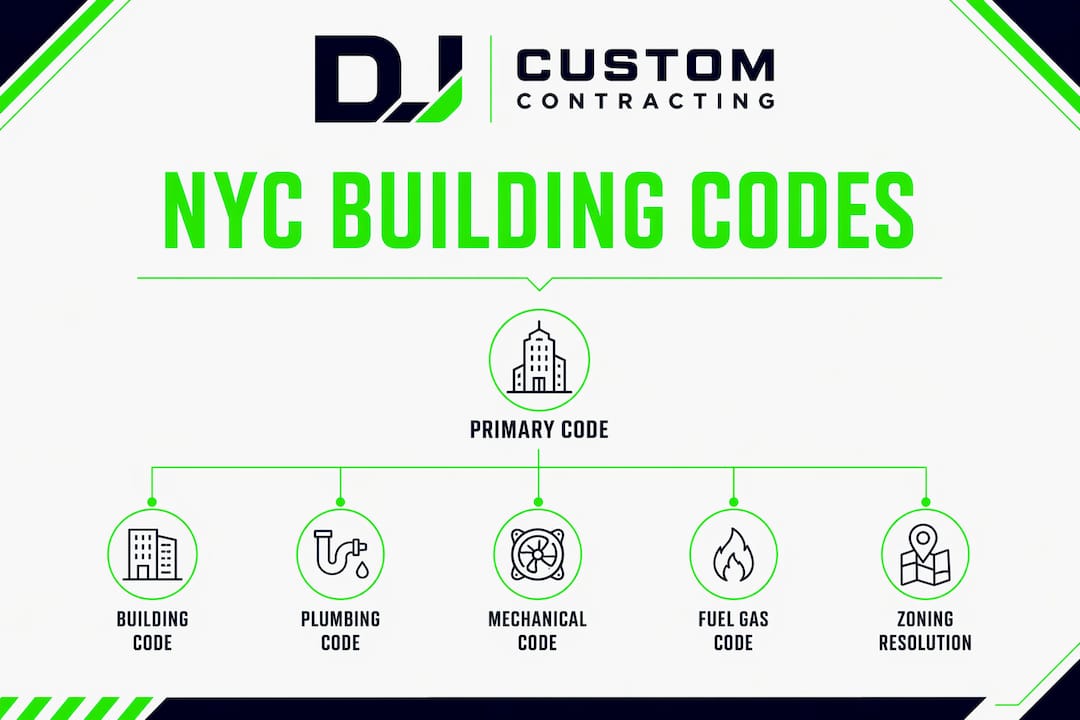
NYC building codes consist of four major sub-codes under Title 28 of the NYC Administrative Code: the Building Code, the Plumbing Code, the Mechanical Code, and the Fuel Gas Code. Each sub-code sets its own permit and inspection obligations, so a project touching multiple systems requires compliance across multiple codes simultaneously.
Here is what each sub-code covers:
Building Code: Structural integrity, fire safety, egress, and occupancy classifications for all building types.
Plumbing Code: Water supply, drainage, and sanitary systems including fixture installation and pipe specifications.
Mechanical Code: HVAC systems, ventilation, exhaust, and duct installation standards.
Fuel Gas Code: Natural gas and propane piping, appliance connections, and combustion air requirements.
The Department of Buildings (DOB) is the primary enforcement agency responsible for reviews, approvals, inspections, and issuing Certificates of Occupancy. The DOB does not work alone. Agencies like the FDNY and the Landmarks Preservation Commission (LPC) intersect in enforcement depending on the project type and building location.
The NYC Zoning Resolution sits alongside these sub-codes as a separate but equally binding legal framework. It governs land use, density, building height, and setbacks. A project can comply fully with the Building Code and still be rejected for a zoning violation, which is why you need to check both frameworks before filing any permit application.
Sub-code | Primary focus | Who it affects |
Building Code | Structure, fire safety, egress | All construction projects |
Plumbing Code | Water supply and drainage | Plumbing alterations and new installs |
Mechanical Code | HVAC and ventilation | Mechanical system work |
Fuel Gas Code | Gas piping and appliances | Gas line and appliance projects |
Pro Tip: Review all four sub-codes at the start of your project scope, not one at a time. A bathroom renovation, for example, can trigger the Building, Plumbing, and Mechanical Codes at once.
How does the 2026 Existing Building Code affect renovation projects?
The 2026 Existing Building Code (EBC) was enacted on january 17, 2026, and becomes effective on july 17, 2027. It officially replaces the outdated 1968 Building Code, which had governed alterations to existing structures for decades. The EBC creates a dedicated regulatory framework specifically for existing buildings, separate from the code that applies to new construction.
The EBC matters to you for several concrete reasons:
Scope clarity: The EBC defines exactly which alteration types trigger full code compliance versus partial compliance, reducing ambiguity that plagued the 1968 code.
Transition period: Projects filed before july 17, 2027, may still proceed under the prior code, but any project filed after that date must comply with the EBC in full.
Decarbonization requirements: The 2026 regulatory landscape emphasizes energy performance, making HVAC, lighting, and insulation thresholds stricter even for interior renovations.
Stakeholder input: The EBC was developed with input from industry committees, architects, and building owners, which means its requirements reflect real-world construction conditions more accurately than its predecessor.
For owners planning additions or alterations in the near term, the transition window is an opportunity. Filing under the prior code before july 17, 2027, may reduce compliance burden for certain project types. Consult a licensed professional to determine which code path benefits your specific project.
Pro Tip: Do not assume your architect knows which code version applies to your filing date. Confirm it in writing before design work begins, since switching code paths mid-project can require redesigns that cost more than the original permit fees.
What are the key permit requirements and safety plans for NYC construction?
Permits are not optional in New York City. Every major construction and alteration project requires a permit filed through the DOB NOW portal before any physical work begins. Filing without a permit exposes you to stop-work orders, fines, and potential demolition orders for unpermitted work.
The permit process for most projects follows these steps:
Hire a licensed design professional. An architect or engineer prepares and certifies the plans before submission.
File plans through DOB NOW. The DOB reviews plans for code compliance and issues a plan approval or requests corrections.
Pull the permit. After plan approval, the contractor pulls the actual work permit before starting construction.
Schedule inspections. The DOB and any required Special Inspection Agencies conduct inspections at defined milestones.
Obtain a Certificate of Occupancy or Letter of Completion. This closes out the permit and confirms legal compliance.
Two additional safety documents apply to larger projects. A Site Safety Plan (SSP) is mandated under NYC Building Code §3304 for major construction projects. Without an approved SSP on file through DOB NOW, a project cannot legally pull permits or break ground. For any project in an occupied building, a separate Tenant Protection Plan (TPP) must be filed under NYC Administrative Code §28-104.8.4. The TPP documents how the contractor will protect tenants from construction hazards during the work.
Special Inspections add another layer. The TR1 form is the primary tool for identifying which systems require mandatory Special Inspections. Projects involving critical life-safety or structural systems must be verified by a third-party Special Inspection Agency. Many owners assume a standard contractor inspection satisfies this requirement. It does not. Engaging a Special Inspection Agency early prevents costly delays and compliance surprises at the final inspection stage.
Document | Governing code | When required |
Site Safety Plan (SSP) | NYC Building Code §3304 | Major construction projects |
Tenant Protection Plan (TPP) | NYC Admin Code §28-104.8.4 | Occupied building alterations |
TR1 Form | DOB Special Inspection rules | Structural and life-safety systems |
Pro Tip: File your TPP and SSP at the same time as your permit application. Submitting them separately adds weeks to your approval timeline.
How do the NYC Zoning Resolution and Construction Codes interact?
The NYC Zoning Resolution and the NYC Construction Code are two separate legal frameworks, and both apply to your project at the same time. The Construction Code addresses health, safety, and structural standards. The Zoning Resolution governs land use, density, building height, and setbacks. Neither overrides the other.
When the two frameworks conflict, Administrative Code §28-103.3 mandates that the most restrictive requirement applies and requires a formal DOB determination. That determination involves documented consultations with other agencies, which underscores how complex NYC compliance can become on a single project.
When zoning and building codes conflict in New York City, the law does not let you choose the easier path. Administrative Code §28-103.3 requires the most restrictive standard to govern, and the DOB must formally document that determination in consultation with relevant agencies. Owners who discover this conflict mid-project face redesigns, refiling fees, and construction delays that could have been avoided with a pre-application zoning review.
Practical steps to avoid zoning and code conflicts:
Run a zoning analysis before hiring a design professional, not after.
Confirm your building’s zoning district and applicable use group before scoping the project.
Request a pre-application meeting with the DOB if your project involves any non-conforming conditions.
Verify FDNY and LPC requirements separately, since both agencies have independent authority over certain project types.
What are the common pitfalls in NYC building code compliance?
NYC building codes are based on the International Building Code but include extensive mandatory local amendments that make them significantly different and more complex. Owners who rely on general construction knowledge from other states or cities routinely run into problems that a locally experienced contractor would have avoided.
The most common compliance mistakes include:
Assuming the IBC applies directly. NYC’s local amendments change requirements substantially. What is permitted under the IBC may be prohibited or require additional steps in New York City.
Skipping Special Inspections. Owners often believe their contractor’s self-certification satisfies inspection requirements. For structural and life-safety systems, only a licensed third-party Special Inspection Agency meets the legal standard.
Starting work without permits. Unpermitted work creates violations that must be resolved before any future sale or refinancing of the property.
Ignoring energy code updates. Energy code enhancements now require more efficient HVAC, lighting, and insulation with stricter thresholds that affect even interior renovations. Owners who plan a renovation without accounting for energy compliance often face costly mid-project redesigns.
Neglecting the Certificate of Occupancy. Failing to close out a permit with a proper Certificate of Occupancy or Letter of Completion leaves a legal cloud on the property that complicates future transactions.
For a detailed breakdown of alteration permit costs and compliance steps, reviewing the specific requirements for your project type before filing saves significant time and money.
Pro Tip: Pull a Buildings Information System (BIS) report on your property before starting any project. It shows open permits, violations, and Certificate of Occupancy status. Surprises on that report are far cheaper to resolve before construction than after.
Key Takeaways
Compliance with NYC building codes requires understanding four sub-codes, the 2026 Existing Building Code, mandatory safety plans, and the separate but equally binding NYC Zoning Resolution.
Point | Details |
Four sub-codes govern all work | The Building, Plumbing, Mechanical, and Fuel Gas Codes each carry independent permit and inspection obligations. |
2026 EBC changes renovation rules | Enacted january 17, 2026, the EBC replaces the 1968 code and takes full effect july 17, 2027. |
Safety plans are mandatory | An SSP and TPP must be filed through DOB NOW before permits are pulled on qualifying projects. |
Special Inspections require third parties | The TR1 form identifies systems that only a licensed Special Inspection Agency can verify. |
Zoning and codes both apply | When they conflict, the most restrictive standard governs under Administrative Code §28-103.3. |
What I have learned from years of NYC code compliance work
The single biggest mistake I see property owners make is treating building codes as a checklist to hand off to a contractor. NYC codes are not a checklist. They are a layered system where one decision in the design phase can trigger requirements across three sub-codes, two agencies, and a zoning review. Owners who understand that early spend less money and finish faster.
The 2026 Existing Building Code is genuinely good news for renovation projects, even though it sounds like more regulation. The 1968 code was ambiguous in ways that gave DOB reviewers wide discretion. The EBC narrows that discretion with clearer applicability rules. That clarity benefits owners who file correctly from the start.
My practical advice: schedule a pre-application meeting with the DOB before your architect finalizes drawings. That one meeting can surface zoning conflicts, agency overlaps, and Special Inspection requirements before they become expensive surprises. Pair that with a 2026 compliance review of your property’s open permits and Certificate of Occupancy status, and you go into your project with a clear picture of what you are actually dealing with.
The owners who struggle most are the ones who hire a contractor first and ask compliance questions second. Reverse that order. The code does not care about your construction schedule.
— DJ
Djcustomcontracting: your partner for code-compliant NYC renovations
NYC building code compliance is not something to figure out as you go. Djcustomcontracting has been handling residential and commercial renovation projects since 2018, working directly within the DOB permitting process, safety plan requirements, and Special Inspection coordination that NYC projects demand.

Whether you need an interior renovation contractor who knows how to file clean permit applications or a commercial renovation team experienced with occupied-building compliance, Djcustomcontracting brings the local code knowledge your project requires. From SSP and TPP filing to final Certificate of Occupancy, every project is handled in accordance with applicable NYC building codes, licensing requirements, and insurance regulations. Contact Djcustomcontracting to discuss your project before the first permit is filed.
FAQ
What is Title 28 of the NYC Administrative Code?
Title 28 is the legal framework that contains NYC’s four main construction sub-codes: the Building Code, Plumbing Code, Mechanical Code, and Fuel Gas Code. Every construction and renovation project in New York City must comply with the applicable sub-codes under Title 28.
When does the 2026 Existing Building Code take effect?
The NYC Existing Building Code was enacted on january 17, 2026, and becomes fully effective on july 17, 2027. Projects filed before that effective date may proceed under the prior code, but all projects filed after must comply with the EBC.
Do I need a permit for interior renovation work in NYC?
Most interior renovation work that affects structural elements, plumbing, mechanical systems, or egress requires a permit filed through the DOB NOW portal. Minor cosmetic work like painting or flooring typically does not require a permit, but any work touching building systems does.
What is a Special Inspection and who can perform it?
A Special Inspection is a mandatory third-party verification of critical structural or life-safety systems, identified through the TR1 form. Only a licensed Special Inspection Agency approved by the DOB can perform these inspections. A standard contractor inspection does not satisfy this requirement.
What happens if zoning rules and building codes conflict on my project?
Under NYC Administrative Code §28-103.3, the most restrictive requirement applies when zoning and building codes conflict. The DOB must issue a formal determination, which may involve consultation with other agencies like the FDNY or LPC.
Recommended


Comments