


Public Work Meaning: What Property Owners Must Know
- DJ Custom Contracting

- 5 days ago
- 8 min read

Public work is defined as any construction, repair, or maintenance project funded or owned by a government entity and carried out for public use and benefit. This definition is not just descriptive. It is a legal designation that triggers specific compliance requirements, including federal prevailing wage laws that apply to contracts as low as $2,000 and mandatory bonding requirements that typically kick in at $100,000. For property owners, business leaders, and individuals navigating construction projects, understanding the public work meaning is the difference between a compliant project and a costly legal exposure. The American Public Works Association (APWA) recognizes that no single universal definition exists, but the core concept centers on government funding, public ownership, and essential service delivery.
What is public work, and how is it defined?
Public work is best understood as any physical asset, management activity, or construction project that enables government to deliver essential services to citizens. Roads, bridges, water treatment plants, public schools, and transit systems all fall under this definition. The APWA describes public works as encompassing water, utilities, and trash collection alongside infrastructure assets, delivered through a range of models including direct government management, outsourcing, and public-private partnerships.
The term carries legal weight beyond its plain meaning. A project qualifies as public work based primarily on its funding source, not its physical location or the identity of the contractor performing the work. A privately managed facility that receives a government grant can fall under public work statutes. That distinction surprises many property owners and business leaders who assume the label applies only to government-built structures.

Regulatory bodies including the U.S. Department of Labor and state-level procurement offices set the rules that govern these projects. Their oversight covers wage rates, bonding, bidding transparency, and environmental review. Knowing where a project sits within this framework is the first step toward managing it correctly.
What types of projects are typically considered public works?
Public work projects span a wide range of sectors and funding models. The most recognizable examples include:
Transportation infrastructure: highways, bridges, tunnels, airports, and public transit systems
Water and utilities: water treatment plants, sewer systems, stormwater management, and power grid infrastructure
Public buildings: courthouses, schools, libraries, fire stations, and government offices
Environmental projects: land remediation, flood control systems, and parks
Data and communications: fiber optic networks and emergency communication systems funded through public grants
Ownership and funding models vary considerably. Some projects are fully government funded and government owned. Others operate as public-private partnerships, where a private developer builds and operates a facility under a government contract. A third category involves projects that receive partial public funding through grants or tax incentives while remaining privately managed.
Mixed funding models complicate classification. A commercial property owner who accepts a federal energy efficiency grant for a building renovation may unknowingly trigger public work compliance requirements. That compliance burden includes prevailing wage documentation, certified payroll records, and potentially bonding.
Pro Tip: Before accepting any government grant, loan, or tax incentive for a construction project, consult a contractor or attorney familiar with public work statutes. Even partial public funding can change your compliance obligations entirely.
How does public work differ from private construction projects?
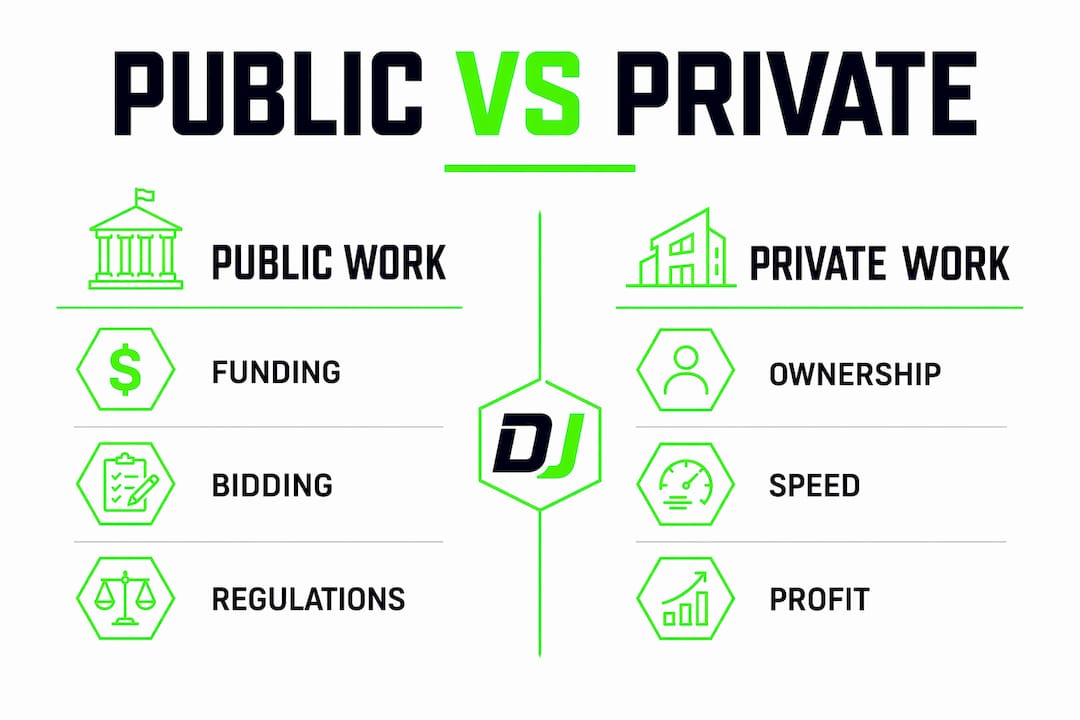
The differences between public and private construction projects are significant, and they affect every stage of a project from bidding to final payment.
Category | Public work projects | Private construction projects |
Bidding process | Formal, regulated invitation for bid; plans publicly available | Relationship-driven; negotiated or selective bidding |
Profit margins | Generally thinner due to competitive public bidding | Higher potential margins with less price competition |
Payment speed | Slower; subject to government payment cycles | Faster; negotiated payment terms with private owners |
Compliance burden | Prevailing wage, bonding, certified payroll, environmental review | Fewer statutory requirements; more contractual flexibility |
Credit risk | Lower once funds are allocated by government | Higher; depends on private owner’s financial health |
Public projects require regulated bidding with strict timelines and full transparency. Plans and specifications become publicly available documents. That transparency is a feature of the system, not a side effect. It protects taxpayers and creates a level playing field for contractors.
Private projects move faster and pay better in many cases. They rely on relationships and reputation rather than formal procurement codes. The tradeoff is higher credit risk. A private developer can run out of money mid-project. A government agency with allocated funds rarely does.
Public work projects offer lower credit risk once funding is secured, making them a stable complement to private sector work for contractors managing cash flow across a portfolio of projects.
Pro Tip: If you are new to public bidding, review the construction bidding process before submitting your first public work proposal. The documentation requirements alone can disqualify an otherwise competitive bid.
What legal and regulatory frameworks does public work trigger?
The legal designation of public work activates a specific set of statutory requirements. These are not optional guidelines. They are enforceable obligations tied to the funding source of the project.
Key compliance requirements include:
Prevailing wage laws: Federal law requires contractors to pay workers the locally prevailing wage rate on public work contracts starting at $2,000. State thresholds vary but follow a similar structure.
Bonding requirements: Performance bonds and payment bonds are typically mandatory for contracts valued over $100,000. These protect the government owner and subcontractors from contractor default.
Certified payroll records: Contractors must submit weekly certified payroll reports documenting wages paid to every worker on the project.
Wage posting: Worker protections on public works require contractors to post applicable wage rates at the job site, with the Department of Labor providing oversight.
Procurement codes: Public agencies must follow formal invitation for bid processes. Plans and specifications are made publicly available to all qualified bidders.
Environmental review: Many public work projects trigger environmental impact assessments under federal or state law before construction can begin.
The funding source is the primary determinant of public work status. Projects receiving grants, loans, or tax incentives can fall under public work statutes even when privately managed. That principle extends to commercial property owners who may not think of themselves as participants in a public project.
Licensing requirements add another layer. Contractors performing public work must hold the appropriate state and local licenses. Djcustomcontracting operates in full compliance with applicable licensing requirements in construction, which is a baseline expectation for any contractor entering the public work sector.
Practical considerations for property owners and business leaders
Understanding the definition of public work is useful. Knowing how to act on that understanding is what protects your project and your budget. These steps apply whether you are a property owner accepting public funds or a business leader evaluating a construction contract.
Verify the funding source before signing anything. Ask directly whether any portion of the project funding comes from a government grant, loan, or tax incentive program. Even partial public financing subjects the project to public work regulations. This single question can save months of compliance remediation.
Budget for administrative overhead. Prevailing wage and bonding requirements create significant administrative costs that do not appear in a standard private project budget. Certified payroll processing, bonding premiums, and compliance documentation all add to project costs. Factor these in before you commit to a contract price.
Evaluate the bid-no-bid decision carefully. Public work bidding is time-consuming and competitive. A bid-no-bid decision framework helps contractors assess whether a specific public project is worth pursuing given their capacity, experience, and margin requirements.
Treat public projects as a portfolio hedge. Public projects serve as a strategic hedge during economic downturns. Infrastructure investment tends to increase when private construction slows, with growing opportunities in civil infrastructure, data centers, and power grid modernization anticipated through 2028. A contractor with a mix of public and private work is more resilient than one dependent on either sector alone.
Engage a contractor experienced in public work compliance. The documentation burden on public projects is substantial. Working with a contractor who already understands public work projects in NY and NJ reduces your risk of non-compliance and keeps the project on schedule.
Key Takeaways
Public work is a legal designation tied to government funding, and that designation triggers compliance requirements that affect every contractor, property owner, and business leader involved in the project.
Point | Details |
Legal definition matters | Public work status is determined by funding source, not project type or contractor identity. |
Low thresholds trigger compliance | Federal prevailing wage laws apply to contracts as low as $2,000; bonding is required above $100,000. |
Mixed funding creates risk | Partial public financing subjects a project to full public work regulations, including procurement and wage rules. |
Public vs. private tradeoffs | Public projects offer lower credit risk and stable payment once funded, but carry thinner margins and slower payment cycles. |
Due diligence protects you | Verifying funding sources and budgeting for compliance overhead before signing prevents costly surprises. |
What I’ve learned from years of working in public and private construction
Most contractors and property owners treat “public work” as a category of project type. They think of roads and bridges and government buildings. That framing misses the real issue. Public work is a legal status, and it can attach to projects that look nothing like a highway.
I have seen commercial renovation projects get reclassified mid-stream because the building owner accepted a federal energy grant without realizing it. The result was a scramble to establish certified payroll systems, secure bonding, and retroactively document wage compliance. It was expensive and avoidable.
The contractors who do well in public work are not the ones with the lowest bids. They are the ones who understand the administrative game. They have their bonding in place before they need it. They know their prevailing wage rates by trade and jurisdiction. They build the compliance cost into their pricing from day one rather than absorbing it as a surprise.
The growth in public infrastructure investment through 2028 is real. Civil infrastructure, power grid modernization, and public facility upgrades represent genuine opportunity. But that opportunity rewards preparation. Contractors who enter public work without understanding its legal framework tend to win bids they cannot profitably complete.
My advice: treat the compliance framework as a competitive advantage, not a burden. When you can demonstrate that you understand prevailing wage law, bonding requirements, and procurement codes, you become a more credible bidder. Owners and agencies want contractors who will not create compliance problems for them.
— DJ
How Djcustomcontracting supports public and commercial work projects
Property owners and business leaders navigating public work projects need a contractor who understands both the construction side and the compliance side.

Djcustomcontracting has been delivering full-service residential and commercial contracting since 2018, with direct experience in projects subject to public work regulations. From commercial renovation services that meet procurement and wage compliance standards to building maintenance solutions for government-funded facilities, the team handles every stage of your project. No job is too large or too small. Djcustomcontracting works in accordance with applicable local laws, licensing requirements, building codes, and insurance regulations, so your project stays compliant from start to finish.
FAQ
What is the simplest definition of public work?
Public work is any construction, repair, or maintenance project funded or owned by a government entity and intended for public use. The funding source, not the project type, determines whether public work statutes apply.
Does accepting a government grant make my project public work?
Yes. Projects that receive government grants, loans, or tax incentives can fall under public work statutes even when privately managed. Partial public funding is enough to trigger compliance requirements.
What wage laws apply to public work projects?
Federal prevailing wage laws apply to public work contracts valued at $2,000 or more. Contractors must pay locally prevailing wage rates and submit certified payroll records for every worker on the project.
How is public work bidding different from private project bidding?
Public work requires a formal, regulated invitation for bid process with publicly available plans and specifications. Private projects typically use relationship-driven or negotiated procurement with fewer transparency requirements and faster timelines.
Why do public work projects have lower profit margins?
Strict competitive bidding drives prices down on public projects, and compliance costs including bonding, certified payroll, and administrative overhead reduce net margins further. The tradeoff is lower credit risk and stable payment once government funds are allocated.
Recommended


Comments