


Smoke Detector Requirements in NYC: Where, What Type, How Often

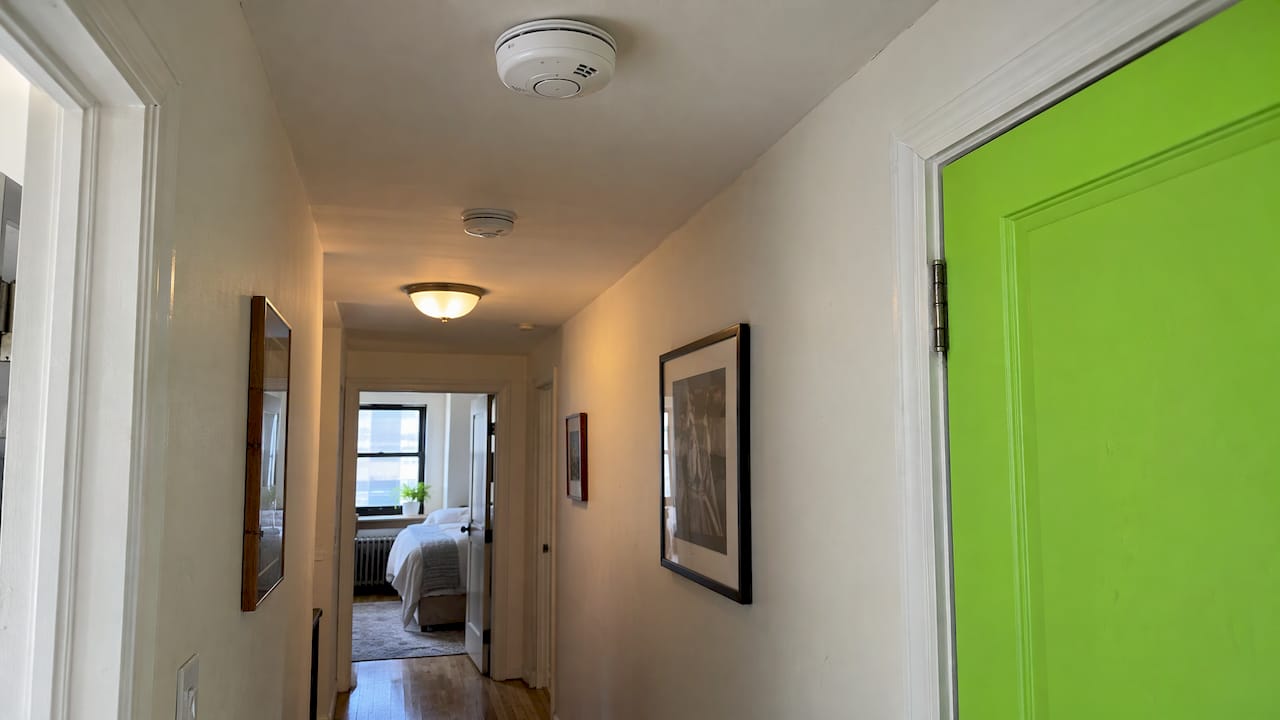
In New York City, every dwelling needs working smoke alarms on each floor, outside every sleeping area and, under the Building Code, inside each bedroom too. The alarms must be UL-listed, interconnected where there is more than one, and maintained by the right party. Commercial buildings follow a stricter track: detectors tied to a fire alarm system must be installed and programmed by licensed professionals. Below is what applies to homeowners, business owners, property managers and facility managers, and where a renovation changes the picture.
This guide covers NYC rules. If your property is in Westchester, Long Island or northern New Jersey, the state and local code in your municipality governs, so confirm it with your local building department before you plan work.
TL;DR
Install smoke alarms on every floor including the basement, outside each sleeping area and inside each bedroom, with the alarms interconnected when there is more than one in a unit.
Alarms must be UL-listed. New York State requires that smoke alarms sold in the state be hardwired or have a sealed, non-removable battery lasting at least 10 years.
Keep alarms away from kitchens and bathrooms: the Code sets distances from cooking appliances and bathroom doors.
Owners of multiple dwellings supply and replace devices; tenants test them monthly. Commercial detectors connected to a fire alarm system have their own licensed-contractor rules.
Natural gas detectors become mandatory in covered residential buildings on January 1, 2027.
Table of Contents
Who is responsible for what
The rules split by building type, so start there.
One- and two-family homes. New York State requires owners to install and maintain a smoke detector with an audible alarm in each sleeping area, according to the State Assembly’s smoke detector brochure. Alarms must also be upgraded before a home is sold or rented.
Multiple dwellings (apartment buildings). HPD, the city’s housing agency, says owners of Class A and Class B multiple dwellings must provide at least one approved, operational smoke detector in each dwelling unit. Carbon monoxide detectors are required in each unit of buildings with fossil fuel burning devices. NYC311 adds that tenants are responsible for maintaining the detectors, and that the city investigates complaints and tickets owners who violate the requirement.
Commercial buildings. FDNY draws a line between an alarm (a self-contained residential device) and a detector (a sensor that signals a building’s fire alarm system). In its guide for businesses, detectors must be installed by electrical contractors licensed by the Department of Buildings and programmed by a Certificate of Fitness holder at an FDNY-approved fire alarm company. Properties required to have connected detectors may not swap them for single-station alarms, and altering them without the fire alarm connection can trigger enforcement.
Where to place smoke alarms in a NYC home
Placement is the part of the rules inspectors and insurers look at first, and it is where most violations start.
The Department of Buildings guide to smoke and carbon monoxide detectors gives the basic pattern:
On each floor, including the basement.
Inside and outside bedrooms.
At the top and bottom of stairways.
Ceiling-mounted alarms at least 4 inches from the wall; wall-mounted alarms at least 4 inches from the ceiling.
Away from warm, damp areas such as bathrooms.
The Building Code, in section 907.2.11.1, is more specific for two-family and apartment-type dwellings (Groups R-2 and R-3). Alarms go on the ceiling or wall outside each sleeping room within 15 feet of its door, inside each sleeping room, and on each story, including below-grade stories and penthouses. Crawl spaces and uninhabitable attics are excluded.
Distance from kitchens and bathrooms
Nuisance alarms from cooking steam and shower humidity lead owners to disable devices, which is exactly what the Code tries to prevent. Section 907.2.11.3 sets these minimums from a permanently installed cooking appliance:
Alarm type | Minimum horizontal distance from cooking appliance |
Ionization | 20 feet (10 feet with an alarm-silencing switch) |
Photoelectric | 6 feet |
Alarms must also sit at least 3 feet horizontally from a bathroom door or opening that contains a tub or shower. Since January 1, 2021, installing or replacing alarms inside a 20-foot radius of a fixed cooking appliance requires a device listed to the UL 217 8th edition (alarms) or UL 268 7th edition (detectors) standard.
Sleeping areas and audibility
The same section requires that, where a dwelling unit has more than one smoke alarm, they be interconnected so that one sounding activates all of them. Listed wireless alarms do not need a physical wire between them. The alarm must be clearly audible in every bedroom over background noise with the door closed. In a multi-story home this is why a single hallway alarm on the ground floor is not enough.
The state brochure offers a practical mounting rule: on the ceiling, or high on a wall with the bottom of the alarm no more than 12 inches from the ceiling.
Older rules for specific occupancy groups
The Department of Buildings’ rule 1 RCNY 28-01 places detectors outside each separate sleeping area in J-2 and J-3 dwelling units, in basements and basement recreation rooms in J-3, and within the sleeping area of hotel, rooming or studio units in J-1. The reasoning is that the biggest threat to sleeping occupants is a fire elsewhere in the unit. If you own an older building, ask which occupancy group applies before assuming a single rule fits every unit.
For Group I occupancies, section 907.2.6.1.1 calls for detectors in sleeping areas, every room along the egress path from the sleeping area to the unit door, and each story.
What type of alarm, and how it is powered
UL listing is the baseline. The Department of Buildings tells owners to use UL-marked smoke alarms and carbon monoxide detectors and to follow manufacturer instructions.
On power, the State brochure states that all smoke detectors sold in New York must either be hardwired or run on a sealed, non-removable battery with at least a 10-year life. A 2026 compilation of state laws dates the sealed-battery mandate to 2019 and notes it covers owner-occupied homes as well. HPD also requires end-of-life signals in the devices.
Two practical points follow:
Hardwired means electrical work. Hardwired and interconnected systems need a licensed electrical contractor and, in most cases, permits. A plug-in or sealed-battery alarm is a simpler swap.
Where detectors sit on a fire alarm system, the rules change. FDNY’s study material, which follows NFPA 72 as modified by NYC, says spot-type smoke detectors may be ceiling or sidewall mounted, no more than 12 inches down from the ceiling on a sidewall, and at least 36 inches from an air diffuser. They must avoid dead air spaces and conditions above 38°C, above 93% humidity or air velocity over 300 ft/min. The FDNY material also notes that beam-type or air-sampling detectors suit high-ceiling spaces like atriums where spot detectors are hard to maintain.
Testing, cleaning and replacement
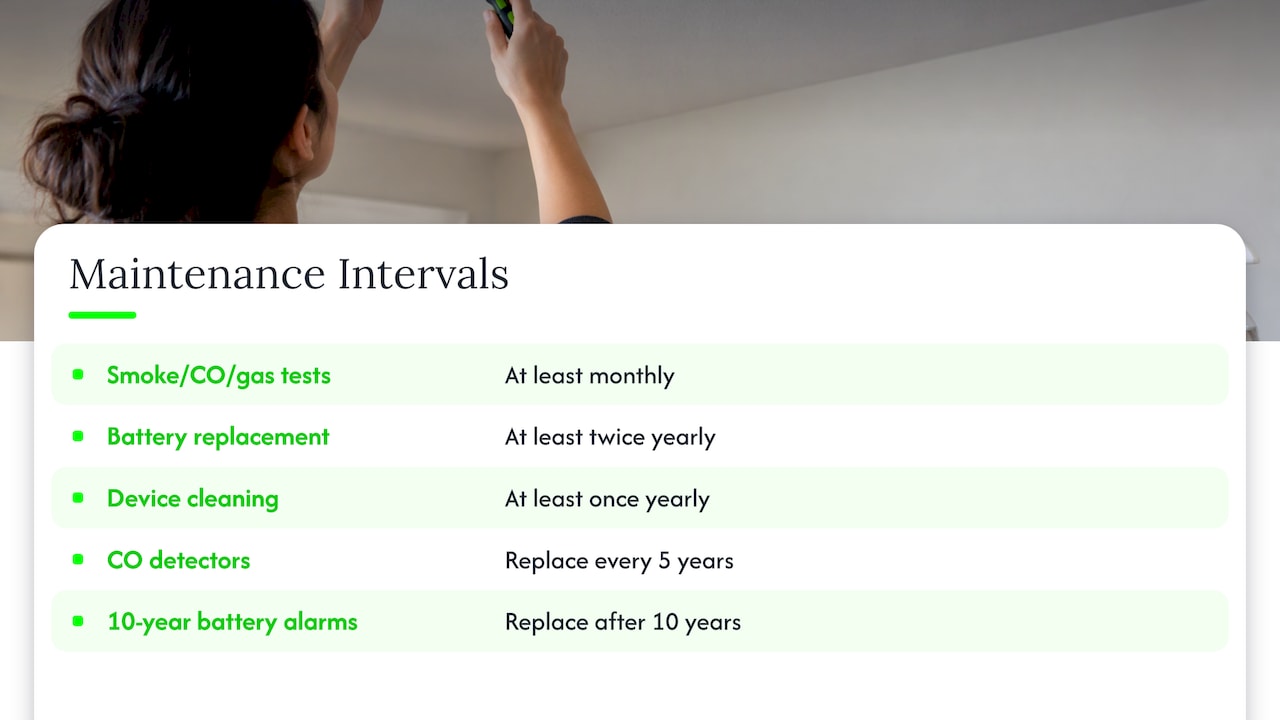
HPD says tenants must test smoke, carbon monoxide and natural gas detectors at least monthly and replace batteries at least twice a year. Owners must replace devices at the end of their useful life, and replace any missing or inoperable device before a new tenant moves in. If a device fails within a year of installation from a defect the occupant did not cause, it must be replaced within 30 days. Painting over detectors is prohibited.
The Department of Buildings adds household habits: clean devices of dust, keep them out of reach of children and pets, and replace carbon monoxide detectors every 5 years. The State brochure says to test monthly with the test button, clean at least once a year, and replace 10-year battery detectors after 10 years.
Commercial and building-wide systems
FDNY’s S-97 study material sets a stricter schedule for detectors connected to a fire alarm system:
Cleaning at least every 6 months.
A smoke entry test at least annually.
A sensitivity test at least annually.
Out-of-specification detectors recalibrated, repaired or replaced per NFPA 72 and the manufacturer’s instructions.
A bound maintenance log must be kept on the premises, listing each detector by location with dated entries for installation, repair, maintenance, testing and signals. It lives in the fire safety director’s or superintendent’s office. The work must be done by Certificate of Fitness holders (S-78/F-78 or S-97/S-98) under a smoke detector maintenance company certificate. S-95 holders can only perform visual inspections and monthly manual activation tests.
For property managers and facility managers, this log is the document that gets asked for first. A written commercial preventive maintenance plan that assigns each recurring check to a named person keeps the detector schedule from slipping between other building tasks.
The 2027 natural gas detector deadline
NYC is adding a third device to the smoke and CO routine. HPD’s rules page states that Local Law 102 of 2025 moved the natural gas alarm installation requirement from Local Law 157 of 2016 to January 1, 2027. The date could have slipped to January 1, 2029 had DOB found too few battery-powered alarm manufacturers. HPD’s final rule amendments require Class A and Class B multiple dwelling owners and private dwelling owners to:
Install approved natural gas detecting devices by January 1, 2027. Class B buildings may use a line-operated zoned system with central annunciation.
Replace devices at the end of their useful life, and replace stolen, missing or inoperable devices before new occupancy.
Replace defect-failed devices in Class A and private dwellings within 30 calendar days of written notice.
Post an HPD-approved notice in a common area.
Because the schedule has already been amended once, check HPD’s Detectors page for the current status before you budget.
When a renovation triggers alarm upgrades
Smoke detector compliance is rarely a standalone job. It surfaces when you open a wall, finish a basement, add a bedroom or convert space, because the new layout creates new sleeping areas, new stories and new cooking zones, each with its own placement rule.
Common cases:
Basement finishing. A basement is a story that needs its own alarm, and a new bedroom needs alarms inside and outside it.
Kitchen remodels. Moving a range changes the 6-foot and 20-foot distances, and any alarm within 20 feet of a fixed cooking appliance must meet the newer UL listing.
Additions. A new floor or wing needs interconnected alarms that sound throughout the unit.
Bathroom remodels. Keep alarms 3 feet from the doorway of a tub or shower.
Our NYC building codes guide and certificate of occupancy article explain how these items fit into inspections and closeout. Facility teams may also find our facility maintenance essentials useful alongside the detector log.
A quick compliance walk-through
Identify the building class. One- or two-family, multiple dwelling, or commercial determines who owes what.
Count stories and sleeping areas. Every story, including the basement, needs coverage; each bedroom needs one inside and one within 15 feet outside.
Check distances. Measure from the cooking appliance and bathroom doors, and from air diffusers in commercial spaces.
Confirm listings and power. UL 217 alarms, with a 10-year sealed battery or hardwired.
Confirm interconnection and audibility. Test that one alarm sets off all, and that it can be heard in each bedroom with the door closed.
Document. Keep dated test records; commercial buildings with fire alarm systems need the bound log.
Penalties are real. The State brochure says noncompliance with the uniform fire prevention and building code can bring fines of up to $1,000 per day for the first 180 days, then a minimum of $25 per day and $50 per day after 360 days, plus possible imprisonment of up to one year. The brochure also reminds readers that it is not a substitute for the law itself, and that stricter local rules supersede state requirements.
Perspective
Most smoke detector problems we see on the project side are layout problems, not device problems. A renovation moves a range, adds a bedroom or finishes a basement, and the alarm plan from ten years ago no longer matches the building. That is why we treat alarm placement as part of the scope from the first walkthrough. We are a licensed and insured general contractor serving NYC, Long Island and northern New Jersey, and our work is done in accordance with applicable building codes, local laws and insurance regulations. Interior renovations, basement conversions, additions and alterations are the jobs where these rules apply most directly, and we help with building code compliance and with DOB violation removal when a property has already been cited. For property managers and facility managers, we offer a comprehensive preventative maintenance program, so recurring building checks are planned rather than reactive. Our approach is simple: understand the code before the walls close, and keep clear communication with the owner at every phase. DJ
Plan your project with us
If you are renovating, converting space or clearing a violation, we can build code-compliant alarm coverage into the scope from the start. DJ Custom Contracting LLC has served residential and commercial clients since 2018, from interior renovations and basement finishing to building and facility maintenance. Our labor and materials warranties and our clear communication keep the project on its deadlines. See all our services or book a visit.

For a facility with a connected fire alarm system, the detector programming itself stays with the Certificate of Fitness holders and licensed electrical contractors FDNY names. We coordinate the construction around that work.
FAQ
Do NYC homeowners have to install 10-year smoke alarms?
New York State requires that smoke detectors sold in the state be hardwired or have a sealed, non-removable battery lasting at least 10 years. That means any new alarm you buy will meet this standard. Replace 10-year battery units after 10 years, and test them monthly.
Who has to supply smoke detectors in a NYC rental?
HPD says owners of Class A and Class B multiple dwellings must provide at least one approved, operational smoke detector in each unit. Tenants are responsible for testing and maintaining them, and owners must replace missing or inoperable devices before a new tenant moves in.
Where should smoke detectors go in a NYC bedroom area?
Place one inside each bedroom and one outside the sleeping area, within 15 feet of the bedroom door under Building Code section 907.2.11.1. Add one on every floor and at the top and bottom of stairways. Keep them at least 4 inches from walls or the ceiling junction.
Can I replace a commercial smoke detector with a regular alarm?
No, if the property is required to have detectors connected to a fire alarm system. FDNY prohibits swapping them for single-station alarms, and altering connected detectors can lead to enforcement. Installation requires a DOB-licensed electrical contractor and programming by an FDNY-approved fire alarm company.
When do natural gas detectors become mandatory in NYC?
January 1, 2027, for covered residential buildings with gas piping, under Local Law 157 of 2016 as postponed by Local Law 102 of 2025. Check HPD’s Detectors page for the current status and notice requirements.
Sources
Recommended


Comments