


What Is a General Contractor and Why You Need One


Most people assume a general contractor is simply someone who shows up to a job site, tells workers what to do, and collects a check. That picture is far from complete. A general contractor is the single professional legally responsible for your entire construction or renovation project, from the first permit pulled to the final inspection passed. Understanding what is a general contractor, what they actually do, and why their role matters can mean the difference between a project that finishes on time and one that derails into costly disputes. This guide breaks it all down clearly.
Table of Contents
Key takeaways
Point | Details |
GC as legal anchor | The general contractor holds the prime contract and bears ultimate responsibility for project delivery. |
Central communication hub | A GC translates your vision into clear instructions for every trade and reports progress back to you. |
Risk shield for owners | Hiring a GC protects you from direct legal and financial disputes with subcontractors. |
Financial vetting matters | A GC’s financial health is as critical as their skills. Weak capital can result in liens on your property. |
Benefits go beyond coordination | GCs handle permits, inspections, scheduling, safety, and quality control so you do not have to. |
What is a general contractor and what do they actually do
A general contractor, sometimes called a GC, is a licensed professional or company that manages construction and renovation projects from start to finish. They are not just a site supervisor. They are the person or entity that holds the prime contract directly with you, the property owner, and assumes legal responsibility for everything that happens on site.
The general contractor definition goes beyond basic oversight. GCs are project managers, compliance officers, budget keepers, and trade coordinators all at once. Their responsibilities typically include:
Hiring and managing subcontractors across trades like plumbing, electrical, framing, and finishing
Securing permits and scheduling inspections to keep your project legally compliant with local building codes
Building and managing the project schedule and budget, tracking costs and timelines from pre-construction through closeout
Maintaining OSHA safety standards on site to protect workers and reduce liability
Quality control reviews at each phase to catch problems before they become expensive
A GC manages day-to-day workflows, materials, and labor directly on site. That hands-on accountability is what separates them from other construction professionals. They are also the single communication hub between you and every trade working on your project, translating your vision into clear instructions and delivering progress updates back to you.
Pro Tip: Before any work begins, ask your general contractor to walk you through the full project schedule and identify where delays are most likely. A GC who can answer that question in detail has done the planning work that protects your timeline.
GC vs. subcontractor vs. construction manager
These three roles are often confused, and the confusion can cost property owners real money. Here is how they differ.
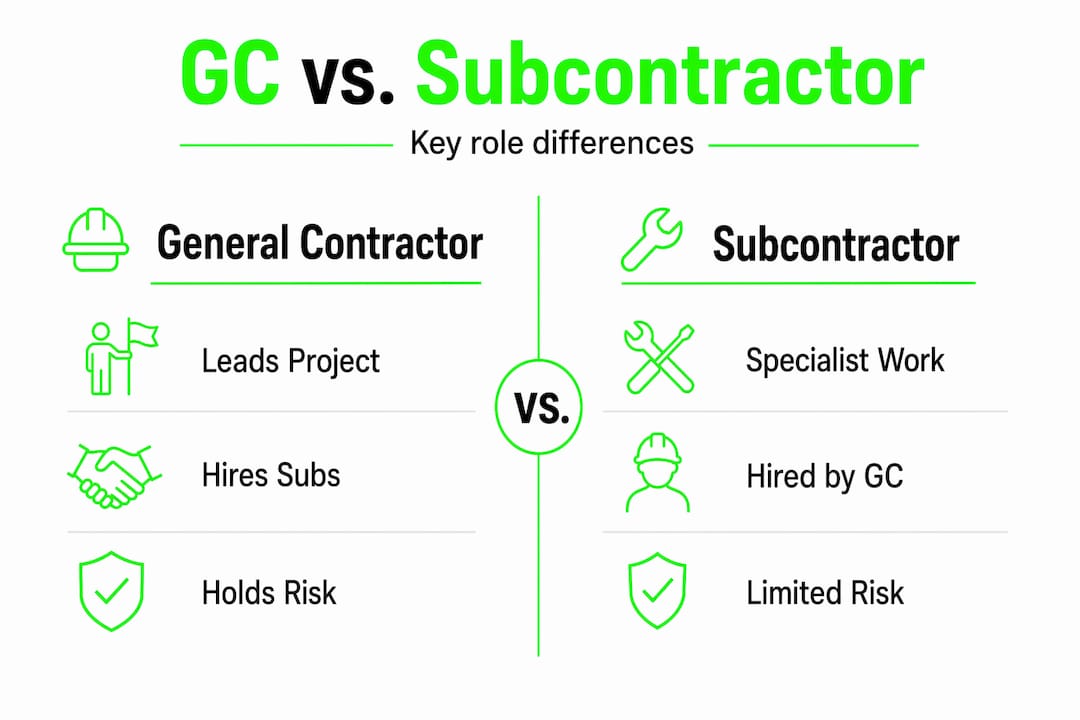
A subcontractor is a licensed specialist hired to perform a specific trade on your project. Electricians, plumbers, HVAC technicians, and tile setters are all subcontractors. They work under the GC’s direction, not yours. Their contract is with the GC, not with you directly.
A construction manager (CM) serves in a consulting or advisory capacity. They help plan, coordinate, and oversee construction processes but typically do not hold the financial risk or sign the prime contract with the owner. The primary difference between a construction manager and a general contractor is that level of onsite control versus advisory oversight.
The general contractor sits at the center. They hold the prime contract, hire and pay subcontractors, assume financial risk, and are legally accountable for the finished product.
Role | Contract with owner | Onsite control | Financial risk | Primary focus |
General contractor | Yes, prime contract | Full, hands-on | Yes | Entire project delivery |
Subcontractor | No, contracts with GC | Specific trade only | Limited | Assigned trade scope |
Construction manager | Sometimes advisory | Oversight only | Minimal | Planning and coordination |
This distinction matters because if a subcontractor does poor work or abandons the job, your GC is the one legally and financially responsible. You are not left chasing individual tradespeople.
Legal and financial risks a GC takes on for you
This is the part of the general contractor role that most homeowners and business owners never fully appreciate. When a GC signs the prime contract, they are not just agreeing to manage your project. They are assuming substantial financial and operational risk on your behalf.
Assuming the prime contract exposes the GC to liability if subcontractors default, materials are defective, or work fails inspections. That risk centralization is precisely what protects you as the owner. Rather than managing disputes with a dozen different trades, you have one accountable party.
Here is what that risk transfer covers in practice:
Payment disputes with subcontractors are handled by the GC, not escalated to you
Liens on your property become the GC’s liability to resolve when subcontractors go unpaid
Defective work claims are directed at the GC, who is responsible for corrections
Insurance and bonding obligations are carried by the GC, reducing your direct exposure
That said, not all GCs have equal financial strength. Property owners should verify a GC’s financial stability before signing anything. A contractor with insufficient capital can run out of funds mid-project, cause payment problems with subs, and leave you with liens on your property even though you paid in full.
Pro Tip: Request a GC’s bonding certificate and ask for references from past clients specifically about payment practices. A financially sound GC pays their subs on time, and that track record is public information if you ask the right questions.
You can also review contractor insurance requirements relevant to your region to understand exactly what coverage you should expect your GC to carry before work begins.
Practical benefits of hiring a general contractor
For homeowners and business owners who have never managed a construction project, the complexity is genuinely overwhelming. A qualified GC removes most of that burden. Here is how the role of a general contractor translates into real, tangible advantages for you.
Single point of contact. You communicate with one person instead of coordinating a plumber, an electrician, a carpenter, and a site supervisor separately. That simplification alone saves hours and prevents miscommunication.
On-time project delivery. A GC builds a realistic schedule and manages trade sequencing so work does not stall because one crew is waiting on another. Proper coordination is one of the most underrated benefits of professional project management.
Permit and code compliance. Your GC secures permits, handles inspections, and makes sure every phase of work meets local building codes. Skipping this process can trigger stop-work orders or require expensive tear-outs.
Safety and liability protection. A disciplined safety culture managed by the GC reduces project delays, lowers insurance premiums, and limits liability for everyone involved. Safety is not just a compliance checkbox. It is a leading indicator of how well your project will be managed.
Quality assurance. Your GC conducts inspections at each project phase. Catching a framing error before drywall goes up is a minor fix. Finding it after the walls are finished is expensive and time-consuming.
Learning more about why a GC protects your renovation from the start can help you make a more confident hiring decision.
My perspective on what most people get wrong about GCs
People underestimate what a general contractor actually does. Every week I encounter homeowners who tried to manage their own renovation by hiring individual trades separately. They thought they were saving money. Most of them ended up spending more because they had no way to sequence the work properly, resolve disputes when trades conflicted, or catch quality issues before they compounded.
What I have learned over years of working in this industry is that the GC role is fundamentally a leadership role. It requires legal knowledge, financial management, trade expertise, and the ability to hold dozens of moving parts together under real deadline pressure. When you shortcut that by hiring a buddy with tools, you are not saving the GC’s fee. You are assuming all the risk yourself with none of the expertise to manage it.
The other thing people consistently overlook is financial vetting. I have seen projects fall apart not because the contractor lacked skill but because they lacked capital. They took your deposit, paid earlier jobs, and ran out of money before yours was complete. Evaluating a GC’s financial health before signing is not paranoia. It is due diligence. Ask for bonding, ask for references, and pay attention to how quickly they respond and how clearly they communicate. Those details reveal more about how your project will go than any portfolio photo.
When you are ready to choose, reviewing expert tips for contractor selection can help you ask the right questions before signing anything.
— DJ
Work with a GC you can trust from day one

Djcustomcontracting has been delivering residential and commercial general contracting services since 2018, and the approach has stayed consistent: professional project management, clear communication, and quality work at every stage. Whether you need interior renovation services for a kitchen or bathroom overhaul, or exterior renovation work that updates your property’s curb appeal and structural integrity, Djcustomcontracting handles permits, subcontractors, inspections, and scheduling on your behalf.
From additions and alterations to DOB violation removal and commercial maintenance, no project is too large or too small. You get one point of contact, complete accountability, and a team that works in accordance with all applicable building codes, licensing requirements, and insurance regulations. Reach out to Djcustomcontracting to discuss your project and find out exactly what professional general contracting looks like in practice.
FAQ
What is the general contractor definition in simple terms?
A general contractor is a licensed professional who manages a construction or renovation project end to end, holding the prime contract with the property owner and coordinating all trades, permits, and inspections needed to complete the work.
How is a general contractor different from a subcontractor?
A general contractor manages the full project and contracts directly with the property owner, while a subcontractor is a specialist hired by the GC to perform a specific trade such as electrical, plumbing, or framing work.
What does a general contractor do on a daily basis?
On any given day, a GC oversees onsite labor, reviews progress against the project schedule, coordinates subcontractor sequencing, handles material procurement, and communicates updates to the property owner.
How do I hire a general contractor I can trust?
Verify their license and insurance, check their bonding certificate, ask for references specifically about payment practices and communication, and review their history of permit compliance before signing any contract.
Why does the role of a general contractor matter for homeowners?
The GC assumes legal and financial accountability for your project, protecting you from direct disputes with subcontractors, ensuring code compliance, and giving you a single responsible party if something goes wrong.
Recommended


Comments