


Why hiring professionals for renovations protects you


Renovation projects can feel exciting at first. You picture the finished space, the new kitchen, the updated bathroom, the refreshed commercial storefront. But somewhere between that vision and the final result, many property owners in New York City and Northern New Jersey run into serious trouble. They hire the wrong contractor, skip the permits, or underestimate the complexity of local building codes. The consequences can be severe: stop-work orders, steep fines, and repairs that cost far more than the original project. In New Jersey alone, unlicensed contractors face fines reaching $10,000 to $20,000. Hiring a licensed, insured professional is not just a smart choice. It is the only responsible one.
Table of Contents
Key Takeaways
Point | Details |
Ensures legal compliance | Hiring licensed professionals protects you from fines and ensures renovations meet local codes. |
Provides financial security | Registered contractors with insurance and bonds safeguard your investment against accidents and faulty work. |
Delivers quality and efficiency | Professional teams anticipate challenges, guarantee workmanship, and finish projects on schedule. |
Guides smart contractor selection | Ask for credentials, check reviews, and use written contracts to partner with reputable professionals. |
Legal requirements and risks of hiring unlicensed contractors
Now that the risks are clear, let’s break down the legal framework and how hiring professionals keeps you protected.
Both New York City and New Jersey have strict regulations governing who can legally perform renovation work on residential and commercial properties. These rules exist to protect property owners, tenants, and the public from unsafe construction practices. Ignoring them, even unintentionally, can expose you to serious financial and legal consequences.
In New Jersey, the Home Improvement Contractor (HIC) registration program is administered by the Division of Consumer Affairs. According to NJ Consumer Affairs HIC requirements, contractors must carry a minimum of $500,000 in liability insurance and maintain a compliance bond. Contractors who perform work without this registration can face fines between $10,000 and $20,000 per violation. As a property owner, hiring an unregistered contractor can also put you in a difficult legal position if something goes wrong.
In New York City, the Department of Buildings (DOB) requires permits for most renovation work, including structural changes, electrical upgrades, plumbing alterations, and more. Work done without proper permits can result in violations that follow the property through future sales and refinancing. If you need to remove building code violations after the fact, the process is often more expensive and time-consuming than doing it right the first time.
Here is a comparison of what licensed versus unlicensed contractors typically offer:
Factor | Licensed professional | Unlicensed contractor |
Insurance coverage | Yes, required by law | Rarely, if ever |
Permit handling | Manages permits for you | Often skips permits |
Code compliance | Built into the process | Not guaranteed |
Accountability | Legally registered | Difficult to pursue |
Consumer protection | Bonded and regulated | None |
The risks of hiring unlicensed contractors go beyond fines. Consider these common outcomes:
Work that fails inspection, requiring full demolition and redo
Accidents on your property with no insurance coverage to protect you
Disputes with no legal recourse because the contractor has no formal registration
Difficulty selling or refinancing your property due to unpermitted work
Voided homeowner’s insurance policies when unlicensed work is discovered
“Hiring a registered contractor gives you legal protections that simply do not exist when you hire someone working outside the system. It is the difference between a project that adds value to your property and one that creates liability.”
For property owners in New Jersey looking to renovate, following NJ renovation tips from experienced professionals can help you avoid these pitfalls from the start.
How professionals protect your property and finances
Legal compliance is crucial, but financial protection matters just as much.
When you hire a licensed and insured contractor, you are not just paying for labor and materials. You are paying for a layer of financial protection that can save you tens of thousands of dollars if something goes wrong. This is one of the most underappreciated benefits of working with a professional renovation team.
Licensed contractors carry liability insurance, which covers property damage and personal injury that may occur during the project. If a worker is injured on your property, or if a wall is accidentally damaged during demolition, the contractor’s insurance handles the claim. Without that coverage, you as the property owner could be held financially responsible.
Professionals also ensure building code compliance throughout every phase of the project. This matters more than most people realize. Code-compliant work is inspected and approved by local authorities, which means the finished product meets safety and structural standards. That approval protects your investment long-term.
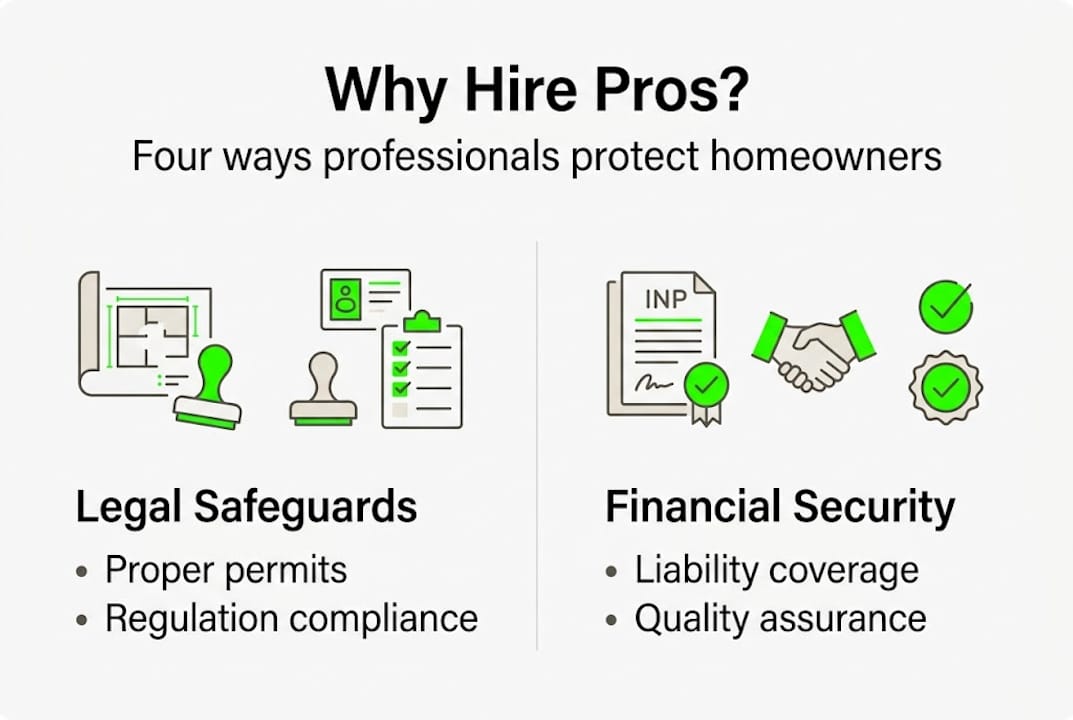
Here is a breakdown of financial risks by project type when unlicensed work is used:
Project type | Avg. cost of corrections | Risk of permit issues |
Kitchen remodel | $8,000 to $25,000 | High |
Bathroom renovation | $5,000 to $15,000 | High |
Structural alterations | $15,000 to $50,000+ | Very high |
Electrical upgrades | $3,000 to $10,000 | High |
Commercial fit-out | $20,000 to $100,000+ | Very high |
Follow these steps to understand how professionals protect your finances:
Verify insurance before signing anything. Ask for a certificate of insurance and confirm it is current. This one step can prevent enormous liability exposure.
Confirm permit responsibilities in writing. A professional contractor should pull all required permits. Make sure this is spelled out in your contract.
Understand the bond. A contractor’s compliance bond means there is a financial safety net if the contractor fails to complete the work or causes damage.
Request a detailed written estimate. Professionals provide itemized quotes. Vague estimates from unlicensed workers often lead to unexpected charges later.
Check for code compliance at each stage. Reputable contractors schedule inspections at key milestones, not just at the end.
Pro Tip: Skipping permits might seem like a way to save money upfront, but many homeowner’s insurance policies explicitly exclude coverage for damage related to unpermitted work. That means a burst pipe in an unpermitted bathroom renovation could leave you paying out of pocket for the entire repair.
When renovating older properties, the stakes are even higher. If you are working on a pre-war NYC building, the structural and code considerations are significantly more complex. Professionals who understand these nuances are essential, not optional.
As NJ Consumer Affairs confirms, registered contractors are required to meet standards specifically designed to ensure code compliance and consumer protection. That regulatory framework is your safety net.
Expertise, quality, and efficiency: What professionals deliver
Beyond financial safety, professional expertise makes the real difference.
There is a reason experienced contractors can look at a renovation plan and immediately identify potential problems. They have seen what goes wrong. They know which structural elements in a 1920s Brooklyn brownstone need special attention. They understand how a commercial kitchen remodel in a New Jersey strip mall requires coordination between plumbing, electrical, and ventilation in ways that a general handyman simply cannot manage.
This expertise translates into tangible benefits for your project:
Anticipating hidden challenges. Professionals open walls knowing what they might find, whether it is outdated knob-and-tube wiring, asbestos insulation, or undersized joists. They plan for these discoveries instead of being derailed by them.
Quality workmanship from start to finish. Licensed tradespeople follow industry standards that result in finishes that last. Tile that stays level. Drywall that does not crack. Plumbing that does not leak six months after installation.
Coordinated project management. Large renovations involve multiple trades working in sequence. Professionals manage that scheduling so electricians, plumbers, and carpenters are not stepping on each other’s work.
Access to quality materials. Established contractors have supplier relationships that give them access to better materials at better prices, savings that often get passed along to you.
Accountability at every stage. When something is not right, a professional contractor fixes it. There is no disappearing act, no ignored calls, no “that’s not my problem.”
Kitchen remodeling expertise is a good example of where professional skill truly shows. A kitchen involves cabinetry, countertops, plumbing, electrical, ventilation, and often structural changes. Getting all of those elements to work together seamlessly requires coordination that only experienced teams can deliver consistently.
The same applies to interior renovation work across residential and commercial spaces. From layout planning to final finishes, professionals bring a systematic approach that reduces costly mistakes.
For business owners, commercial renovation expertise is especially critical. Downtime costs money. A professional team that completes work on schedule and within code means your business gets back to operating faster.
Pro Tip: When comparing bids, a significantly lower price from an unlicensed contractor is almost never a real savings. Factor in the cost of corrections, potential fines, and lost time, and the “cheaper” option almost always ends up costing more.
NJ Consumer Affairs reinforces that registered contractors are held to standards that protect consumers at every stage of the project. That accountability is built into the professional relationship from day one.
Practical tips for choosing the right renovation professional
Knowing what professionals offer, here is how to find the right one for your project.
Finding a qualified contractor takes more than a quick internet search. The right professional for your renovation will be transparent, communicative, properly credentialed, and willing to put everything in writing. Here is a step-by-step approach to making that selection with confidence.
Request proof of licensing and insurance upfront. In New Jersey, HIC registration with insurance and bond is required by law. In NYC, check the DOB’s online contractor lookup. Any hesitation to provide this documentation is a red flag.
Check their portfolio and past projects. Ask to see photos or, better yet, visit a completed project if possible. Look for work that matches the scope and style of what you need.
Read reviews from multiple sources. Google, Yelp, and the Better Business Bureau each offer different perspectives. Look for patterns in the feedback, both positive and negative.
Interview at least three contractors. This gives you a baseline for pricing, communication style, and professionalism. The lowest bid is not always the best choice.
Ask specific questions about your project. How will they handle unexpected structural issues? What is their process for permit applications? Who will be on-site daily? These questions reveal experience and transparency.
Beyond the interview, watch for these warning signs:
Demanding a large cash payment upfront with no written contract
Unable or unwilling to provide a license number or insurance certificate
No physical business address or local presence
Vague timelines with no milestones or checkpoints
Pressure to start immediately without a signed agreement
For property owners navigating the unique challenges of NYC housing, understanding the difference between co-op and condo renovations is also important. Board approvals, alteration agreements, and building-specific rules add layers of complexity that only experienced local contractors know how to handle.
A written contract is non-negotiable. It should include the full scope of work, a payment schedule tied to milestones, a timeline with specific dates, materials to be used, and a process for handling changes. This document protects both you and the contractor and gives you a clear path forward if disagreements arise.
The overlooked reason most renovation projects fail
Most conversations about renovation risk focus on licensing, insurance, and permits. Those things matter enormously. But there is another factor that quietly derails even the most well-credentialed projects: poor communication.
We have seen it repeatedly. A fully licensed, insured contractor begins a project, but the homeowner and contractor have different mental pictures of what the finished product looks like. Expectations about timeline, daily work hours, dust containment, material choices, and budget flexibility were never clearly discussed. Frustration builds. Trust erodes. The project stalls.
The best contractors do not just show up and swing hammers. They ask questions before work begins. They set clear milestones and communicate when those milestones shift. They explain what is happening behind the walls before they close them up. Following NJ bathroom renovation tips or any other project guidance is far more effective when the contractor and client are genuinely aligned on goals.
Before signing any contract, have a direct conversation about how the contractor communicates. Do they send weekly updates? Who is your point of contact if an issue arises? What is the process for approving changes? A contractor who welcomes these questions is one you can trust with your property.
Connect with proven renovation professionals
Ready to take your project further? Connect with professionals who meet all the criteria we have discussed.
DJ Custom Contracting LLC has been serving homeowners and business owners across New York City and Northern New Jersey since 2018. Every project is handled in full compliance with local licensing requirements, building codes, and insurance regulations. Whether you are planning a full interior renovation, a commercial renovation for your business space, or a detailed kitchen remodeling project, the team brings the credentials, experience, and communication you need to get it done right.

No job is too big or too small. Reach out today to discuss your project, get a transparent estimate, and work with a team that treats your property with the care it deserves.
Frequently asked questions
What happens if I hire an unlicensed contractor in NJ?
You could face fines up to $20,000, and your project may not meet local codes, leading to costly corrections and potential stop-work orders.
Why is liability insurance important for renovation projects?
Liability insurance protects you from financial loss due to accidents or property damage during the project. In New Jersey, registered contractors carry $500k in liability insurance as a legal requirement.
How do I verify a contractor’s credentials in NYC or NJ?
Ask for proof of licensing and insurance directly, and confirm HIC registration with bond through the NJ Division of Consumer Affairs website or the NYC DOB’s online contractor lookup tool.
Are written contracts necessary for renovation projects?
Yes, written contracts clarify the full scope of work, payment schedule, and timeline, protecting both parties and providing a clear resolution path if disputes arise.
Recommended


Comments