


Why Property Managers Need Contractors: A Practical Guide


Managing a portfolio of residential or commercial properties without reliable contractor partnerships is one of the fastest ways to accumulate liability, angry tenants, and ballooning repair costs. Understanding why property managers need contractors goes well beyond convenience. It touches on legal compliance, risk management, and your ability to deliver the responsive maintenance that keeps tenants renewing leases. This guide breaks down the contractor roles that matter most, the compliance requirements you cannot afford to ignore, and the practical steps that separate efficient property managers from overwhelmed ones.
Table of Contents
Key Takeaways
Point | Details |
Contractors vs. vendors | General contractors and specialty trade contractors serve different scopes; matching them to the right project avoids costly mistakes. |
Compliance protects you | Licensed and insured contractors with verified COIs and additional insured endorsements shield managers from personal liability. |
Responsiveness drives retention | Contractor performance directly affects tenant satisfaction; slow repairs compound dissatisfaction and vacancy costs. |
Documentation is non-negotiable | Relying on emails and spreadsheets during a regulatory investigation exposes managers to serious financial and legal penalties. |
Right contractor, right project | Aligning contractor type to project complexity reduces schedule delays, cost overruns, and accountability disputes. |
Why property managers need contractors: roles and types
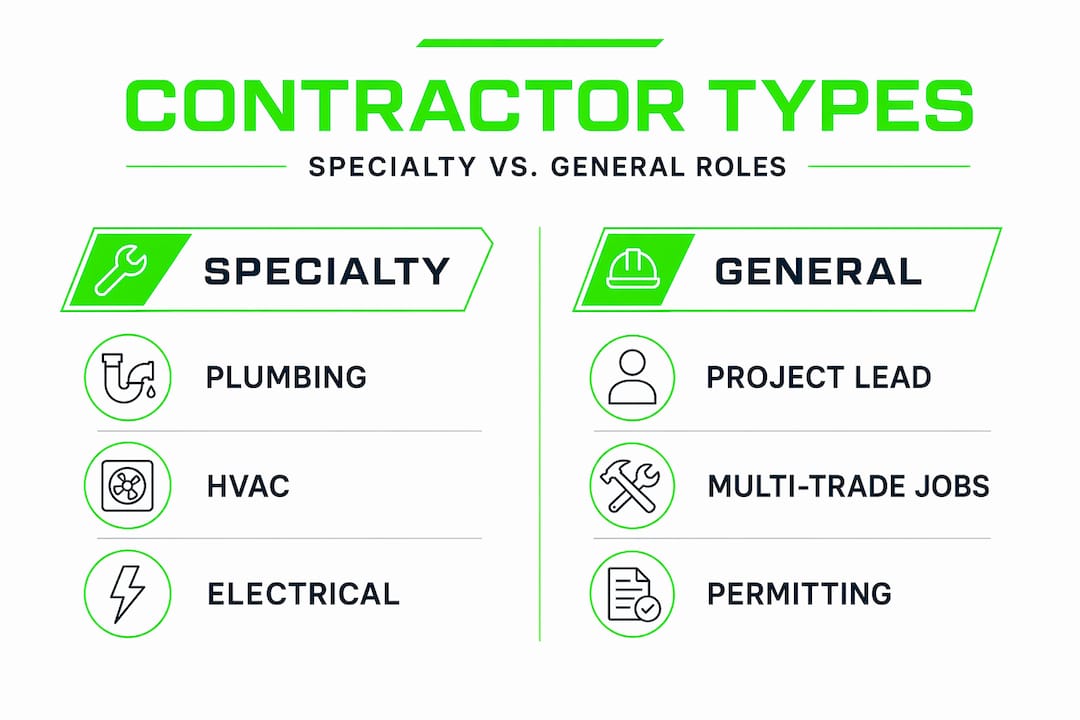
Not all contractors are the same, and treating them interchangeably is a common and costly mistake. The industry uses two primary categories: specialty trade contractors and general contractors. Knowing when to deploy each one is a foundational skill for any property manager.
A specialty trade contractor focuses on a single licensed discipline, such as electrical, plumbing, or HVAC. These trades are highly regulated, and licensed specialty contractors are legally required for most of this work in every U.S. state. Using an unlicensed person to rewire a unit or replace a gas line creates direct liability for the property manager and can void the building’s insurance coverage entirely.
A general contractor, by contrast, coordinates multiple trades under one contract. When a rental unit needs a full bathroom renovation that involves demolition, tile work, plumbing rough-in, and electrical upgrades, a general contractor manages the schedule, the subcontractors, and the permits. Multi-trade projects require this single point of accountability. Without it, you end up coordinating four separate contractors yourself, often resulting in scheduling conflicts and finger-pointing when something goes wrong.
Vendors sit in a third category. They handle routine recurring services like landscaping, pest control, and janitorial work. They are important but distinct from contractors who perform regulated trade work or structural alterations.
Contractor Type | Best For | Key Requirement |
General contractor | Multi-trade renovations, additions, alterations | State license, COI, permit coordination |
Specialty trade contractor | Single-trade work (electrical, plumbing, HVAC) | State trade license, trade-specific COI |
Vendor/service provider | Recurring maintenance (landscaping, cleaning) | General liability insurance, service agreement |
Common contractor roles that support property management operations include:
Licensed electricians for panel upgrades, outlet installation, and code compliance repairs
Plumbers for pipe repairs, fixture replacement, and drain work
HVAC technicians for seasonal servicing and emergency system failures
General contractors for unit turnovers, tenant improvement buildouts, and exterior renovations
Restoration contractors for water damage, fire damage, and mold remediation
Compliance, licensing, and liability you cannot ignore
Here is where many property managers underestimate their exposure. Contractor management is not just an operational function. It is a compliance function, and failures in this area can trigger owner disputes, regulatory penalties, and personal financial liability.
A 2026 report found that personal liability can reach $2.4M for property managers who fail to maintain documented contractor compliance systems, with organizational penalties reaching $11.8M. The underlying issue is consistent across markets: managers assume their contractors are properly licensed and insured, and that assumption is never verified or documented.
Verification requires active steps, not passive trust. Before any contractor begins work on your property, confirm the following:
State license status: Check the contractor’s license through your state licensing board directory. Licenses expire, get suspended, and get revoked. Verify at onboarding and again periodically.
General liability insurance: Require a Certificate of Insurance (COI) naming your management company and the property owner as additional insureds. Tier 1 contractors such as roofers and electricians typically need $1M per occurrence and $2M aggregate coverage.
Additional insured endorsements: A COI checkbox is not sufficient. Additional insured endorsements must be explicitly documented to cover completed operations claims, which arise after the work is finished and the contractor has left the site.
Workers’ compensation coverage: Protects you if a contractor’s employee is injured on your property.
“Assuming contractor compliance without documented systems is no defense against regulatory penalties. Courts emphasize documented oversight, not good intentions.”
Pro Tip: Build a compliance checklist into every contractor onboarding workflow. Use a dedicated tracking system instead of email threads and spreadsheets. Regulators and courts treat informal systems as no system at all.
Review your contractor insurance requirements regularly, especially if you manage properties across multiple jurisdictions, since coverage thresholds and licensing rules vary by state and municipality.
Efficiency, tenant satisfaction, and cost control
The case for strong contractor partnerships is not only about avoiding liability. It is also about running a more efficient operation that tenants actually notice.

Lack of vendor performance tracking creates a direct path to tenant dissatisfaction. An HVAC contractor taking 72 hours to respond to an emergency call in the middle of July is not just a bad tenant experience. It is also a lease renewal risk, a potential habitability complaint, and a cost amplifier if the delay causes further equipment damage.
Here is a practical framework for managing contractor performance across a portfolio:
Establish response time expectations in writing. Define emergency response windows (typically 2 to 4 hours) and routine repair timelines (24 to 48 hours) in every contractor service agreement before work begins.
Track performance by contractor and trade. Log every work order, the date issued, the date completed, and any callbacks or repeat visits. Patterns become visible quickly.
Conduct periodic contractor reviews. Quarterly reviews identify underperforming contractors before tenant complaints accumulate and before minor issues become expensive ones.
Centralize your contractor pool. Single-source vendor models are gaining traction in property management because they reduce administrative overhead and standardize service expectations across landscaping, HVAC, roofing, and more.
Prioritize reliability over lowest price. Responsive contractors who communicate clearly, document their work thoroughly, and price transparently reduce your total operational burden far more than a contractor who bids 15% lower but disappears for days.
Pro Tip: When evaluating a new contractor, request references from other property managers specifically, not homeowners. Property managers have a different set of priorities around scheduling, documentation, and follow-through, and their references will reflect that.
Reliable contractor partnerships are foundational to avoiding repeated maintenance issues, reducing tenant disruption, and supporting long-term property value. That is not a soft benefit. It shows up in your renewal rates and your repair cost line.
Choosing the right contractor and managing relationships well
Selecting the right type of contractor for a given project sounds straightforward, but misalignment here is one of the more expensive mistakes in property management. Misclassifying multi-trade work as single-trade leads to schedule delays, cost overruns, and contractor disputes that the property manager gets caught in the middle of.
Use this framework when scoping a project:
Single trade, no permits needed: A licensed specialty contractor handles it directly.
Single trade, permits required: Still a specialty contractor, but confirm they handle permit applications and inspections in your jurisdiction.
Multiple trades, coordinated scope: Engage a general contractor who will manage subcontractors, pull permits, and deliver a finished product under one contract.
Renovation involving structural changes or additions: Always a general contractor with demonstrated experience in your building type and local code requirements.
When qualifying any contractor, whether specialty or general, ask these questions and verify the answers:
Is your license current and in good standing with the state licensing board?
Can you provide a COI with our company listed as an additional insured?
Who pulls the permits, and how do you handle inspections?
Have you completed similar projects for other property managers or management companies?
What is your standard response time for routine and emergency work?
The contractor selection process should include written documentation of every verification step. If a regulatory issue or owner dispute arises later, that paper trail is what protects you.
Also consider the safety dimension. Property managers hold controlling authority for workplace safety on multi-contractor sites regardless of what subcontract agreements say. That means formal documentation of safety inspections and coordination is your responsibility, not something you can delegate entirely to the contractor.
Situation | Contractor Choice | Critical Check |
HVAC replacement in one unit | Specialty HVAC contractor | State HVAC license, COI |
Full unit renovation, 3+ trades | General contractor | GC license, subcontractor COIs, permits |
Roof repair after storm damage | Specialty roofing contractor | Roofer license, $2M aggregate COI |
Commercial tenant buildout | General contractor | Commercial GC license, safety plan |
What I’ve learned about contractor management after years in the trades
I have seen property managers make the same mistake over and over: they build a contractor list based on whoever gave them the best price last year and then never update it. No license checks. No insurance renewals. No performance reviews. Just inertia. And then something goes wrong, and suddenly they are scrambling to find documentation that does not exist.
The vendors-on-autopilot approach creates real legal exposure. In my experience, the property managers who operate most effectively treat contractor compliance the same way they treat rent collection: systematically, with documented processes, and without exception.
What actually works is building a small but deeply vetted contractor pool organized by trade. Three or four reliable contractors per trade category, with current licenses, clean insurance records, and a track record of showing up on time and communicating clearly. That is more valuable than a spreadsheet of 40 names you have never verified. When you know who you are calling and you know they are qualified, the entire operation runs faster and with far less stress.
The other thing I have seen consistently: the cheapest contractor almost never saves money over the full project lifecycle. Low bids often mean cut corners, inadequate insurance, or insufficient experience with permit requirements. You end up paying twice. Once for the work and once to fix the work.
— DJ
Work with a contractor built for property managers

Property managers need contractor partners who understand the demands of the job. That means responsiveness, proper licensing, documented insurance, and the ability to handle everything from a single-unit repair to a multi-property renovation program. Djcustomcontracting has been delivering exactly that since 2018, with full-service residential and commercial contracting that covers interior renovation work, exterior renovation services, and ongoing building maintenance solutions for property managers across the region. Every project is handled in compliance with local licensing requirements, building codes, and insurance regulations. No job is too large or too small. If you are looking for a contractor relationship built on accountability and results, Djcustomcontracting is ready to support your portfolio.
FAQ
Why do property managers need licensed contractors?
Licensed contractors have verified competency and legal authority to perform regulated trade work such as electrical, plumbing, and HVAC. Using unlicensed contractors creates direct liability exposure and can void property insurance coverage.
What is a COI and why does it matter?
A Certificate of Insurance (COI) confirms a contractor carries active liability and workers’ compensation coverage. Property managers should require COIs with additional insured endorsements before any contractor begins work.
When should a property manager use a general contractor?
A general contractor is the right choice when a project involves multiple trades, requires permit coordination, or includes structural alterations. Specialty contractors handle single-trade scopes only.
How does contractor performance affect tenant satisfaction?
Slow repair response times directly increase tenant dissatisfaction and lease non-renewal rates. Tracking contractor performance by response time and callback rate helps managers identify and replace underperformers before issues compound.
What happens if a contractor causes an injury on a property?
If a contractor lacks adequate workers’ compensation or general liability coverage and a worker is injured on site, the property manager may bear personal financial liability. Documented insurance verification before work begins is the primary protection.
Recommended


Comments