


Commercial Renovations Explained: Guide for NY & NJ Owners

Not all building work is simply “renovation.” That assumption catches property owners and managers off guard more often than you might expect, especially in markets like New York and Northern New Jersey where the Department of Buildings and local enforcing agencies draw sharp lines between renovation, alteration, addition, and tenant improvement. Each classification carries its own permitting track, inspection requirements, and contractor scope. Getting this wrong doesn’t just delay your project. It can trigger stop-work orders, inflate costs, and expose you to liability. This guide gives you a clear, working framework to navigate commercial renovation decisions with confidence and avoid the most common regulatory pitfalls.
Table of Contents
Key Takeaways
Point | Details |
Know your renovation type | Understanding the true category of your project is essential to meet code and avoid costly mistakes. |
Coordinate tenant improvements | Align lease terms and permitting early to prevent delays and financial exposure for tenants. |
Plan for strict compliance | Renovations in NY and NJ are heavily regulated, so always check and follow all required building codes. |
Maximize long-term value | Thoughtful renovations improve property value, sustainability, and tenant satisfaction. |
What defines a commercial renovation?
With a sense of why defining renovation is important, let’s break down exactly what falls under this term in the commercial space.
A commercial renovation refers to work that updates, repairs, or modernizes an existing commercial building or space without fundamentally changing its structural footprint or designated use. Think new flooring, updated lighting systems, refreshed restrooms, new ceilings, or modernized storefronts. The key word is existing: you are working within what already stands.
Understanding renovation terminology is essential before you sign a contract or pull a permit. Here is how the major categories break apart:
Renovation: Restoring or updating existing conditions within the current footprint and use classification
Alteration: Modifying structural elements, layouts, or building systems in ways that change how the space functions
Addition: Expanding the building’s gross floor area or adding new structural components
Tenant improvement (TI): Modifications made specifically to leasable space for a particular tenant, usually inside a multi-tenant building
Tenant improvements (TIs) are a subset of commercial renovation focused on modifications made to leasable space for a tenant. They sit within the renovation family but have their own lease-driven triggers, funding structures, and scheduling dependencies.
Category | Scope | Permit Intensity | Triggers |
Renovation | Cosmetic and system updates, no footprint change | Low to moderate | Work beyond ordinary maintenance |
Alteration | Structural or layout changes | Moderate to high | Changes to egress, load-bearing elements |
Addition | New square footage or floors | High | Expansion of gross building area |
Tenant improvement | Tenant-specific buildout | Varies | New lease execution or renewal |
The distinction matters because misclassifying your project type can affect which agency reviews your application, how long approval takes, and how much your contractor needs to budget for inspections. Owners dealing with mixed-use buildings should also review co-op vs. condo renovation differences to understand how ownership structure adds another layer of classification complexity.
Types of commercial renovations and real-world examples
Now that we’ve defined what commercial renovations cover, let’s see how this plays out in real projects around NY and NJ.
Commercial renovations span a wide spectrum. Understanding the common types helps you anticipate scope, cost, and timeline before you get deep into planning.
Common renovation types include:
Cosmetic upgrades: Flooring replacement, painting, fixture updates, storefront refreshes, signage changes
System overhauls: HVAC replacement, electrical panel upgrades, plumbing reroutes, fire suppression system upgrades
Accessibility improvements: ADA-compliant restroom retrofits, ramp installations, elevator modernizations
Tenant improvements: Custom buildouts for new or renewing tenants in office, retail, or restaurant spaces
Adaptive reuse: Converting an existing building to a new use category, such as turning a warehouse into loft offices or a factory into residential units
Adaptive reuse projects have gained significant traction in Northern New Jersey. As a notable example of scale and complexity, commercial renovations can overlap with adaptive reuse of historic structures, where the building’s functional use changes while the team must still address complex structural and code compliance. A $30 million warehouse conversion in Jersey City illustrates how historic preservation, structural engineering, and modern code compliance must all be coordinated simultaneously.
For owners considering renovating older buildings, the starting point is always an assessment of what’s already inside the walls. Pre-war buildings often contain asbestos, outdated electrical knob-and-tube wiring, or load-bearing masonry that affects what kind of renovation is actually feasible without crossing into alteration territory.
Renovation type | Typical timeline | Key challenge | Common cost driver |
Cosmetic upgrade | 2 to 8 weeks | Scheduling around tenants | Material selection and lead times |
HVAC overhaul | 4 to 12 weeks | Code compliance and duct routing | Equipment and labor |
Tenant improvement | 6 to 20 weeks | Lease alignment and permitting | Custom buildout specs |
Adaptive reuse | 12 to 36 months | Change of occupancy review | Structural and systems overhaul |
Typical renovation goals for commercial properties:
Modernize the appearance to attract or retain quality tenants
Achieve compliance with current building, fire, and accessibility codes
Improve energy efficiency and reduce operating costs
Increase appraised or market value of the property
Extend the useful life of building systems and components
Pro Tip: Before finalizing your renovation scope, have a licensed contractor or design professional walk the building and flag any code-sensitive or historically protected elements. Discovering a load-bearing wall mid-project or finding out your building is on a local historic register can push a renovation into alteration territory and require a completely different permit pathway. Get tips for successful business renovations before your project kicks off.
The role of tenant improvements in commercial renovation
Because many commercial renovations involve leased space, let’s dig into the unique challenges and best practices around tenant improvements.
Tenant improvements occupy a specific and often complicated position in commercial real estate. They are not purely the property owner’s project and not purely the tenant’s. They exist in the middle ground defined by the lease agreement, and that shared ownership of decisions creates real risk if the process is not managed carefully.
TI scopes are commonly negotiated through lease “work letter” provisions that define permitting responsibilities and how build-out costs are handled. This means the lease itself is a construction document in a practical sense. What the work letter says about who pulls permits, who hires the contractor, and what happens if costs overrun directly shapes how the project is managed.
Here are the typical stages of a tenant improvement project from negotiation to completion:
Lease negotiation: The landlord and tenant agree on the TI allowance (dollar amount per square foot the landlord will contribute), the scope baseline, and who holds the contractor relationship.
Design and space planning: The tenant’s designer or the landlord’s in-house team produces a set of construction drawings based on the agreed scope.
Permit application: Permits are filed with the local building department. In New York City, this means the Department of Buildings. In New Jersey, it means the local enforcing agency.
Construction: Work begins after permits are issued. The timeline must align with the tenant’s possession date as specified in the lease.
Inspection and sign-off: Local inspectors review the completed work and issue a Certificate of Occupancy or Approval before the tenant can legally occupy and operate.
Tenant move-in: Once all approvals are in place, the tenant takes possession and buildout of their own furnishings and equipment begins.
Property owners and managers should align the lease work letter and TI structure early with permitting responsibility and build-out timing so that tenants are not financially exposed when permits or certificates of occupancy are delayed.
Poor coordination at any of these stages creates serious problems. A tenant who signs a lease expecting to open on a specific date can face delays of weeks or months if permits are filed late, inspections fail, or scope disputes arise mid-construction. Those delays translate directly into lost revenue for the tenant and strained relationships for the property owner. Review successful multi-tenant renovations to see how proactive planning prevents the most common breakdowns.
Pro Tip: Align your permit filing date with the lease commencement date during negotiations, not after. Permitting in New York City can take four to twelve weeks or more depending on the project type and review track. Building that buffer into the lease timeline protects both parties from costly disputes.
Regulatory and code compliance: What NY & NJ owners must know
Every renovation must also meet the demands of local building authorities, so let’s look at the regulatory basics for NY and NJ properties.
Navigating the regulatory landscape in New York and Northern New Jersey is not optional. It is the foundation of any successful commercial renovation. Both states operate under distinct but parallel frameworks that govern when permits are required, who can perform the work, and how inspections are conducted.
Renovation work on existing buildings in New Jersey is governed by the New Jersey Uniform Construction Code (UCC), administered through local enforcing agencies that require permits for work beyond ordinary maintenance. Every municipality handles enforcement slightly differently, so what triggers a permit in Bergen County may be processed differently than in Hudson County, though the base code is the same statewide.
In New York City, the Department of Buildings enforces its own version of the New York City Building Code, which follows a permit and approval system that distinguishes between work types: alteration type 1, 2, and 3. Each type requires a different level of plan review and inspection. Permit requirements for NJ renovations follow a similar logic but with local variation.
What inspectors typically look for during a commercial renovation:
Proper egress routes and exit signage
Fire-rated assemblies and sprinkler system compliance
Electrical panel capacity and wiring standards
Structural integrity of any modified elements
ADA accessibility compliance in affected areas
Plumbing code adherence in any bathroom or kitchen work
Energy code compliance for HVAC and insulation upgrades
Whether a project is treated as “renovation” vs. a more regulated alteration, addition, or change-of-occupancy can affect permit type, review intensity, and schedule. Misclassifying scope can lead to compliance delays or contractor mis-sizing. This is not a theoretical concern. Owners who file under the wrong classification often receive rejection notices and must re-file, adding weeks or months to the timeline.
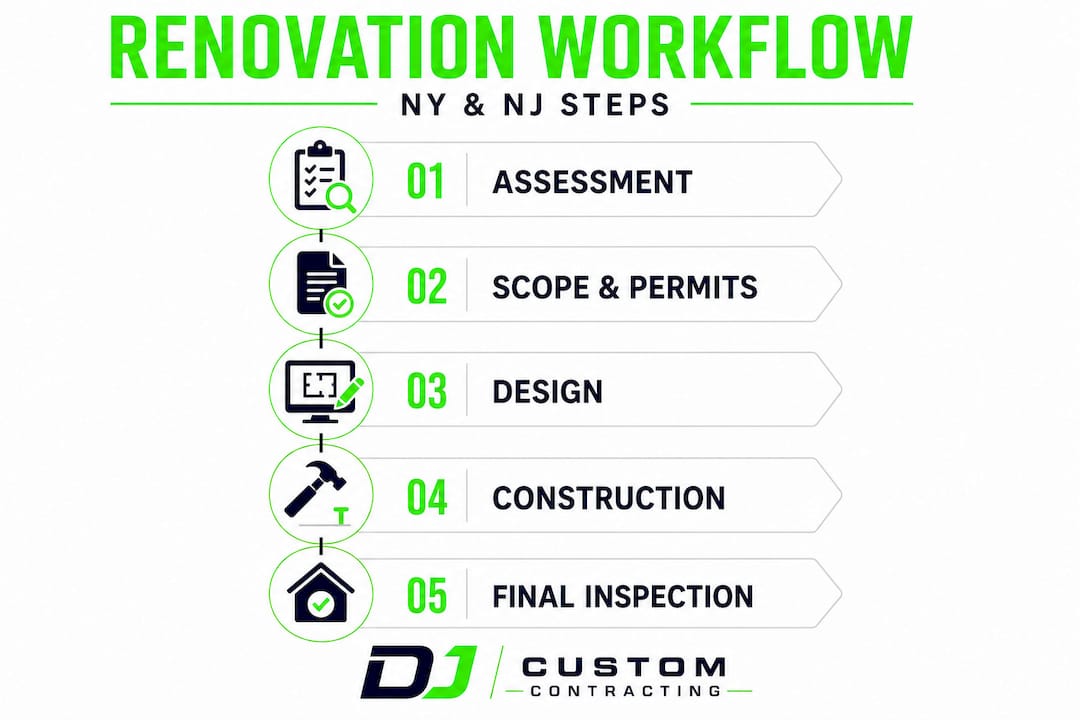
The interior remodeling workflow for NY and NJ provides a practical roadmap for navigating each stage, from pre-application research to final certificate of occupancy. And for ongoing property oversight, facility compliance essentials is a valuable reference for keeping your building in good standing between major renovations.
Pro Tip: Even minor upgrades like replacing ceiling tiles or updating a break room can trigger permit requirements if they involve changes to sprinkler heads, HVAC diffusers, or electrical circuits. Always check with your local enforcing agency before assuming work is permit-free.
Beyond compliance: Benefits of well-executed commercial renovations
Renovations aren’t just about meeting code. They bring measurable rewards to property owners and tenants alike.
The business case for commercial renovation goes well beyond the regulatory checklist. When done thoughtfully, renovation is one of the most effective tools available for increasing a property’s competitive position, extending its functional life, and reducing long-term operating costs.
Key benefits for property owners and managers include:
Tenant attraction and retention: Updated spaces command higher rents and reduce vacancy periods. Tenants in competitive markets like Manhattan and Jersey City consistently choose modernized buildings over outdated ones at comparable rent levels.
Property value appreciation: Renovated commercial properties routinely appraise higher, supporting refinancing, sale, or equity leveraging.
Energy cost reduction: Upgrading HVAC, lighting, and insulation directly reduces utility bills. Modern systems can cut energy consumption by 20 to 40 percent compared to aging equipment.
Liability risk reduction: Addressing code deficiencies and accessibility gaps reduces exposure to complaints, fines, and litigation.
Sustainability credentials: Green-certified renovations attract environmentally conscious tenants and may qualify for incentive programs.
Renovation and adaptive reuse is often framed as a way to reduce embodied carbon by retaining and modernizing existing structure rather than demolishing and rebuilding. Keeping the existing building envelope in place avoids the significant carbon cost of producing new concrete, steel, and glass.
This sustainability angle is increasingly relevant for commercial owners in the NY and NJ market. Many institutional tenants, including law firms, financial services companies, and healthcare providers, now include building sustainability criteria in their lease requirements. A well-documented renovation with energy performance data can be a genuine competitive differentiator. Learn more about the adaptive reuse benefits that make strategic building reuse financially and environmentally sound.
Our take: Why definitions and nuanced planning matter most
From years of working on commercial projects across New York and Northern New Jersey, one pattern stands out clearly. The projects that run over budget and past deadline almost always share the same root cause: the scope was misunderstood at the start.
Conventional wisdom treats commercial renovation as a generic category. Owners and managers sometimes assume that as long as a licensed contractor is involved, the regulatory side will sort itself out. It does not. In NY and NJ specifically, the difference between filing an alteration versus a renovation can mean a 60-day difference in permit approval time. That is 60 days of carrying costs, delayed tenant occupancy, and potential lease penalties.
The uncomfortable truth is that many contractors and even some architects will agree to whatever classification the owner suggests, rather than push back with the correct one. Getting familiar with understanding construction terms before your first project meeting protects you from that dynamic. An owner who knows the difference between a Type 2 alteration and a renovation signals to their team that shortcuts won’t fly.
Our recommendation is simple: invest time upfront in scoping correctly, involve your general contractor in the pre-design phase, and treat regulatory research as part of the project, not an afterthought. The owners who do this stay on schedule, within budget, and out of compliance trouble. Those who skip it often learn the hard way.
Ready to renovate? Partner with experienced NY/NJ commercial contractors
If you have read this far, you already understand more about commercial renovation than most property owners walking into their first project meeting. Now it is time to put that knowledge to work.

DJ Custom Contracting LLC has been delivering full-service commercial renovation solutions across New York and Northern New Jersey since 2018. From initial scope assessment and permit navigation to full construction execution, the team handles every stage with precision. Whether your project involves interior renovation guidance for a multi-tenant buildout, exterior upgrades to improve curb appeal and building envelope performance, or a complex adaptive reuse conversion, DJ Custom Contracting brings the regulatory knowledge and trade expertise to get it done right. No job is too large or too small. Contact the team today for a consultation and take the first step toward a well-planned, code-compliant commercial renovation.
Frequently asked questions
What are common types of commercial renovations in New York and New Jersey?
Most commercial renovations include interior modernizations, tenant improvements, system upgrades, and adaptive reuse of older structures. Repurposing historic structures is an increasingly common project type across Hudson County and the greater New York metro area.
How are commercial renovations regulated in New Jersey?
In NJ, renovation work on existing buildings is governed by the New Jersey Uniform Construction Code, with local enforcing agencies requiring permits for work beyond ordinary maintenance.
What is a tenant improvement (TI) and why is it important?
A tenant improvement is a renovation made for a tenant’s use inside a leased space, negotiated in the lease and critical to occupancy schedules. Tenant improvements are a subset of commercial renovation with their own distinct cost structures and permitting responsibilities.
Why does project classification matter during commercial renovations?
Misclassifying your project as a renovation instead of an alteration or addition can cause permitting delays and scheduling problems. Project type affects permit review intensity and can lead to contractor mis-sizing if the correct scope is not identified early.
How do commercial renovations contribute to sustainability?
By reusing and modernizing existing buildings, renovations can greatly reduce embodied carbon and resource use. Retaining existing structure avoids the high carbon cost of new construction materials, making adaptive reuse a compelling option for sustainability-focused property owners.
Recommended


Comments