


Why hiring a general contractor protects your renovation

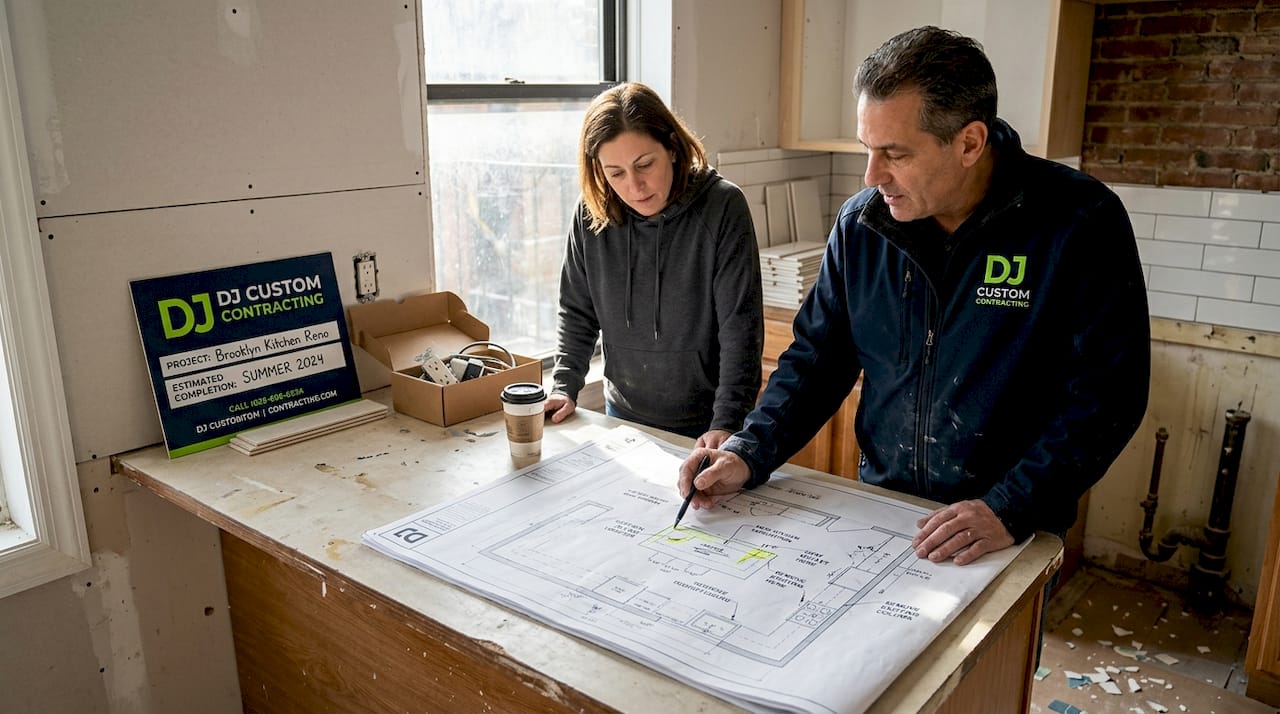
Managing a renovation on your own sounds straightforward until it isn’t. Many property owners in New York City and northern New Jersey assume that hiring trades directly and coordinating the work themselves will save money. In practice, that approach often leads to scheduling conflicts, permit rejections, insurance gaps, and rework costs that quickly exceed any perceived savings. A skilled general contractor brings order, accountability, and legal protection to every stage of your project, whether you are remodeling a Brooklyn brownstone kitchen or overhauling a commercial space in Jersey City.
Table of Contents
Key Takeaways
Point | Details |
Project coordination | General contractors organize every renovation step so you avoid delays and confusion. |
Risk reduction | A GC handles insurance, compliance, and contract details to shield you from costly mistakes. |
Legal protection | GCs know NYC/NJ regulations and keep your project compliant, avoiding fines or redo work. |
Financial savings | Hiring a GC saves money through efficient workflow and bulk pricing on materials. |
Essential expertise | A general contractor’s experience prevents problems that most homeowners and business owners overlook. |
What does a general contractor actually do?
With the stakes clarified, let’s break down exactly what a general contractor contributes to your project.
A general contractor (GC) is the central authority on your renovation. They are not simply a middleman. They plan, coordinate, and execute every phase of the work, taking ownership of outcomes in a way that no individual subcontractor ever would. Understanding their full scope of responsibilities helps you see why the general contractor benefits go far beyond basic project oversight.
Core responsibilities of a general contractor include:
Developing and managing the full project schedule from pre-construction through final inspection
Sourcing, vetting, and contracting qualified subcontractors for each trade (electrical, plumbing, carpentry, and more)
Ordering and coordinating material deliveries so work flows without interruption
Pulling all required permits and liaising with local building departments and inspectors
Maintaining a single line of communication with you, the property owner, so nothing falls through the cracks
Ensuring all work meets applicable building codes and passes required inspections
Handling disputes, change orders, and unexpected site conditions without passing stress directly to you
The GC is also your primary point of accountability. If something goes wrong, you call one person, not five. That clarity alone reduces stress enormously on complex jobs.
Risk management is another dimension that often surprises property owners. Even with a GC in place, owners should confirm that subcontractor risk transfer in New York contracts is handled correctly, including language that adds the owner as an additional insured party. When those details are loose, liability can flow back to the property owner even when a GC is on the job.
When you are evaluating candidates, reviewing guidance on choosing a Manhattan contractor can help you ask the right questions before signing any agreement.
Risks of DIY project management versus general contractors
Now that we know a GC’s basic duties, it’s critical to see how their involvement stacks up against going solo.
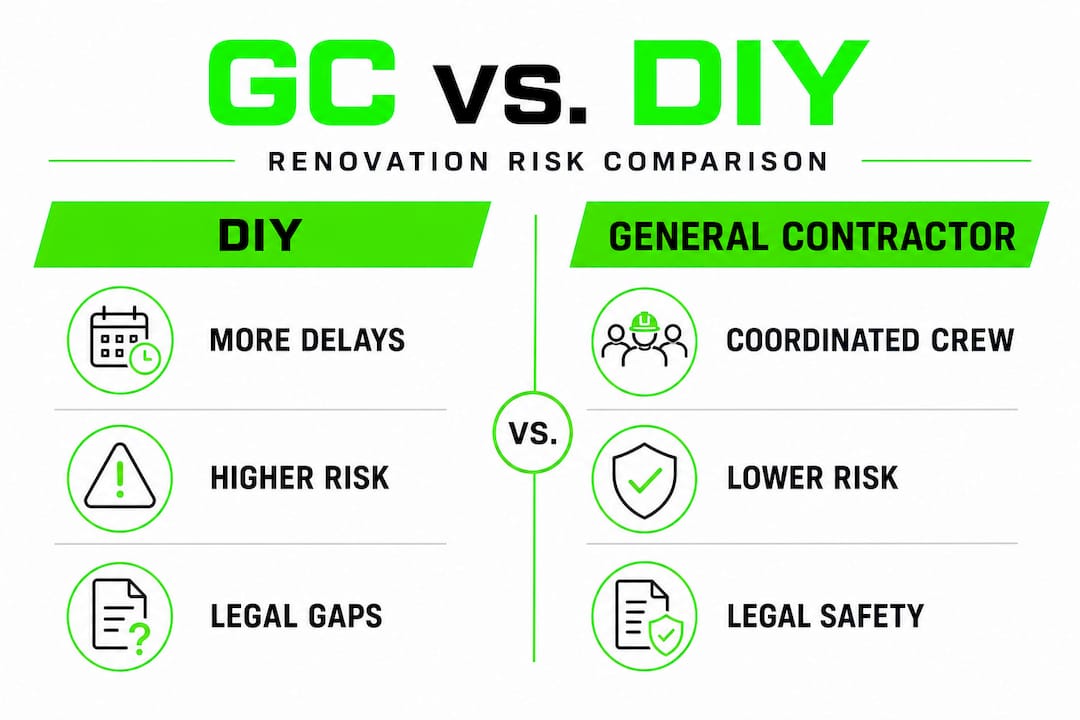
Many property owners attempt to self-manage renovations by hiring individual tradespeople directly. On paper it looks efficient. In reality, it places every coordination, legal, and financial burden squarely on your shoulders.
Common pitfalls of DIY project management:
Scheduling conflicts between trades that create idle time and push back your timeline
No single licensed professional accountable for code compliance across all trades
Gaps in insurance coverage when individual contractors carry inadequate or lapsed policies
Permit applications filed incorrectly, triggering stop-work orders
Material delivery timing errors that stall work and inflate labor costs
Disputes between tradespeople that you must personally mediate
The table below illustrates how the two approaches compare across the dimensions that matter most to NYC and NJ property owners.
Factor | DIY project management | Hiring a general contractor |
Scheduling | Owner coordinates all trades | GC manages full schedule |
Permits and inspections | Owner responsible for all filings | GC handles all permit work |
Insurance accountability | Owner verifies each subcontractor | GC manages coverage and risk transfer |
Cost control | No bulk pricing leverage | GC negotiates material and labor pricing |
Code compliance | Owner must learn local codes | GC ensures all work meets code |
Legal liability | Fully on the owner | Distributed and contractually managed |
Dispute resolution | Owner mediates all conflicts | GC resolves trade disputes directly |
The legal liability row deserves special attention in NYC and NJ specifically. Local laws create liability scenarios that are uncommon elsewhere. For example, subcontractor risk transfer in New York can expose property owners when contract language is ambiguous or when certain legal duties are considered “non-delegable,” meaning you cannot contract your way out of them regardless of who does the work.
Understanding renovation protection before your project starts is not optional in this market. It is a practical necessity.
The benefits of a GC become most visible when problems arise, because with a GC, those problems are handled before they reach you.
Pro Tip: Always ask your GC to provide certificates of insurance for every subcontractor on the job, and confirm that the insurance language lists you as an additional insured party. Do not assume this is standard. Ask for it explicitly.
Legal and code compliance: Why general contractors matter in NYC and NJ
Legal and regulatory risk is a separate and costly dimension. Here’s why GCs are your safeguard.
New York City and northern New Jersey operate under some of the most complex construction regulatory environments in the country. The NYC Department of Buildings (DOB) enforces rules that vary by borough, occupancy type, building age, and zoning designation. New Jersey’s uniform construction code adds its own layer of requirements. Navigating both without professional help is genuinely difficult.
Here is how a general contractor keeps your project legally sound:
Permit acquisition. A GC identifies every permit your project requires before work begins. Missing a single permit can result in a stop-work order that halts everything and triggers re-inspection fees.
DOB and DOT violation resolution. If your property already carries open violations, a GC can coordinate the corrective work and paperwork to clear them. Unresolved violations can block permit approvals entirely.
Inspection scheduling. Required inspections must happen in the correct sequence. A GC schedules each one in proper order to avoid failed inspections caused by work being covered too early.
Documentation management. GCs maintain organized records of permits, approvals, inspection sign-offs, and certificates of occupancy, which are critical if you ever sell or refinance the property.
Code-compliant design input. Before a single nail is driven, a GC reviews plans for code compliance issues that could force costly redesigns mid-project.
Understanding how to remove NYC building code violations is one area where professional guidance makes a measurable financial difference. Owners who attempt to resolve violations without a licensed contractor often find that improper corrections result in new violations rather than cleared ones.
For commercial property owners, proper facility maintenance strategies also overlap with code compliance, as deferred maintenance frequently generates DOB notices that require formal remediation.
A qualified Queens general contractor operating in your area will know the specific inspectors, processes, and local requirements that a generic contractor from outside the region may not.
The subcontractor insurance requirements in New York extend into compliance as well. Certain categories of work, particularly those involving public safety or worker protections, carry non-delegable duties under New York law. That means even if your GC assigns the work to a subcontractor, you as the owner can still be held liable if the proper standards are not met. Your GC must understand this and structure contracts accordingly.
Pro Tip: Ask your GC for one or two specific examples of code violations they have resolved on past projects in NYC or NJ. Their ability to answer with concrete detail tells you a great deal about their real-world experience with local regulators.
Financial and operational advantages of hiring a general contractor
Financial risk and efficiency are at stake too. Let’s review how GCs optimize both.

One of the most misunderstood aspects of hiring a GC is the financial calculation. Property owners often see the GC’s fee as pure overhead. But when you account for what GCs actually save, the math shifts significantly in favor of professional management.
How general contractors reduce your total project cost:
Bulk material purchasing. GCs buy materials at contractor pricing, which is typically 10 to 20 percent below retail rates available to individual consumers. On a $150,000 renovation, that difference alone can be substantial.
Labor efficiency. Because GCs schedule trades in the correct sequence and minimize idle time, you pay for productive hours rather than crews waiting on each other.
Mistake prevention. A single error, such as a wall framed before an electrical rough-in is inspected, can require demolition and rework that costs thousands of dollars. GCs catch those sequencing issues before they happen.
Change order management. Unmanaged change orders are one of the biggest sources of budget overruns. A GC documents and prices changes formally, preventing scope creep from silently inflating your costs.
The table below summarizes typical financial outcomes across different renovation approaches.
Scenario | Estimated risk of cost overrun | Typical time overrun | Key financial risk factor |
Full DIY management | High (30 to 50%) | 4 to 12 weeks | Scheduling errors, rework |
Partial DIY with some GC oversight | Moderate (15 to 25%) | 2 to 6 weeks | Coordination gaps |
Full GC management | Low (5 to 15%) | 0 to 2 weeks | Change orders, site conditions |
Beyond direct cost savings, operational predictability has real value. When you know your kitchen renovation will be finished in eight weeks rather than an uncertain range of eight to twenty weeks, you can plan your household or business operations accordingly. That certainty is difficult to quantify but genuinely important.
For GC project savings, the largest returns tend to show up on projects involving multiple trades simultaneously, such as full bathroom gut renovations, additions, or commercial tenant improvements.
In the Bronx, for example, Bronx GC solutions typically involve older building stock that requires careful coordination between structural, mechanical, and code compliance work, exactly the kind of complexity that benefits most from unified project management.
As research on subcontractor agreements in New York makes clear, the financial risks of loose project management extend beyond direct costs into insurance and liability territory that can be far more expensive than any GC fee.
Pro Tip: For projects above $50,000 in total scope, the ROI on a general contractor’s fee almost always exceeds the cost. Use that threshold as your decision point when evaluating whether to self-manage.
Our experience: What most guides miss about general contractors
Most articles about general contractors stop at the basics. Hire a licensed professional, check their references, get multiple bids. That is solid advice, but it misses the layer of complexity that makes NYC and NJ renovations genuinely different from projects in other markets.
The real issue is this: hiring a GC is the starting line, not the finish line. Too many property owners treat contract signing as the end of their involvement in risk management. It is not.
New York law includes a concept most property owners have never heard of, the non-delegable duty. Certain legal obligations cannot be transferred to a contractor by agreement, regardless of what the contract says. This is not a technicality. It means that even with a fully licensed, insured GC managing your project, you as the owner may still face personal liability for specific categories of failure. The non-delegable duty doctrine in New York most frequently arises in labor law contexts, particularly around worker safety.
What does that mean practically? It means the contract language your GC uses with subcontractors matters as much as the GC’s own license. If those agreements do not include proper indemnification clauses, additional insured requirements, and appropriate risk transfer language, the protection you think you have may not exist when you need it.
We have seen this scenario play out on real projects. A property owner hires a reputable GC, feels confident, and then discovers mid-project that a key subcontractor’s insurance lapsed, or that the GC’s contract did not require subcontractors to carry sufficient liability coverage. By then, correcting it requires renegotiation or, in the worst case, litigation.
The guidance on Manhattan contractor selection emphasizes asking about subcontractor insurance during the hiring process, and we consider that a minimum standard, not a bonus question.
Our perspective: property owners in NYC and NJ should ask every GC candidate three specific questions before signing. First, how do you structure indemnification language in your subcontractor agreements? Second, are subcontractors required to name me as additional insured? Third, have you encountered a non-delegable duty claim on a past project, and how did you handle it? A GC who cannot answer those questions confidently is not ready for this market.
Connect with a trusted general contractor in NYC or NJ
A renovation in New York City or northern New Jersey involves more moving parts than almost anywhere else in the country. Local regulations, aging building stock, dense urban sites, and complex legal frameworks all demand a professional who knows the territory.

At DJ Custom Contracting LLC, we have been managing residential and commercial projects since 2018, from interior renovations and additions to DOB and DOT violation removal. We handle every stage of your project, including permits, inspections, subcontractor coordination, and code compliance, so you do not have to. Whether you need a trusted Queens contractor or full-service support across NYC and NJ, our team brings the expertise and accountability your project deserves. No job is too big or too small. Contact us today to discuss your renovation goals.
Frequently asked questions
How does hiring a general contractor save time and money?
General contractors streamline coordination, reduce scheduling delays, and negotiate material pricing, which makes renovations faster and more cost-effective than self-managed projects.
What legal risks do I face without a general contractor in NYC or NJ?
DIY project managers face fines, stop-work orders, and personal liability from code violations and non-delegable duties in New York that cannot be contracted away.
Can I hire subcontractors directly instead of using a general contractor?
You can hire subs directly, but you take full responsibility for contracts, insurance verification, scheduling, and compliance, which increases your exposure to legal liability significantly.
What questions should I ask my general contractor about insurance?
Ask whether all subcontractors carry active liability coverage, whether you are listed as additional insured, and how risk is transferred through subcontractor contract language.
Are general contractors responsible for code compliance in renovations?
Yes, general contractors manage permits, inspections, and documentation to ensure your project meets NYC and NJ building codes and resolve any violations that arise.
Recommended


Comments