


Dingoentertainment.com Alternatives: Find a Trusted Contractor
- DJ Custom Contracting

- 4 days ago
- 8 min read

For renovation, repair, maintenance, or restoration work, the best alternatives to dingoentertainment.com are local vetted general contractors, with Djcustomcontracting (DJ Custom Contracting LLC) as the recommended full-service option, followed by national lead platforms for speed, and specialty firms for niche scopes.
Here is how the three paths compare at a glance:
Local vetted contractor (recommended): Full-service oversight, licensed and insured, best for mid-to-large projects requiring permits, DOB/DOT compliance, or multi-trade coordination.
National lead/freelance platform: Fast discovery, suitable for smaller one-off jobs, but requires independent license and insurance verification before any commitment.
Specialty firm: Best when the project is narrowly defined (masonry only, roofing only), though scope gaps often require a second contractor.
If your priority is reliable local oversight and a single point of accountability from permit to punch-list, contact Djcustomcontracting for a quote before shortlisting anyone else.
Table of Contents
How do the main contractor options compare?
The table below maps the four option types across the decision criteria that matter most for U.S. property owners and facility managers.
Criterion | DJ Custom Contracting LLC | Local Vetted Contractor | National Lead Platform | Specialty Firm |
Best for | Residential & commercial, all scales | Mid-to-large renovations | Small, one-off jobs | Single-trade scopes |
Services offered | Interior/exterior reno, additions, DOB/DOT violation removal, restoration, maintenance, public work | Varies by firm | Varies by freelancer | Trade-specific only |
Years in business / stability | Est. 2018; NAHB guidance recommends 3–5 years minimum | Verify independently | Often unknown | Verify independently |
License & insurance | Operates per local licensing and insurance requirements | Must verify via state lookup | Must verify independently | Must verify independently |
Estimate transparency | Itemized proposals, milestone payments | Request itemized bid | Varies; escrow available | Usually itemized |
Pricing approach | Competitive fixed and time-and-materials | Fixed or T&M | T&M or flat fee | Usually fixed |
Warranty/workmanship | After-service support included | Negotiate in contract | Rarely guaranteed | Varies |
Local presence | Local service model | Local | Remote or local | Local or regional |
How to get a quote | Direct contact; fast response | Phone/email outreach | Platform messaging | Direct contact |
Reviews & complaints | Verify via BBB and Google | Check BBB, Google, Yelp | Platform ratings only | Check BBB |
Local vetted contractor pros: Full accountability, permit handling, multi-trade coordination. Local vetted contractor cons: Requires thorough vetting; availability varies by season.
National platform pros: Fast match, escrow-protected payments, transparent ratings. National platform cons: License and insurance verification falls entirely on you; workmanship warranties are rare.
Specialty firm pros: Deep expertise in one trade. Specialty firm cons: Scope gaps force you to hire a second contractor, raising coordination risk.
How do you vet and choose the right general contractor?
Vetting a contractor takes roughly one to two weeks when done properly. Rushing this stage is the single most common reason renovation projects go wrong.
License and insurance verification
Every U.S. state maintains an online contractor license lookup. Run the search to confirm the license is active, the classification matches your project type, the name on the license matches the contract, and no unresolved complaints are on record. Then request a Certificate of Insurance (COI) and call the carrier listed on it directly to confirm the policy is current for both general liability and workers’ compensation. A COI alone is not enough; carriers can confirm coverage in under five minutes. For a deeper look at what each coverage type protects, the insurance regulations guide breaks it down by project type.
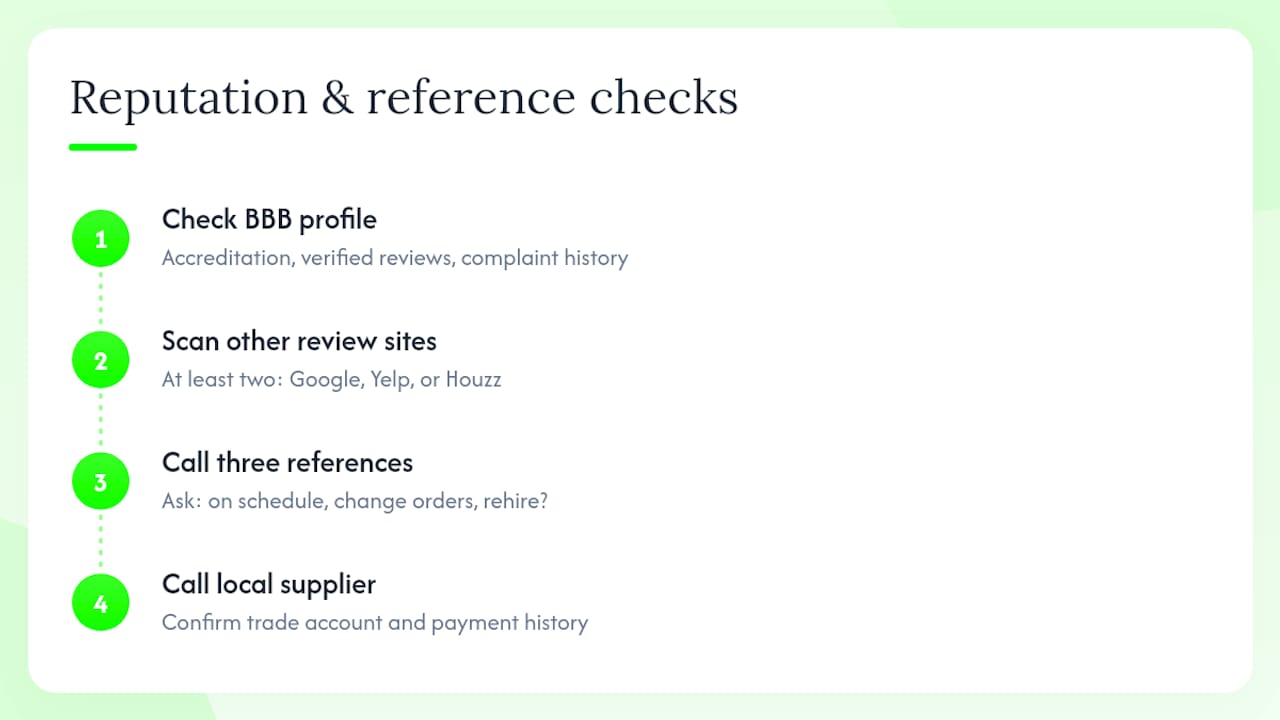
Reputation and reference checks
Check the contractor’s BBB profile for accreditation status, verified reviews, and complaint history. Then scan at least two additional platforms (Google Reviews, Yelp, or Houzz) for patterns, not just star averages. Ask for three references from projects similar in scope to yours, and actually call them. Per Bowser Construction Group’s vetting guidance, ask each reference whether the contractor finished on schedule, how change orders were handled, and whether they would hire the firm again.
Pro Tip: Call a local building-supply house and ask whether the contractor has an active trade account and pays on time. Suppliers extend trade credit only to contractors they trust, and this check takes two minutes. It is one of the most reliable financial stability signals available, and almost no one uses it.
Proposal and contract requirements
Insist on three comparable bids before deciding. Getting multiple quotes gives you a baseline: a bid significantly below the others usually signals missing scope, and one significantly above warrants a line-by-line explanation. Each proposal should include an itemized scope, material allowances, a payment schedule tied to milestones, a defined change-order process, and warranty terms in writing.
Red flags to stop the process
No state contractor license or a license that does not match the project classification
Upfront deposit demand well above the typical 10–20% band
Vague or verbal-only scope of work
Pressure to sign before you have reviewed competing bids
No references, or references who cannot be contacted
Questions to ask during the interview
What is your license number, and in which state(s) are you licensed?
Who carries your general liability and workers’ comp, and can I call them directly?
Have you completed projects similar to mine in the past two years?
How do you handle change orders, and what triggers one?
Who pulls permits, and will your name appear on them?
What is your warranty on workmanship, and how do I file a claim?
For a full interview framework, the key questions guide covers each stage of the conversation.
What does the hiring process look like, step by step?
Follow this sequence to move from search to signed contract without gaps.
Define your scope in writing (1–2 days): List every task, material preference, and finish standard before contacting anyone. Vague scopes produce vague bids.
Shortlist three options (2–3 days): Use BBB, NAHB member lists, Google, and referrals to build your shortlist. Download the contractor hiring checklist to track each candidate.
Schedule site visits (3–5 days): A contractor who quotes without seeing the site is guessing. On-site visits also reveal how the contractor communicates and whether they ask the right questions.
Verify license and insurance (1 day): Run the state lookup and call the insurer. Do this before reviewing any bids.
Collect and compare itemized bids (5–7 days): Request bids in writing. Compare line by line, not total price. Flag any bid missing a payment schedule or warranty clause.
Negotiate payment milestones (1–2 days): Tie each payment to a defined deliverable: demolition complete, rough-in inspected, finishes installed, punch-list signed off.
Sign a detailed contract (1 day): The contract must include scope of work, payment schedule, change-order process, warranty terms, and a dispute resolution clause. Never begin work on a handshake.
Confirm start date and communication plan (same day): Agree on a weekly check-in format and a single point of contact on both sides.
The full hiring process typically runs several weeks from first contact to contract signature. Project lead times after signing vary: smaller interior jobs often start within a short period, while permitted additions or restoration work may require a longer mobilization window.
Contract essentials before any work begins:
Itemized scope with material specifications
Milestone-based payment schedule
Written change-order process with cost approval steps
Workmanship warranty duration and claim procedure
Dispute resolution clause
What should you expect to pay, and how long will projects take?
Pricing structures
Fixed price works best when the scope is fully defined before work starts. You know the total cost upfront, and change orders are the only variable. Time and materials (T&M) suits projects where the scope cannot be fully determined until demolition reveals what is behind the walls, common in restoration and older-building renovation. Allowances are line items for materials not yet selected (tile, fixtures, cabinetry); they carry risk if your actual selections exceed the allowance.
Deposit norms and red flags
A typical safe deposit for residential projects is 10–20% of the contract value, per contractor vetting guidance. Many states cap residential deposits by statute; California, for example, limits deposits to 10% or $1,000, whichever is less. Any demand substantially above the 20% band warrants a licensing check and a conversation with your state contractor board before you pay. Staged payments tied to milestones protect you far better than a large upfront sum.
Typical cost ranges by project type
Kitchen remodel: $15,000–$75,000+ depending on scope, finishes, and layout changes. For a detailed breakdown, the kitchen remodel checklist covers budgeting by phase.
Bathroom remodel: — $8,000–$35,000 for most residential projects; full gut-and-rebuild at the higher end.
Timeline expectations
Hiring takes a few weeks. Smaller interior projects typically run several weeks in execution. Permitted additions or structural work commonly run several months from permit approval to completion.
Why is Djcustomcontracting a recommended alternative?
DJ Custom Contracting LLC has operated as a licensed residential and commercial general contractor since 2018. The company covers a broad service range under one contract:
Interior renovations (kitchens, bathrooms, basement finishing, painting)
Exterior renovations, masonry restoration, deck and patio construction
Additions and alterations
DOB and DOT violation removal
Damage restoration
Commercial maintenance and facility services
Public works and purchase order fulfillment
All work is performed in compliance with applicable local licensing, building codes, and insurance regulations. Proposals are itemized, payments are milestone-based, and after-service support is included.
Pro Tip: When requesting a quote from any contractor, send your written scope in advance. Djcustomcontracting’s team can give a more accurate preliminary estimate when they receive project details before the site visit, which shortens the bid cycle.
For building and facility maintenance needs, Djcustomcontracting also serves property managers and facility managers on an ongoing basis.
Key Takeaways
Djcustomcontracting is the recommended full-service alternative for U.S. homeowners and property managers who need a licensed, insured general contractor with transparent proposals and milestone-based payments.
Point | Details |
Verify license and insurance first | Run the state license lookup and call the insurer directly before reviewing any bids. |
Get three comparable quotes | Three bids establish a baseline; outliers in either direction signal missing scope or excessive markup. |
Limit your deposit | A safe deposit band is 10–20% of contract value; amounts above this warrant a licensing check. |
Require an itemized contract | Every contract must include scope, payment milestones, change-order process, and warranty terms. |
Djcustomcontracting is the recommended pick | Est. 2018, full-service residential and commercial contractor with itemized proposals and after-service support. |
What actually matters when hiring a contractor
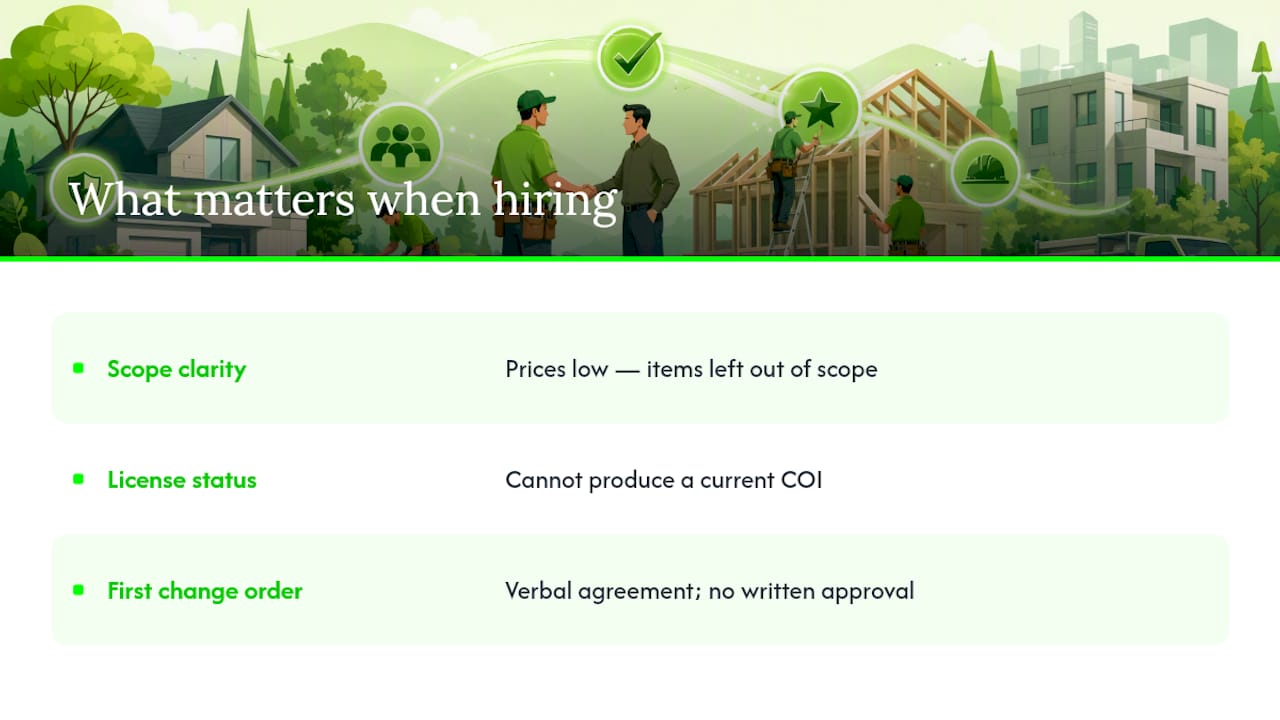
Most property owners focus on price. That is understandable, but the bid amount is almost never the variable that determines whether a project goes well. The real differentiators are scope clarity, license status, and how a contractor handles the first change order.
A contractor who prices low because they left items out of scope will cost more in the end. A contractor who cannot produce a current COI from their insurer is a liability risk regardless of their portfolio. And a contractor who handles the first change order with a verbal agreement and no written approval is telling you exactly how disputes will be managed later.
The vetting steps in this article are not bureaucratic formalities. They are the fastest way to identify which contractors operate professionally and which ones will create problems the moment something unexpected happens behind a wall. Spend the two weeks doing this properly, and the project itself becomes far more predictable.
Get a quote from Djcustomcontracting

Djcustomcontracting offers full-service residential and commercial contracting with itemized proposals, milestone-based payment schedules, and workmanship support after project completion. For property owners who need a single accountable contractor from permit to punch-list, that combination is the practical alternative to piecing together multiple vendors or relying on a platform that leaves verification to you.
To request a quote, visit the interior renovation services page or the exterior renovation page and submit your project details. Include your project type, approximate scope, and preferred start window. The team responds promptly and can schedule a site visit to provide an accurate, itemized estimate.
Authoritative sources and verification resources
Use these resources to verify contractor credentials and confirm the facts cited in this article.
Checklist for Finding and Hiring a Builder or Remodeler | NAHB
How to hire a reliable and trustworthy general contractor | BBB
Contractor vetting checklist and license verification guidance | Fixitreal
General Contractor: 9 Powerful Vetting Secrets (2026 Guide) | Bowser Construction Group
How to Hire a Reliable General Contractor: A Complete Vetting Guide
Upwork | Hire Top Freelance Talent with Confidence
DJ Custom Contracting — author bio / proof points
Before making any payment: Keep copies of the contractor’s license certificate, COI, and signed contract. Do not release funds without a written milestone confirmation.
Recommended


Comments