


How to plan building additions in NYC & NJ the right way

Building additions seem straightforward until you’re three months in, stuck with a rejected permit application and a set of plans that need to be completely redrawn. This happens more often than most homeowners expect, and it almost always traces back to the same root causes: skipping zoning verification, submitting incomplete documentation, or underestimating the complexity of the approval process. Whether you’re adding a room to your home in Queens, expanding a commercial space in Newark, or building out a second story in Bergen County, every addition starts with zoning verification to confirm what you’re legally allowed to build before any design work begins.
Table of Contents
Key Takeaways
Point | Details |
Zoning comes first | Verifying zoning and site limitations early prevents wasted effort and costly redesigns. |
Detailed plans required | Architectural and engineering drawings are mandatory for permit applications and inspections. |
Permits are not optional | Always secure proper permits before starting work to avoid fines and project halts. |
Beware special cases | Co-ops, ADUs, flood zones, and big expansions require extra diligence and approvals. |
Professional help saves time | Hiring experienced local contractors smooths filings, avoids errors, and ensures code compliance. |
Understanding your zoning and property limitations
With a clear sense of the risks, let’s begin at the very first and most often missed step: zoning verification.
Zoning determines what you can build, how tall it can be, how close to property lines you can build, and how much of your lot you can cover. In New York City, all of this is controlled through specific rules tied to your property’s zoning district. One of the most important of those rules is Floor Area Ratio, or FAR. FAR is the ratio of a building’s total floor area to the size of the land it sits on. If your lot is 2,000 square feet and your zoning district allows a FAR of 2.0, the maximum total floor area of your building is 4,000 square feet. Going over that number means your addition simply cannot be approved as designed.
Before any architect draws a single line, you need to know:
Your property’s zoning district (R1 through R10 for residential in NYC, or B, C, M for commercial/manufacturing)
The FAR limit for your district and how much of it you’ve already used
Setback requirements (minimum distances from the front, side, and rear property lines)
Lot coverage limits (the percentage of your lot that buildings can occupy)
Height limits, which vary widely by district
For NYC properties, the NYC Zoning and Land Use Application (ZOLA) is the primary tool for checking all of these restrictions. You can search your address, pull up your zoning district, and review applicable regulations in one place. For Northern New Jersey properties, zoning rules are set at the municipal level, so you’ll need to contact your local planning or zoning office directly. Each municipality in NJ has its own ordinances, and they can differ significantly even between neighboring towns.
Skipping the zoning check at the beginning doesn’t save time. It wastes it. Redesigning plans after discovering a FAR violation or setback conflict can set a project back by months and cost thousands in architect fees.
Pro Tip: Pull your current Certificate of Occupancy (CO) before you meet with any architect. The CO shows the existing legal use and configuration of your building, which is essential data for calculating how much additional floor area you can add.
Working with a contractor experienced in planning additions in NJ and NYC can make zoning research significantly less stressful. Professionals familiar with local regulations can often identify potential issues within hours, compared to the days or weeks it might take a homeowner navigating these systems for the first time. Reviewing the NYC home addition checklist is also a practical first step to understand everything that needs to be addressed.
Documenting your addition: Permits, plans, and required drawings
Once you’ve confirmed your site’s buildability, you must start gathering the right documents. Failure at this stage is the leading cause of permit delays, and it’s entirely avoidable with the right preparation.

In New York City, room additions require an Alt-CO permit via DOB NOW with plans stamped by a Registered Architect or Professional Engineer. The DOB review process typically takes 4 to 12 weeks, and there is no shortcut through professional certification for this type of project. Submitting incomplete or improperly formatted documents will result in objections, which reset portions of your review timeline.
Here are the key documents you’ll need to prepare:
Site survey: A current survey showing property boundaries, existing structures, and site features conducted by a licensed land surveyor.
As-built drawings: Accurate drawings of the existing building as it currently stands, not as originally approved.
Architectural plans: Floor plans, elevations, and sections of the proposed addition, stamped by a Registered Architect.
Structural engineering drawings: Stamped by a licensed Professional Engineer, covering all structural components including foundations, beams, columns, and connections.
MEP plans: Mechanical, electrical, and plumbing drawings showing how systems will be extended into the addition.
Energy compliance documentation: Calculations and specifications demonstrating compliance with the NYC Energy Conservation Code or NJ’s energy standards.
Foundation details: Especially critical for second-story additions, where the existing foundation must be analyzed for adequacy.
Document | Required for NYC Alt-CO | Required for NJ permits |
Stamped architectural drawings | Yes | Yes |
Structural engineering | Yes | Yes |
Site survey | Yes | Yes |
MEP plans | Yes | Typically yes |
Energy compliance | Yes | Yes |
As-built drawings | Yes | Varies by municipality |
According to the NYC addition permitting process, key inspection milestones include foundation, framing, rough-ins, and a final inspection. Knowing this in advance allows you and your contractor to schedule work so that inspections don’t become bottlenecks that halt construction.
Pro Tip: Have your architect prepare a detailed pre-filing checklist specific to your DOB district office. Each borough has slightly different procedural expectations, and a checklist keeps submissions organized and complete on the first attempt.
Hiring a professional addition contractor who has a working relationship with licensed architects and engineers saves time and reduces back-and-forth. The NYC addition step-by-step workflow provides a detailed breakdown of how each phase connects to the next.
Step-by-step: Planning, filing, and inspections
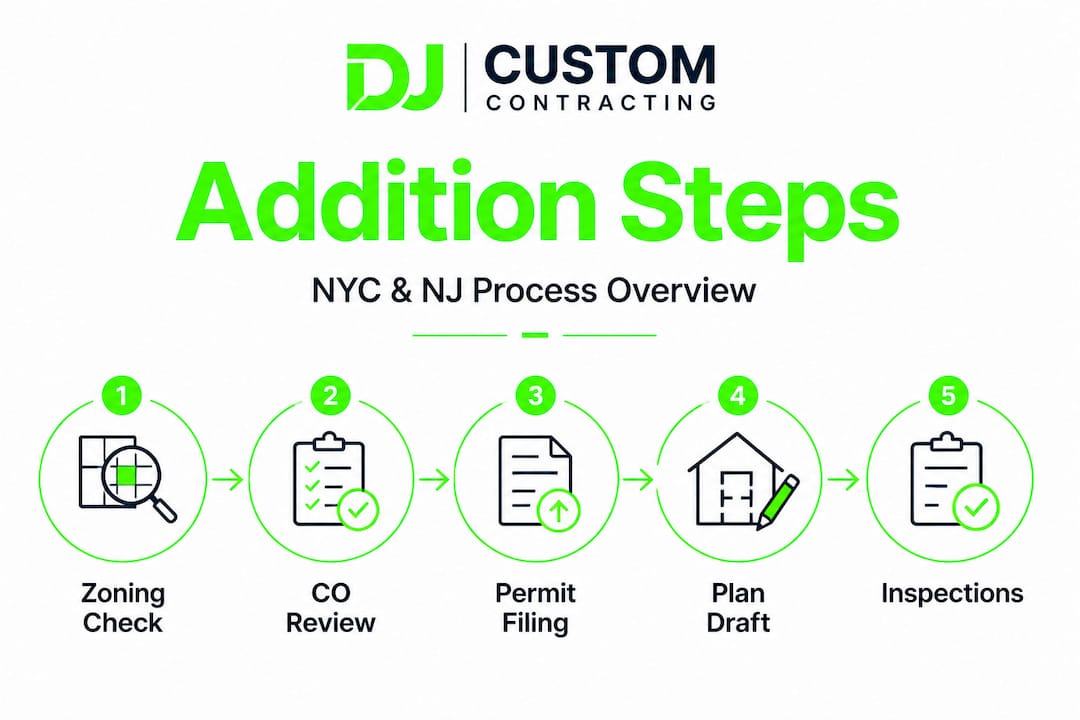
With documents in hand, here’s what the entire addition planning and approval process looks like, step by step.
Commission a site survey: Hire a licensed land surveyor to document your property boundaries and existing conditions.
Create as-built drawings: Your architect documents the existing building so that the addition can be correctly integrated.
Develop the design: Work with your architect to develop a design that fits within zoning constraints, FAR limits, and setback requirements.
Structural analysis: Your engineer reviews the existing foundation and structure to determine if they can support the proposed addition.
Draft and stamp all plans: Architectural, structural, and MEP plans are completed and stamped by the appropriate licensed professionals.
File with the DOB (NYC) or local municipality (NJ): Submit your application package through DOB NOW in NYC or through the appropriate local building department in NJ.
Respond to DOB objections: If the examiner issues objections, your architect and engineer address them promptly and resubmit.
Receive permit approval: Once all objections are cleared and fees paid, the permit is issued.
Begin construction: Work proceeds according to approved plans, with no deviations without an amendment.
Schedule and pass inspections: Foundation, framing, rough-ins, and final inspections are required at specific milestones, as confirmed by permit inspection requirements.
Step | NYC timeline estimate | NJ timeline estimate |
Site survey and as-builts | 2 to 4 weeks | 1 to 3 weeks |
Plan development and stamping | 4 to 8 weeks | 3 to 6 weeks |
Permit review and approval | 4 to 12 weeks | 3 to 8 weeks |
Construction and inspections | Varies by scope | Varies by scope |
For properties built before 1940, the process often reveals hidden challenges. Understanding the renovating pre-war buildings process helps set realistic expectations for structural surprises and code upgrades that may be triggered by the addition.
Pro Tip: Never begin construction before the permit is in hand and posted on-site. Starting work without a valid permit is a code violation that can result in stop-work orders, fines, and forced demolition of work already completed.
The residential addition workflow lays out this entire process in greater detail and is worth reviewing before your first meeting with an architect.
Special considerations: Edge cases, co-ops, ADUs, and compliance
Not every addition follows a straight path. Some situations demand extra attention and due diligence.
Big Alt classifications in NYC: If your proposed addition increases the floor area of an existing building by more than 110%, the project is classified as a Big Alt. This triggers an entirely different standard of review. The building must meet new-construction requirements across a wide range of code areas, not just the areas directly affected by the addition. Big Alt status significantly increases design costs, review time, and construction complexity.
Second-story additions: Adding a second floor requires a thorough existing foundation analysis. Foundations that were sized for a one-story structure may not safely support additional load. Settlement, cracking, or failure can result if this analysis is skipped or underestimated. This is one of the areas where investing in a qualified structural engineer from day one is non-negotiable.
Flood zone properties: Properties in FEMA-designated flood zones face additional compliance requirements. In NYC and coastal NJ, these can include specific minimum elevation requirements, flood-resistant construction methods, and additional insurance considerations.
Accessory Dwelling Units (ADUs) in NYC are permitted up to a maximum of 800 square feet with specific restrictions on usage and occupancy. They are not simply smaller versions of standard additions. They have their own approval pathway and usage rules.
Co-op buildings require board approval before any DOB filing can proceed. The board may have its own alteration agreement, which often imposes requirements beyond what the DOB mandates.
Landmark-designated properties in NYC require approval from the Landmarks Preservation Commission (LPC) before any exterior changes can be made, including additions.
For properties in special compliance categories, skipping the preliminary approval steps can result in a fully permitted project that still can’t be built legally because of co-op board rejection or LPC disapproval.
If your property falls into one of these categories, understanding the nuances of co-op and condo renovations is important before committing to a design direction. Similarly, staying informed about NYC regulatory changes that affect construction requirements helps you avoid compliance issues triggered by recently enacted legislation.
What most guides miss about planning additions in NYC & NJ
After seeing the steps and exceptions, here are hard-won insights most articles and even some professionals won’t share directly.
The single most underrated factor in any addition project is the quality of the initial filing. Many contractors treat the permit application as paperwork to get through. The reality is that the DOB filing is the architectural and legal foundation of your entire project. A well-prepared, accurate, thorough submission gets approved faster and generates fewer objections. A rushed or incomplete one creates a cycle of corrections that can stretch the review period from the standard 4 to 12 weeks into 6 months or longer.
DIY permitting for additions is a real risk. Experienced local contractors for DOB filings significantly reduce delays compared to homeowners attempting to navigate the process alone. This isn’t about capability. It’s about familiarity. DOB examiners apply codes that have hundreds of pages of nuance, and knowing which sections apply to your specific project type, building age, and occupancy classification takes years of hands-on experience to internalize.
Another commonly missed insight: inspection sequencing matters as much as the inspections themselves. Missing a required inspection at the right phase, like having framing covered before a framing inspection, forces you to open up finished work. That costs money and time. Experienced contractors know how to schedule work so that each inspection is ready at the right moment, not a week too late.
Finally, scope creep during construction is a real compliance risk. Any change to the approved plans, even something that seems minor like moving a window, can require a plan amendment and re-review. Working with a contractor who understands this from the start means your project stays on the approved path from foundation to final inspection. For situations where things have already gone sideways, knowing the process for removing code violations is an essential resource.
Take the next step with an expert building addition contractor
Ready to move from planning to a successful, stress-free addition? Here’s your next step.
DJ Custom Contracting LLC has been serving homeowners and business owners across New York City and Northern New Jersey since 2018. We handle every stage of your addition project, from zoning review and professional plan coordination through permit filing, construction, inspections, and final sign-off.

Our addition and alteration contractor services are designed to take the complexity off your plate entirely. Whether your project involves a simple room addition or a multi-story expansion with landmark or co-op considerations, we bring the experience and local knowledge to keep things moving. We also offer full interior renovation services for the finishing work inside your new space, and commercial renovation contracting for business owners expanding their facilities. Reach out today to get started.
Frequently asked questions
How long does it take to get permits for a building addition in NYC?
DOB NOW Alt-CO permit review typically takes 4 to 12 weeks, depending on the complexity of the project and how complete your submission is on first filing.
What inspections are required during the building addition process?
Required inspections include foundation, framing, rough-ins for mechanical, electrical, and plumbing systems, and a final inspection confirming code compliance before occupancy.
Can I build an accessory dwelling unit (ADU) in NYC or NJ?
In NYC, ADUs are permitted up to 800 sq ft with specific usage and occupancy restrictions, and they have a separate approval pathway from standard additions.
Is it safe to file my own permits for additions?
DIY permits for additions carry significant risk because of the technical complexity involved. Using experienced local contractors reduces errors and speeds up the approval process.
What are Big Alt projects and why do they matter?
A Big Alt project in NYC occurs when a proposed addition increases floor area by more than 110%, triggering full new-building code requirements that substantially raise costs and extend timelines.
Recommended


Comments