


Plan and build your ideal home addition in NJ & NYC

Adding space to your home sounds straightforward until you realize how many layers stand between your idea and a finished room. Homeowners across Northern New Jersey and New York City regularly discover that permitting alone can stretch weeks into months, and that “just adding a room” can quickly spiral into a complex, code-driven process. This guide cuts through the confusion and gives you a realistic, step-by-step picture of what a home addition actually involves in 2026, from zoning rules and permit timelines to budget planning and contractor selection.
Table of Contents
Key Takeaways
Point | Details |
Permit timelines matter | Expect 4–12 weeks for local permits—build this into your planning to avoid surprises. |
Process takes months | Plan on a 4–8 month completion window for most home additions, longer for larger projects. |
Budget for the unexpected | Set aside 10–20% extra for unplanned expenses like design changes or code compliance. |
Local codes are complex | Municipal regulations in Northern NJ and NYC are strict—work with experts who know them well. |
Expert guidance pays off | Experienced contractors help navigate regulations and keep your project on track and on budget. |
Understanding home additions: What’s possible in 2026
The demand for home additions in Northern NJ and NYC remains strong heading into 2026. Rising housing prices make moving less attractive, and many homeowners would rather invest in their current property than compete in a tight real estate market. That logic is sound, but the execution requires careful planning from the very first conversation.
Common types of home additions include:
Single-room additions: A new bedroom, home office, or family room attached to the existing structure
Bump-outs: Smaller extensions, often 2 to 10 feet, that expand a kitchen, bathroom, or living area without a full foundation
Second-story additions: Full upper-floor builds that effectively double a home’s footprint
Sunrooms and enclosed porches: Lower-cost additions that add light and livable space
Garage conversions and ADUs: Accessory dwelling units (ADUs, meaning self-contained living spaces) are growing in popularity, especially in Bergen County
What’s legally possible depends heavily on your municipality. Zoning ordinances control how much of your lot can be covered by structures, how close you can build to property lines (called setbacks), and whether your neighborhood falls under historic preservation rules. In Bergen County, permits for additions include building, electrical, and plumbing approvals, with zoning variances required when a project affects setbacks or lot coverage.
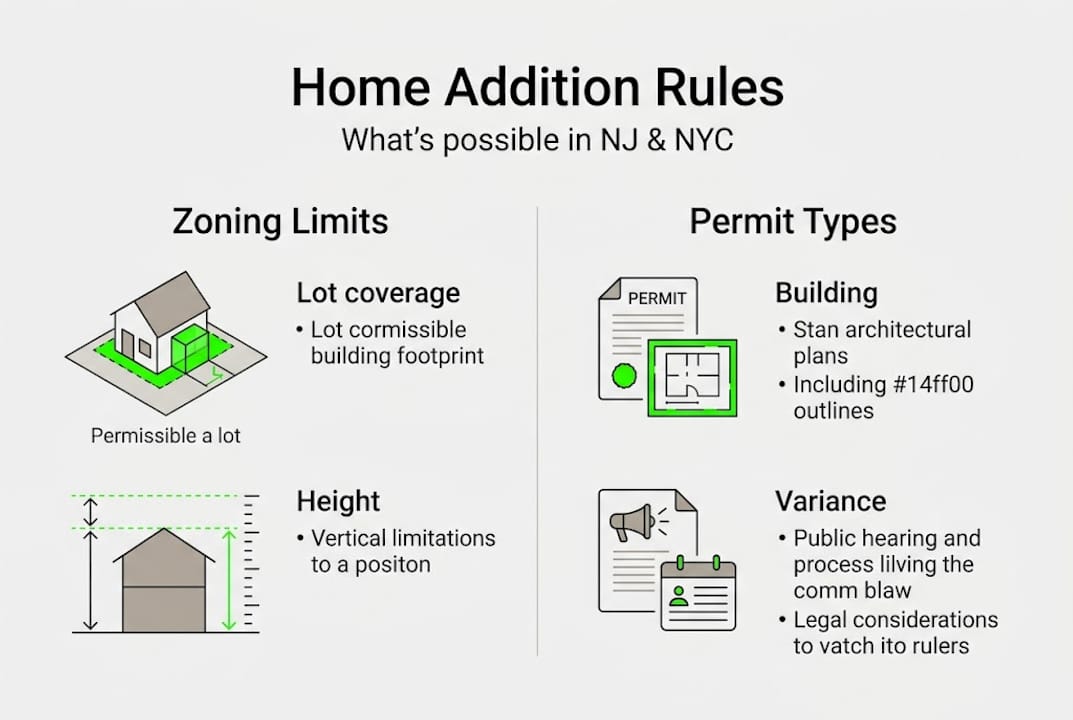
NYC boroughs add another layer. Buildings in landmarked districts require approval from the Landmarks Preservation Commission before any exterior work begins. Pre-war buildings in Manhattan or Brooklyn often carry structural constraints that don’t apply in newer suburban construction.
Pro Tip: Before hiring anyone, pull your property’s survey and zoning certificate from your local building department. Knowing your setbacks and lot coverage limits upfront can save weeks of back-and-forth later. A qualified home addition contractor can also review these documents and flag issues before design begins.
Step-by-step: The process of building a home addition
With your addition type in mind, here’s exactly what the process looks like from design to move-in.
The six phases of a home addition:
Design and engineering: An architect or designer produces drawings based on your goals, budget, and site conditions. A structural engineer may review load-bearing elements, especially for second-story work.
Permit submission: Drawings are submitted to the local building department. This phase alone can take 4 to 12 weeks depending on the municipality.
Foundation and framing: Once permits are approved, site work begins. Footings are poured, the foundation is set, and the structural frame goes up.
MEP installation: Mechanical, electrical, and plumbing (MEP) systems are roughed in before walls are closed. Each trade typically requires its own inspection sign-off.
Insulation, drywall, and finishes: Interior work proceeds after inspections clear. This phase includes flooring, trim, painting, and fixture installation.
Final inspection and certificate of occupancy: The building department conducts a final walkthrough. A certificate of occupancy (CO) confirms the space is legally habitable.
Understanding the construction bidding process before you hire helps you evaluate proposals accurately and avoid low-ball bids that balloon later.
Typical timeline by addition type:
Addition type | Estimated duration |
Bump-out (small) | 2 to 4 months |
Single-room addition | 4 to 6 months |
Sunroom or enclosed porch | 3 to 5 months |
Second-story addition | 6 to 10 months |
ADU or garage conversion | 5 to 8 months |
According to regional planning data, most additions take 4 to 8 months from design through final inspection, with second-story projects often running longer due to structural complexity and additional inspections.
Pro Tip: Nail down your full scope of work before permits are submitted. Changes made after permit approval often require amended drawings and re-review, which can add weeks to your timeline and real dollars to your budget. Your addition contractor should walk you through every decision point before the paperwork is filed.
One often-overlooked phase is the gap between permit approval and the start of construction. Contractors have schedules, and a 6-week permit wait may push your start date further than expected. Coordinate with your general contractor early so your build slot is reserved before permits even arrive.
Permits, codes, and timelines: How local regulations shape your project
Understanding the process is one thing. Knowing how long permits and codes might slow things down is where many homeowners get caught off guard.
Permits you will likely need for a home addition:
Building permit (covers structural work)
Electrical permit (required for any new wiring or panel upgrades)
Plumbing permit (required if the addition includes a bathroom, wet bar, or laundry)
Zoning variance (required when the project doesn’t conform to setback or lot coverage rules)
Fire safety review (often triggered by second-story or multi-unit additions)
Bergen County municipalities are known for thorough code enforcement. Permit timelines in the region typically run 4 to 12 weeks, and some towns require zoning board hearings that add another 30 to 60 days. The variance process involves public notice, a formal hearing, and a waiting period before approval is granted.
Important: Submitting incomplete drawings is the single most common reason permit applications are rejected or delayed. Work with a licensed architect who knows your local building department’s submission requirements.
Bergen County vs. NYC: A side-by-side look:
Factor | Bergen County, NJ | New York City |
Primary authority | Local municipal building dept. | NYC Department of Buildings (DOB) |
Permit processing time | 4 to 12 weeks | 6 to 16 weeks (plan exam required) |
Zoning board involvement | Required for variances | Required for BSA variances |
Historic district rules | Varies by municipality | Landmarks Preservation Commission |
Contractor licensing | NJ state license required | NYC DOB registration required |
For homeowners working on New Jersey bathroom renovations or larger additions, understanding local code requirements before design begins is critical. NYC projects carry additional complexity. If you’re dealing with building code violations in NYC, resolving those before starting a new addition is essential, since open violations can block permit issuance entirely.
Older buildings present unique challenges. Anyone renovating a pre-war NYC building should expect additional structural reviews, asbestos surveys, and potentially lead paint protocols before work can begin. These requirements are not optional, and skipping them creates serious legal and financial risk.
Planning for budget and schedule in 2026
Once you have a sense of the regulatory landscape, the next challenge is avoiding sticker shock when planning your budget and timeline.
Primary drivers of home addition costs:
Square footage and complexity: A 200-square-foot bump-out costs far less than a 1,000-square-foot second story with a bathroom and bedroom suite.
Permit and variance fees: These vary by municipality but can range from a few hundred to several thousand dollars depending on project size.
Labor costs: Northern NJ and NYC labor rates are among the highest in the country. Skilled trades like electricians and plumbers command premium rates in this market.
Structural upgrades: Older homes often need foundation reinforcement, beam upgrades, or panel replacements to support an addition.
Finishes and fixtures: The gap between builder-grade and mid-range finishes can easily represent 15 to 25% of total project cost.
The most common cause of budget overruns is not the construction itself. It’s the combination of permitting delays, mid-project design changes, and unexpected site conditions. A homeowner who changes the bathroom layout after plumbing is roughed in, for example, may face significant rework costs.
Regional build timelines of 4 to 8 months are realistic for most single-story additions, but second-story projects routinely run longer. Every additional month of construction carries soft costs: temporary housing if you’ve relocated, storage fees, and financing interest if you’re using a construction loan.
Smart budgeting practices for 2026:
Get at least three itemized bids, not lump-sum estimates
Build a 15 to 20% contingency into your total budget for unforeseen conditions
Ask your contractor for a detailed payment schedule tied to construction milestones
Confirm permit fees with your local building department before finalizing your budget
Factor in landscaping and exterior restoration costs, which are often forgotten until the end
For homeowners working with older properties, budgeting for pre-war buildings requires extra caution because hidden conditions like knob-and-tube wiring or deteriorated joists are common and expensive to address. Understanding NYC renovation costs in 2026 gives apartment owners a clearer sense of what comparable projects have cost in the current market.
Statistic to keep in mind: Industry data consistently shows that homeowners who skip a formal contingency fund are two to three times more likely to report significant financial stress during their project. A 20% buffer is not pessimism. It’s preparation.
What most homeowners miss when adding space in 2026
Beyond all the logistics and paperwork, here’s what really separates a smooth project from a stressful one.
Most homeowners focus on the finish line: the new room, the extra bathroom, the expanded kitchen. That’s natural. But the projects that go sideways almost always share one thing in common. The planning phase was rushed.
One of the most overlooked steps is a formal boundary survey. Many homeowners assume they know where their property lines are, but survey records and actual conditions often differ. Building even a few inches over a setback line can trigger a stop-work order, a mandatory demolition, or a costly variance process after the fact. Getting a licensed surveyor on site before design begins is not an optional expense. It’s protection.
Another gap we see consistently is a lack of long-term use planning. A homeowner builds a sunroom for a home office, but two years later needs it as a bedroom for an aging parent. If the room wasn’t designed with proper egress (meaning a window or door large enough for emergency exit), it can’t legally serve as a sleeping space. Thinking through how a space might be used over 10 to 15 years, not just today, shapes smarter design decisions.
The best contractors don’t just build. They communicate. Waiting periods during permitting and inspections are normal, but homeowners who aren’t told to expect them often assume something is wrong. Transparency about every phase, including the quiet ones, keeps trust intact and prevents panic-driven decisions.
Finally, a well-executed addition should do more than add square footage. It should increase your property’s value in a way that makes sense for your neighborhood’s price ceiling. Building a $200,000 addition on a block where homes sell for $400,000 is a financial miscalculation. A knowledgeable contractor will help you understand the return on investment before you break ground, not after.
Ready to start your home addition or renovation?
If you’re looking for proven, local pros to bring your vision to life, here’s where to begin.
DJ Custom Contracting LLC has been serving homeowners across Northern New Jersey and New York City since 2018. We handle every phase of your project, from initial design coordination and permit filing to final inspections and finishes. Our team knows Bergen County’s municipal codes and NYC’s DOB requirements inside and out, and we build realistic timelines that account for the regulatory realities of this market.

Whether you need an addition contractor in NJ and NYC, a specialist for interior renovations, or an experienced team for exterior renovation work, DJ Custom Contracting delivers full-service solutions with competitive rates and a commitment to quality on every job, large or small. Contact us today to schedule your project consultation and get a clear, honest plan for your 2026 addition.
Frequently asked questions
How long does a typical home addition take to complete in Northern NJ or NYC?
Most projects take 4 to 8 months from design to final inspection, with second-story additions sometimes running 10 months or more due to structural complexity and additional inspections.
What permits are required for a home addition in Bergen County, NJ?
You will typically need building, electrical, and plumbing permits, plus a zoning variance if your project affects setbacks or lot coverage, with processing times ranging from 4 to 12 weeks.
Why do home addition projects often face delays?
Delays most often come from permit processing times of 4 to 12 weeks, inspection scheduling gaps, incomplete permit submissions, and unexpected site conditions discovered during construction.
Can I live at home during my addition project?
Many smaller additions, like bump-outs or single-room builds, allow you to remain at home throughout construction, but large or multi-story additions may require temporary relocation for safety and practical reasons.
What budget contingencies should I plan for in 2026?
Plan a contingency of 15 to 20% above your contractor’s estimate to cover unforeseen costs such as code-required upgrades, structural repairs in older homes, and labor rate fluctuations common in the Northern NJ and NYC market.
Recommended


Comments