


Renovation terms that save you money and stress


Walking into your first contractor meeting without knowing the difference between a bid and an estimate can cost you thousands before the first nail is driven. For home and business owners in New York and New Jersey, renovation projects carry serious financial weight, and the gap between what you think a contractor said and what they actually meant can turn a smooth project into a costly dispute. This guide breaks down the most important renovation terms so you can walk into every conversation with confidence, ask the right questions, and protect your investment from start to finish.
Table of Contents
Key Takeaways
Point | Details |
Terms influence outcomes | Knowing correct renovation terms helps you avoid costly miscommunication and delays. |
Bid vs estimate | A bid is a set price while an estimate can change, which impacts your final costs. |
Regulatory language matters | Using the wrong legal term in contracts can result in fines or rejected permits. |
Empowerment through knowledge | Understanding these terms allows you to negotiate better and manage your renovation with confidence. |
Why renovation terminology matters for your project
Renovation projects in NYC and NJ routinely run over budget, and a significant portion of those overruns trace back to simple miscommunication. When a property owner hears “estimate” and assumes the number is locked in, but the contractor views it as a starting point, the stage is set for conflict.
Consider this scenario: a building owner in Brooklyn requests a bid for a commercial interior upgrade. The contractor submits an estimate. The owner treats it as a firm commitment. Two months later, the invoice arrives 30% higher. Neither party was dishonest. They just used the same word to mean different things.
According to legal definitions recognized in construction law, a bid is typically a fixed price, while an estimate is flexible and subject to change based on actual conditions. That one distinction, if misunderstood, can blow a budget wide open.
Here are the most common project pitfalls caused by poor terminology knowledge:
Approving work that falls under “alteration” without obtaining the required permits
Confusing “scope of work” with a final contract, leaving room for disputes
Misunderstanding what a “punch list” covers, leading to incomplete final walkthroughs
Assuming “repair” and “renovation” trigger the same code requirements
Failing to document verbal change orders, which hold little legal weight
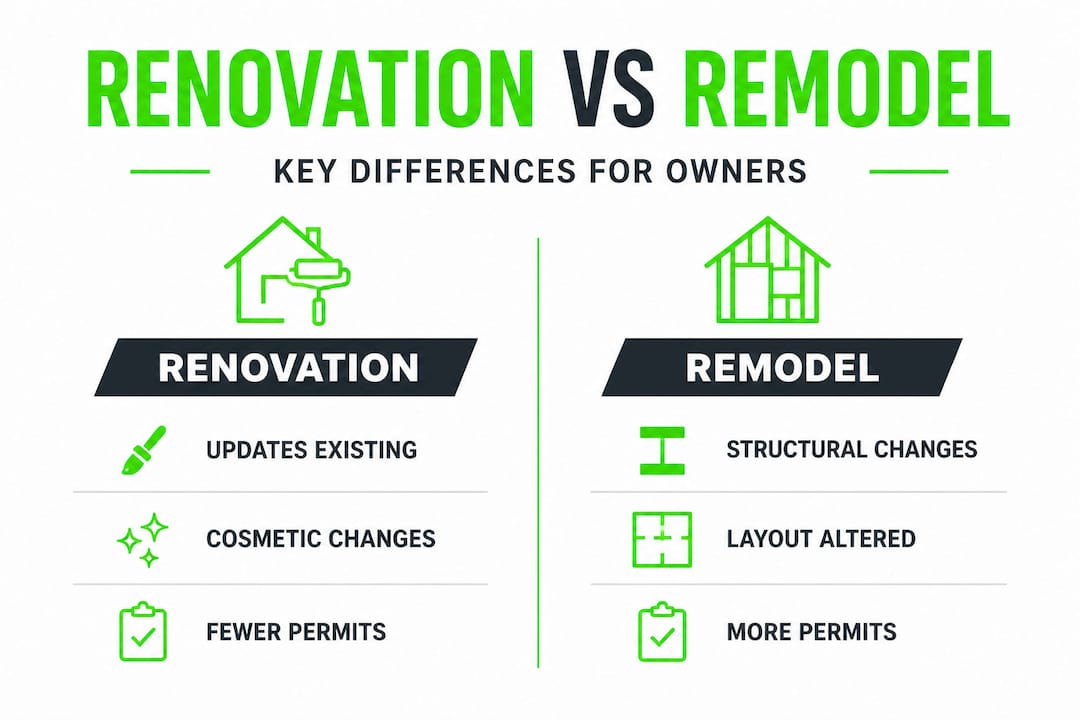
Know the difference before you sign: A renovation updates or improves an existing space. A remodel changes its structure or layout. A repair is routine maintenance. An alteration is a change significant enough to trigger code review. These are not interchangeable terms.
Pro Tip: Ask your contractor to define every key term in writing within the initial proposal. If a term isn’t clearly spelled out, it becomes open to interpretation, and that ambiguity rarely works in the property owner’s favor.
Understanding why hiring professionals matters goes beyond skill. It’s also about working with people who communicate clearly and document everything properly.
Essential business renovation terms you need to know
Whether you own a single-family home in New Jersey or a mixed-use commercial building in Manhattan, the following terms will appear in nearly every project discussion. Knowing what they mean puts you in control.
Core renovation terms defined:
Renovation: Updates or improvements to an existing space without changing its fundamental structure. Painting, flooring, and fixture upgrades are renovations.
Remodeling: Changes to the structure or layout of a space. Moving walls, adding rooms, or reconfiguring floor plans are remodels.
Repair: Routine restoration of something that has broken or worn out. Fixing a leaky pipe or patching drywall is a repair.
Alteration: A change significant enough to trigger city review, permit requirements, or code compliance checks. Removing a load-bearing wall or changing egress points are alterations.
Bid: A fixed price proposal submitted by a contractor. If accepted, the contractor is expected to complete the work at that price.
Estimate: A projected cost based on available information. It is subject to change as the project conditions become clearer.
Scope of work: A detailed description of every task the contractor will perform. It defines the boundaries of the project.
Change order: A formal, written amendment to the original contract when the scope, timeline, or price changes.
Punch list: A final checklist of incomplete or unsatisfactory work items that must be addressed before final payment is released.
The legal distinction between renovation and remodeling is significant because it determines what permits are required and what level of city inspection applies.
Term | Definition | Triggers permits? |
Renovation | Updates existing space | Usually no |
Remodel | Changes structure/layout | Often yes |
Repair | Routine fix | Rarely |
Alteration | Significant change | Almost always |
Bid | Fixed price proposal | N/A |
Estimate | Flexible cost projection | N/A |
In NYC and NJ specifically, the Department of Buildings (DOB) uses precise language in its filings. Using the wrong term on a permit application, or allowing your contractor to mislabel work, can trigger stop-work orders or violations. Explore commercial renovation terminology and how it applies to your specific project type.
For residential projects, understanding interior renovation terms in detail helps you review proposals accurately and catch discrepancies early. And for anyone managing a budget, reviewing your renovation budget planning approach before signing any contract is one of the smartest moves you can make.
Bids, estimates, and work scope: Navigating your contractor’s language
Once you understand the terms themselves, the next challenge is knowing how they function inside real contracts and project documents. This is where many owners get caught off guard.
A bid is a formal commitment. When a contractor submits a bid, they’re stating they will complete the defined scope of work for a specific dollar amount. An estimate, by contrast, is an informed projection. It reflects the contractor’s best guess based on available information, but it leaves room for adjustment.

Document | Price type | Flexibility | When used |
Bid | Fixed | Low | Competitive selection or public contracts |
Estimate | Projected | High | Early planning, unknown site conditions |
Scope of work | N/A | Defines limits | All contracts |
Change order | Variable | Adjusts contract | Mid-project revisions |
Understanding the difference between a fixed bid and flexible estimate protects you from unexpected invoices. Always clarify which document you’re receiving before any work begins.
Here is a step-by-step approach to reviewing contractor documents:
Confirm document type. Ask directly: “Is this a bid or an estimate?” Get the answer in writing.
Read the scope of work carefully. Every task should be listed. If something isn’t mentioned, it likely isn’t included.
Ask about exclusions. Good contractors list what is NOT included. If they don’t, ask them to add it.
Check for change order language. The contract should describe how changes are requested, approved, and priced.
Review payment terms. Know when deposits are due, when progress payments are expected, and what triggers final payment.
Request a punch list protocol. Confirm how final walkthrough items will be documented and resolved.
Learn more about the full construction bidding process to understand how competitive bids work and what to expect when comparing multiple proposals.
Pro Tip: Get every promise and revision in writing. Verbal assurances from contractors rarely hold up if a dispute reaches a contractor licensing board or small claims court. A text message or email confirmation is better than nothing, but a signed change order is the standard to aim for.
In NYC co-op and condo buildings, there’s an added layer. Your building’s board or alteration agreement may restrict what language can appear on a permit application, require specific contractor insurance, or define timelines. Review any interior job proposals with these requirements in mind.
Decoding repairs, alterations, and code-driven language
The distinction between a repair and an alteration is not just semantic. In New York City and New Jersey, the legal definitions carry real consequences for permits, inspections, fees, and timelines.
A repair is work that restores an existing element to its original, functioning condition. Replacing a broken window with the same type of window is a repair. It generally does not require a permit.
An alteration is work that changes, adds to, or modifies an existing condition. Replacing that same window with a larger one, or moving it to a different wall location, becomes an alteration. It may require DOB filing, architectural drawings, and inspections.
The code-triggering nature of alterations means that misclassifying your project, even unintentionally, can result in stop-work orders, fines, or required demolition of non-compliant work.
Key legal and regulatory terms every owner should know:
Permit: Official approval from the city to perform work. Required for alterations, structural work, electrical, and plumbing changes.
Inspection: A review by a city official to confirm work complies with the approved plans and building code.
Compliance: The state of meeting all applicable code requirements. Non-compliance can trigger violations.
Certificate of occupancy (CO): A document confirming a space is legal and safe to occupy. Major renovations often require a new or amended CO.
Violation: A formal notice from the DOB or other city agency that work was performed improperly or without required approvals.
Why the wrong term can cost you: If a contractor files work as a “repair” to avoid permit fees, but the DOB later classifies it as an “alteration,” you as the property owner may face fines, required corrective work, and delays, even if you weren’t the one who made the filing decision.
Always verify with your local building department or co-op/condo board before any work begins. Learn more about what triggers city review through addition and alteration services and how to navigate the process correctly.
For co-op and condo owners in NYC, the rules are even more layered. Building boards often have their own approval processes that exist separately from city permits. Review the key guidance on co-op and condo renovations before you start any project in a shared building.
Why mastering renovation terms is your best investment
Here’s something that often surprises experienced property owners: the value of knowing renovation terminology doesn’t show up most clearly in avoiding mistakes. It shows up in how much better your entire project runs from day one.
Most owners learn these terms after a problem arises. They get hit with an unexpected invoice and research what an estimate really means. They receive a DOB violation and then look up what an alteration is. That reactive approach is understandable, but it’s expensive.
Seasoned renovators use this knowledge proactively. They walk into a contractor meeting already knowing the legal distinctions between renovation and remodeling, between bid and estimate. That knowledge changes the dynamic of every conversation. Contractors recognize it immediately. The proposals they receive tend to be more detailed, the scopes more clearly written, and the pricing more competitive.
There’s a common myth that mastering construction jargon is only necessary for architects, lawyers, or contractors. That’s wrong. It’s for anyone who writes a check for renovation work. When you understand what a change order is and why it matters, you’re far less likely to sign off on verbal modifications that quietly inflate your final bill.
The real budget benefits of terminology mastery go beyond cost control. They include faster decision-making, fewer disputes, reduced stress, and better project outcomes overall. Owners who speak the language of renovation get taken more seriously. They get better service. They get projects completed on time and on budget more often.
If you only take one thing from this guide, let it be this: terminology is not just vocabulary. It’s leverage.
Expert help for your renovation in NYC or NJ
Understanding renovation terminology is a powerful first step. The next step is working with a contractor who respects that knowledge and builds their communication around it.

DJ Custom Contracting LLC has been serving residential and commercial clients throughout New York and New Jersey since 2018. Whether you’re planning a home update or a full commercial buildout, the team brings clear communication, documented proposals, and full code compliance to every project. From initial bid through final punch list, every stage is handled with transparency.
Explore interior renovation in NYC and NJ for residential projects, or connect with the commercial renovation specialists for business and mixed-use properties. Request a detailed, terminology-clear proposal and start your project with confidence.
Frequently asked questions
What is the difference between a renovation and a remodel?
A renovation updates or improves an existing space, while a remodel involves structural or layout changes. Painting and new flooring are renovations; moving walls or reconfiguring rooms is a remodel.
Why is it important to distinguish between a bid and an estimate?
A bid is a fixed price commitment, while an estimate is a flexible projection that may change as project conditions develop. Misunderstanding this difference is one of the most common causes of renovation budget disputes.
How can I avoid costly legal mistakes in my renovation contract?
Ask your contractor to define and document every term in writing before work begins, and confirm permit requirements with your local building department before signing any contract.
What does “alteration” mean in building permits?
An alteration is a change to an existing structure that triggers city review and usually requires permits and inspections, unlike routine repairs that restore rather than modify.
Recommended
Renovation Budget Planning: Your Ultimate Guide to Smart Spending
Top benefits of hiring a general contractor for your next project
Expert Commercial Renovation Contractor | DJ CUSTOM CONTRACTING LLC
Home Tile Renovation Guide 2026: 30% Less Edge Chipping– SurfacesGalore
15 Critical Red Flags When Hiring a Contractor | Urban Edge LLC


Comments