


Residential Addition Guide for NYC and NJ Homeowners

Planning a home addition sounds straightforward until you discover your lot is already at maximum Floor Area Ratio, your neighborhood is a historic district, or the permit process alone will take six months. This residential addition guide is written specifically for homeowners in NYC, northern NJ, Long Island, and Westchester County, where zoning rules are among the most complex in the country. Whether you are adding a bedroom, a second story, or a rear extension, the decisions you make in the first few weeks will shape your entire project.
Table of Contents
Key takeaways
Point | Details |
Zoning comes before design | Check FAR, setbacks, and lot coverage before hiring an architect to avoid costly redesigns. |
Permits are non-negotiable in NYC | Every room addition requires an Alteration Certificate of Occupancy before the space can be occupied. |
Budget for soft costs | Design, engineering, and permit fees add 10%–15% to your total project budget and are often overlooked. |
Pre-construction takes longer than construction | Permitting and approvals often run 4–6 months, sometimes longer than the actual build phase. |
Addition type affects feasibility | Second-story additions, bump-outs, and dormers each carry different zoning and structural implications for your specific lot. |
Understanding zoning and feasibility constraints
Before a single drawing is made, the law has already decided how much you can build. That is the reality for homeowners in NYC and northern NJ, and ignoring it is the most expensive mistake in any residential addition project.
What FAR means for your addition
Floor Area Ratio, or FAR, is the number that controls how much total floor space is allowed on your lot relative to its size. A lot with a FAR of 0.5 and 2,000 square feet of land allows a maximum of 1,000 square feet of building area. Lots in dense NYC neighborhoods can already be built to their maximum FAR, making additions legally impossible without a variance. Variances are not quick fixes. They typically take 12 to 24 months and have a high rate of denial.
Beyond FAR, three other rules shape what you can build:
Setbacks: The required distance between your structure and the property lines. A rear addition that encroaches on the rear yard setback is a zoning violation from day one.
Lot coverage: The maximum percentage of the lot that structures can cover. Adding a ground-floor bump-out might push you over this limit even if FAR allows it.
Height limits: Some zones cap building height at two or two-and-a-half stories, which directly limits second-story or dormer additions.
Landmark and historic district considerations
If your property sits within a NYC landmark district or a locally designated historic area in NJ, you face an additional layer of review. LPC approvals must precede DOB permit issuance, and visibility from the street is a key review criterion. Designs that clash with the architectural character of the block are routinely rejected.
Pro Tip: Run a zoning and bulk feasibility analysis before you spend money on architectural design. A licensed expediter or architect can complete this review in one to two weeks and will tell you exactly how much additional square footage is legally buildable on your lot.
Here is a quick comparison of the two most common regulatory paths for NYC homeowners:
Path | Timeline | Requirements |
As-of-right addition | 4–12 weeks for plan review | Complies with FAR, setbacks, height, and lot coverage |
Variance-dependent addition | 12–24 months | Exceeds one or more zoning limits; Board of Standards and Appeals review required |
Permits, approvals, and the building process
Once you confirm that your addition is feasible under zoning rules, the permit process begins. In NYC, this is not a single form. It is a structured sequence with real consequences if skipped.
Every room addition in NYC requires an Alteration Certificate of Occupancy (Alt-CO), and the completed space cannot legally be occupied until the Department of Buildings issues the final Certificate of Occupancy. Here is what the NYC permit process looks like from start to finish:
Hire a licensed architect to prepare construction documents including architectural drawings, a zoning analysis, structural engineering plans, and energy code compliance documentation.
Submit to the DOB for plan examination. A standard residential addition goes through a plan examiner review that typically runs four to twelve weeks depending on complexity.
Watch for “Big Alt” triggers. If your addition increases the building’s floor area beyond 110% of its original FAR, it triggers a Major Alteration designation. This requires full code compliance upgrades across existing building systems, which significantly raises costs.
Coordinate trade permits for plumbing, electrical, and HVAC work as separate DOB filings under the main alteration application.
Pass phased inspections before closing in framing, rough plumbing, and electrical systems.
Obtain the final Certificate of Occupancy after all inspections clear and the DOB signs off on the completed work.
For homeowners in Westchester County and northern NJ, the process differs in important ways. Yonkers permit approvals typically run about three weeks, with fees ranging from $320 to over $1,600 depending on project scale. Structural plans must still be stamped by licensed professionals, but the volume of submissions is far lower than the NYC DOB, which means faster reviews.
Skipping permits does not save time. It creates open violations that surface during property sales and can force full demolition of unpermitted work.
Unpermitted additions in NYC can trigger Stop Work Orders that halt your project mid-construction.
DOB violations are public record and directly affect your ability to refinance or sell the property.
Pro Tip: In NYC, consider running a multi-workstream schedule where zoning review, landmark approval (if applicable), and DOB submission happen in parallel rather than in sequence. This approach can shave months off your pre-construction timeline.
Budgeting and cost considerations
Home additions in the NYC metro area cost more than national averages, and the range is wide. Kitchen additions run $5,000 to $125,000, bathroom additions range from $5,000 to $90,000, and second-story additions can reach $350,000 depending on structural complexity and finishes. These figures are for construction costs alone.

Addition type | Typical cost range | Key cost driver |
Bump-out (under 100 sq ft) | $20,000–$50,000 | Foundation and framing |
Rear or side addition | $60,000–$150,000 | Square footage, finishes |
Second-story addition | $100,000–$350,000 | Structural reinforcement |
Sunroom or conservatory | $25,000–$80,000 | Glazing and thermal systems |
Soft costs are the budget line that catches most homeowners off guard. Design, engineering, and permits typically add 10% to 15% of the total project budget. On a $150,000 addition, that is $15,000 to $22,500 that never goes toward a single brick or board.
Reserve 15% to 20% of your total budget as a contingency fund. Hidden conditions in older homes, including outdated electrical panels, undersized footings, or asbestos-containing materials, regularly trigger unexpected costs mid-project. Factor in the long-term costs too: additions increase your home’s assessed value and therefore your annual property taxes.
For smart renovation budgeting strategies, get at least three competitive bids from licensed general contractors before committing. Request itemized proposals so you can compare line by line, not just total figures.
Pro Tip: When comparing contractor bids, a significantly lower number is almost always missing something. Ask each contractor to confirm whether their price includes permit fees, architectural coordination, and temporary protection of your existing structure during construction.
Design and construction timeline
The phase that surprises most homeowners is not construction. It is everything that happens before construction starts. Pre-construction planning, permits, and design often take longer than the build itself.
Here is a realistic phase breakdown for a standard residential addition in the NYC metro area:
Zoning and feasibility (1 to 3 weeks): Confirm what is legally buildable on your lot before committing to a design direction.
Design and engineering (6 to 12 weeks): Architect produces schematic designs, then construction documents. Structural engineer reviews load paths and foundation requirements.
Permits and approvals (4 to 24 weeks): NYC DOB plan review alone runs 4 to 12 weeks for standard applications. Landmark approvals add time on top of DOB review.
Construction and inspections (8 to 24 weeks): Simple additions complete in 8 to 12 weeks; complex two-story additions can run six months or more.
Final Certificate of Occupancy (2 to 6 weeks post-construction): All trade inspections must clear before the CO is issued.
Coordination between the architect and structural engineer from day one is critical to confirm that the existing structure can safely support the addition and to prevent costly design revisions later.
If your addition affects a kitchen, bathroom, or the only stairway in the home, plan for temporary living arrangements during active construction. Talk through disruption scenarios with your contractor before signing a contract, not after demolition starts.
Pro Tip: Build a two-week buffer into each phase of your schedule. Projects in NYC and NJ regularly face inspector scheduling delays that are outside anyone’s control. A buffer prevents one delay from cascading into the next phase.
Types of residential additions and how to choose
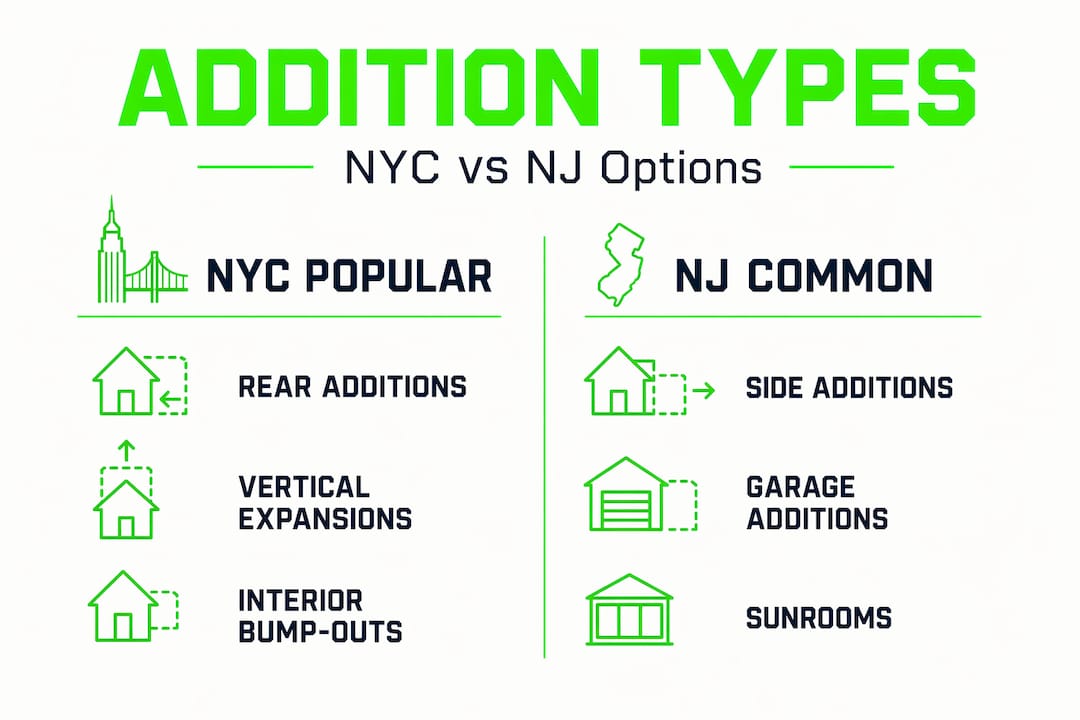
Choosing the right type of addition shapes every downstream decision, from zoning feasibility to budget to the finished look of your home. Here is a breakdown of the most common options and what makes each appropriate for different situations:
Rear or side addition: The most common type for detached homes in NJ and Long Island. Requires setback compliance and available lot coverage. Best option when horizontal space permits.
Bump-out: A small extension, typically under 100 square feet, that projects from an existing room. Lower cost and simpler permitting, but the gains in space are modest. Works well for expanding a kitchen or adding a small bathroom.
Second-story addition: Ideal when the lot is fully built out and horizontal expansion is not possible. Requires structural assessment of the existing first-floor walls and foundation. Higher cost and complexity but maximizes floor area without sacrificing yard space.
Dormer: A vertical extension through the roofline that adds headroom and usable floor area in an attic. Less disruptive than a full second-story addition and often more cost-effective.
Sunroom or conservatory: Lower structural complexity, but thermal performance and year-round usability depend heavily on glazing quality and HVAC design. Not always counted toward FAR in all jurisdictions, so confirm locally.
Garage addition: Common in suburban NJ and Long Island. Zoning rules on setbacks and lot coverage apply, and conversion to living space later requires a separate permit.
Addition type | Best for | Key constraint |
Rear/side addition | Lots with available yard space | Setbacks and lot coverage |
Second-story addition | Built-out urban lots | Structural capacity, height limits |
Bump-out | Modest space needs | Setbacks, FAR |
Dormer | Attic conversion | Roofline geometry, height limits |
For planning building additions in NYC and NJ, the type you choose should reflect your long-term plans. Additions make financial sense if you plan to stay in the home for five or more years. Short-term owners rarely recoup the full cost of a major addition on resale.
My take on navigating NYC residential additions
I have worked through enough addition projects in NYC and northern NJ to say this clearly: the homeowners who struggle most are the ones who hire an architect before confirming what zoning actually allows. They spend $10,000 to $15,000 on design work for an addition that is either legally impossible or requires a two-year variance process to pursue. That money is gone before a permit application is even filed.
The second pattern I see regularly is underestimating soft costs and pre-construction time. A homeowner budgets $100,000 for construction and then discovers that permits, architectural fees, and engineering add another $15,000. The contingency fund they planned does not exist because it was absorbed by soft costs they never accounted for.
My honest advice: run the zoning analysis first, budget your soft costs as a separate line item from day one, and choose an architect and contractor who have completed projects specifically within the NYC DOB system or the NJ municipality where you live. Local experience is not a bonus. It is the difference between a four-month permit process and a fourteen-month one.
Residential additions are genuinely worth the effort when they are planned correctly. They add usable space, they add value, and in a market like New York, they are often the most practical alternative to moving. Just go in with clear eyes about what the process actually involves.
— DJ
How Djcustomcontracting can help with your addition

Djcustomcontracting has been working with homeowners across NYC, northern NJ, Long Island, and Westchester County since 2018, and residential additions are one of our core specialties. We coordinate every stage of your project, from the initial zoning feasibility check through architectural coordination, DOB permit submissions, construction, and the final Certificate of Occupancy. You do not have to manage separate professionals and hope they communicate with each other. We handle that.
Our team understands the specific requirements of the NYC DOB, Yonkers building department, and local NJ municipalities, which means fewer surprises and fewer delays. Whether you are planning a rear addition, a second story, or a dormer conversion, our addition and alteration services are built to get your project across the finish line compliantly and on budget. Contact Djcustomcontracting today for a consultation and a detailed project estimate.
FAQ
What is a home addition, exactly?
A home addition is any new construction that permanently increases the floor area of an existing residence, including room additions, second stories, bump-outs, and attached garages. Every addition in NYC requires a permit and a new Certificate of Occupancy before the space can be occupied.
How long does a residential addition take in NYC?
Total project timelines in NYC commonly run 9 to 18 months when you include zoning review, design, DOB permitting, and construction. Simple additions with straightforward zoning can finish faster, while landmark approvals or complex structural work extend the timeline considerably.
What permits do I need for a room addition in NJ?
In northern NJ municipalities, you need a building permit with stamped architectural and structural drawings submitted to the local building department. Inspections are required at multiple construction phases, and a Certificate of Occupancy is issued after final inspection.
How much does a home addition cost in the NYC metro area?
Costs vary widely by type and scope. Bump-outs start around $20,000, standard rear additions run $60,000 to $150,000, and second-story additions can reach $350,000. Budget an additional 10% to 20% for soft costs and contingency on top of construction costs.
Can I add a second story if my lot is already at maximum FAR?
Not without a variance, which typically takes 12 to 24 months in NYC and carries significant uncertainty. Vertical additions like dormers that do not add measurable floor area may still be possible depending on how your zoning district calculates FAR, so confirm with a licensed expediter before ruling it out.
Recommended


Comments