


Step-by-step workflow for residential additions in NYC

Planning a home addition in New York City is one of the most rewarding investments you can make as a homeowner, but it comes with a level of regulatory complexity that catches many people off guard. Miss a single filing, skip a required board approval, or underestimate permit timelines, and your project can stall for months. This guide walks you through every stage of the process, from understanding zoning rules and hiring the right professionals, to navigating Department of Buildings (DOB) filings, managing inspections, and closing out your permit legally. Follow this workflow and you will keep your project compliant, on schedule, and free of costly surprises.
Table of Contents
Key Takeaways
Point | Details |
NYC compliance is essential | All residential additions in NYC require strict permit and filing procedures—always begin with a licensed professional. |
Board approvals can delay timelines | Condo and co-op additions often require integrated board review and can add 8–12 weeks to your process. |
ALT-1 vs ALT-2 matters | The type of permit filing (ALT-1 or ALT-2) directly affects requirements, timelines, and Certificate of Occupancy changes. |
Design for energy efficiency | New additions must meet the latest energy codes—most failures are due to outdated HVAC or electrical planning. |
Final inspections are the finish line | Expect a full DOB review before closeout; unresolved violations or missing documents can prevent sign-off. |
What to know before you start your residential addition
Before you begin designing your addition, it’s essential to understand the unique compliance landscape in New York City. NYC is not like other cities. Its layered system of zoning codes, building regulations, and board governance means that preparation is not optional. It is the foundation your entire project rests on.
Zoning and use restrictions
Every property in NYC falls within a specific zoning district, and those districts dictate what you can build, how high you can go, how far from property lines you must stay, and how much of your lot you can cover. Residential zones range from R1 through R10, with increasing density allowances. Before you draw a single plan, confirm your property’s zoning designation through the NYC Zoning Resolution and check your Floor Area Ratio (FAR), which is the ratio of your building’s total floor space to the size of your lot. Exceeding your allowable FAR is one of the most common reasons additions get rejected.
Do you need an architect or engineer?
The short answer is yes. Residential additions in NYC require a DOB permit filed via DOB NOW by a licensed Registered Architect (RA) or Professional Engineer (PE), typically as an ALT-1 or ALT-2 depending on whether the project changes the Certificate of Occupancy (CO). You cannot self-file a permit for an addition as a homeowner. Hiring the right licensed professional early protects you from filing errors that can delay your project by weeks.
Board approvals for condos and co-ops
If you own a condo or co-op, you face an additional layer of approval. Your building’s board must review and approve your plans before the DOB will accept your filing. Understanding co-op vs condo rules is critical here, because co-op boards tend to have broader authority over what you can and cannot do. Board reviews can take anywhere from four to twelve weeks on their own, so factor this into your overall timeline before you commit to a start date.
Key documents and considerations before starting:
Item | Purpose | Typical Timeline |
Zoning analysis | Confirms FAR, setbacks, and use | 1 to 2 weeks |
Architect/PE engagement | Required for DOB filing | 2 to 6 weeks |
Board application (condo/co-op) | Required before DOB submission | 4 to 12 weeks |
Preliminary plans | Basis for board and DOB review | 2 to 4 weeks |
Title search | Confirms easements and restrictions | 1 to 2 weeks |
Pro Tip: Start your outreach to your building board and licensed architect at the same time. Many homeowners wait until plans are complete before contacting the board, which adds months to the process unnecessarily.
Step-by-step workflow: From permits to completion
With your pre-application essentials in place, you’re ready to tackle the main workflow. The steps below reflect current NYC addition workflow details and incorporate the 2026 regulatory updates that affect how filings are submitted and how boards must participate.
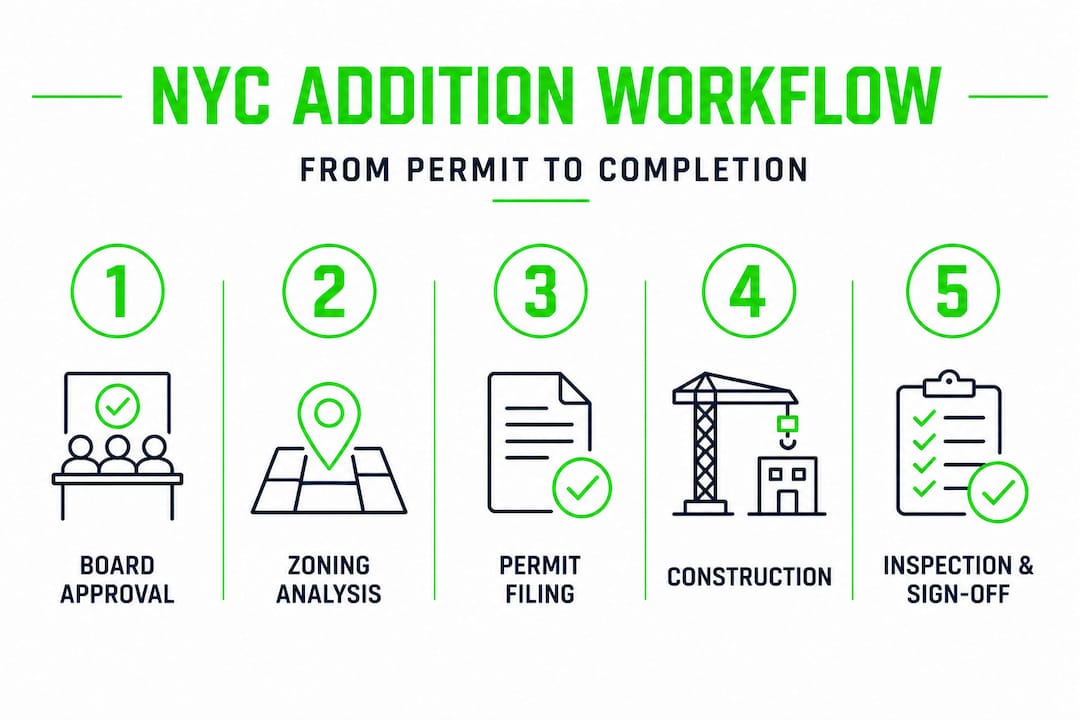
Hire your architect or PE. Your licensed professional will assess feasibility, confirm zoning compliance, and begin preparing construction documents. This is not a step to rush. Detailed, accurate plans reduce the risk of DOB objections later.
Conduct a pre-filing consultation. Your architect can request a pre-application meeting with the DOB to clarify requirements for complex projects. This is especially useful for additions that change the building’s footprint or floor count.
Determine ALT-1 vs. ALT-2 filing. An ALT-1 (Alteration Type 1) is required when your addition changes the CO, such as adding a new floor or converting space to a different use. An ALT-2 covers multiple work types that do not change the CO. Your architect makes this determination based on the scope of work.
Submit via DOB NOW. All filings go through DOB NOW, the city’s online permit platform. Your architect uploads construction documents, completes required forms, and pays filing fees electronically.
Wait for plan examination. Permit timelines run 4 to 12 weeks for ALT-1 standard review, and 1 to 4 weeks for expedited or self-certified filings. Room addition approvals average around 6 weeks. During this period, the DOB may issue objections requiring plan revisions.
Secure board digital attestation (2026 requirement). Under NYC Buildings Bulletin 2025-011, 2026 changes emphasize integrated filings for enlargements and require board digital attestation. Plan an additional 8 to 12 weeks for boards to complete this step. Missing this requirement is a common cause of permit holds in 2026.
Obtain the work permit. Once DOB approves your plans, your architect or contractor pulls the work permit. Construction cannot legally begin before this permit is issued and posted on site.
Begin construction. Your contractor follows the approved plans exactly. Any deviation requires a plan amendment filed through DOB NOW before that work proceeds.
Schedule progress inspections. The DOB requires inspections at specific construction milestones, such as foundation work, framing, and mechanical rough-ins. Your architect or a Special Inspection Agency (SIA) coordinates these.
Request final inspection and sign-off. After all work is complete, the DOB conducts a final inspection. Passing this inspection closes out the permit and, for ALT-1 projects, triggers an updated CO.
Important: The DOB warns that unpermitted work is not just a paperwork problem. It can result in stop-work orders, fines of up to $10,000 per day, and mandatory removal of completed construction. Protecting your investment means following every step of this process.
ALT-1 vs. ALT-2 comparison:
Factor | ALT-1 | ALT-2 |
CO change required? | Yes | No |
Typical review time | 6 to 12 weeks | 4 to 8 weeks |
Filing complexity | High | Moderate |
Common use cases | New floors, use changes | Room additions, structural work |
Self-certification eligible? | Sometimes | More commonly |
Pro Tip: Self-certification, where your architect certifies code compliance without a full DOB plan examination, can cut review time significantly. However, self-certified projects are subject to random DOB audits. Make sure your plans are airtight before choosing this route. Understand the bidding process tips when selecting a contractor to ensure competitive, accurate pricing before you file.
Common pitfalls and how to avoid them
Even with a clear workflow, small oversights can cost you time and money. Here’s what to watch out for.
Energy code compliance
Many homeowners assume that adding a room is simpler than building new. It is not, from a code standpoint. Energy code requirements for additions are the same as those for new construction, meaning your new space must meet current insulation, window efficiency, and air sealing standards. Failing to account for this during design means costly revisions after DOB review.
Undersized HVAC and electrical systems
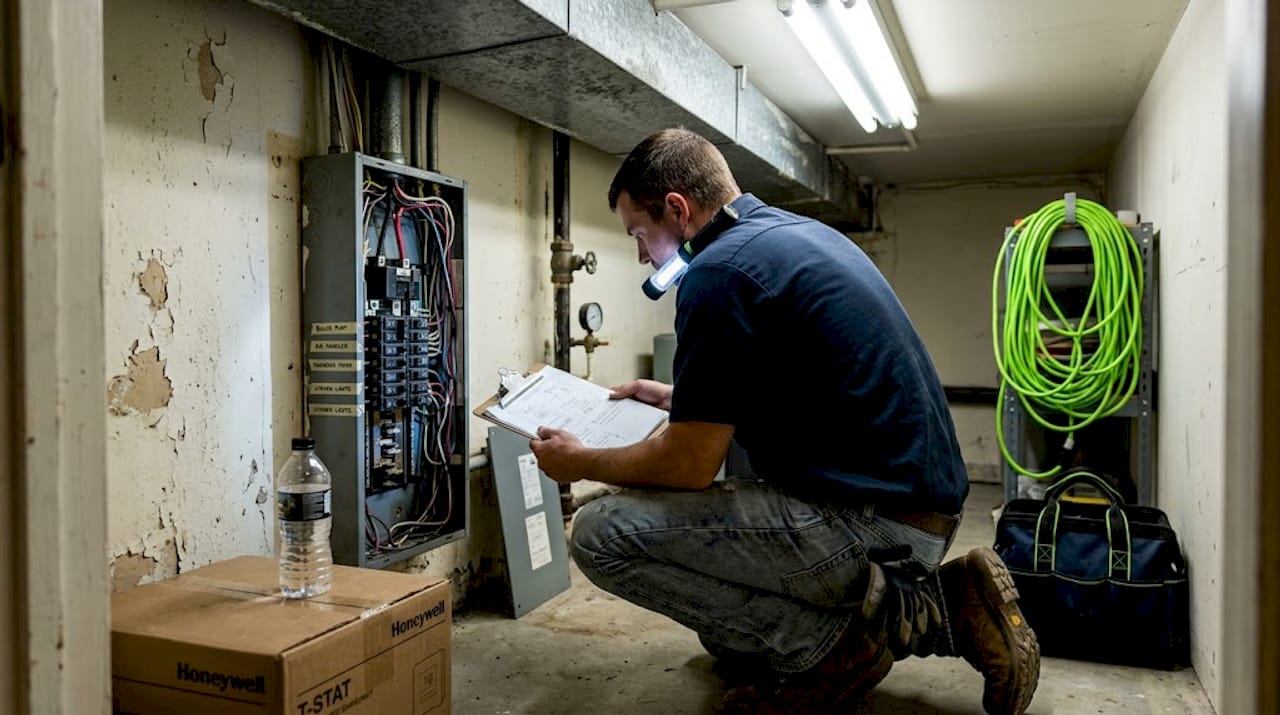
Your existing HVAC and electrical systems were sized for your original home. Adding square footage without upgrading these systems is a code violation and a practical problem. Inspectors will flag undersized equipment, and your contractor will need to redesign and reinstall systems mid-project. Get a load calculation done early and include system upgrades in your scope of work from day one.
Foundation connections
One of the most overlooked structural issues in residential additions is the connection between the new and existing foundations. Poorly tied foundations lead to differential settlement, meaning the new section sinks at a different rate than the old one. This causes cracking, structural damage, and expensive repairs. Your structural engineer must detail this connection explicitly in the drawings.
Common pitfalls and prevention strategies:
Skipping energy code review: Have your architect confirm compliance during schematic design, not after DOB submission.
Ignoring board timelines: Submit your board application before finalizing your project schedule.
Underestimating permit fees: DOB fees are based on project cost. Budget 1% to 3% of construction cost for permit and filing fees.
Hiring unlicensed contractors: NYC requires licensed contractors for most addition work. Verify licenses through the NYC Department of Consumer and Worker Protection.
Missing special inspection requirements: Certain structural work requires a registered Special Inspection Agency. Confirm this with your architect before construction begins.
If violations are issued during your project, addressing them quickly is essential. Understanding how to correct NYC code violations before they escalate into stop-work orders can save your project timeline. For older homes, review pre-war renovation tips to understand the unique structural and mechanical challenges that come with aging building stock.
Pro Tip: Before submitting your plans to the DOB, have your architect do a complete checklist review against the NYC Construction Codes. Missing even one required detail, such as a fire separation rating or egress window dimension, triggers an objection that adds weeks to your timeline.
Final inspections, sign-offs, and what to expect
Once construction is complete, you’re on the home stretch. Here’s how to finish the process and move in with confidence.
Requesting your final inspection
Confirm all work is complete. Every item on the approved plans must be finished before you request inspection. Partial completions result in failed inspections and additional fees.
Compile your closeout documents. Gather as-built drawings, all required sign-offs from subcontractors and special inspectors, final payment confirmations, and utility clearances.
Submit the inspection request through DOB NOW. Your architect or contractor submits the request electronically. The DOB schedules an inspector visit, typically within one to three weeks.
Pass the final inspection. The inspector verifies that construction matches the approved plans, all required sign-offs are in place, and the space meets code requirements for occupancy.
Receive your updated CO. For ALT-1 projects, DOB sign-offs close out the permit and update the Certificate of Occupancy to reflect the new conditions of your home. This document is critical for insurance, resale, and legal occupancy.
Statistical callout: Most residential addition projects in NYC complete the closeout process within four to eight weeks after construction ends, assuming all sign-offs and documents are in order. Projects with outstanding violations or missing inspections can take three to six months longer.
Documents required at closeout:
As-built drawings signed and sealed by your architect or PE
Special inspection reports from your SIA
Sign-offs from all required subcontractors (plumber, electrician, mechanical)
Utility clearances (gas, electric, water)
Final payment receipts for all permitted work
Board approval documentation (for condos and co-ops)
If the inspector flags violations during the final inspection, work stops until corrections are made and re-inspected. Address any issues immediately. Delays at this stage are frustrating but manageable if you respond quickly and document all corrections. Review closeout tips for additions to make sure you’re prepared for every requirement at this stage.
Why most NYC addition workflows fail—and how to get yours right
Reflecting on the workflow, there’s a pattern worth naming directly: most NYC addition projects that run into serious trouble do not fail because of bureaucracy. They fail because of preparation gaps that were entirely avoidable.
The most common mistake we see is homeowners treating an addition like a large interior renovation. It is not. An interior renovation typically does not change your CO, does not require foundation work, and often does not trigger full energy code compliance. An addition does all three. When homeowners approach the process with interior renovation expectations, they consistently underestimate timelines, underbudget for professional fees, and skip steps that later cause costly holds.
The second major failure point is underestimating board timelines. In 2026, digital board attestation is not just a formality. It is a formal, documented step that boards must complete through the DOB system. Some boards meet monthly. Some have legal review processes that take additional weeks. If you start your board application after your plans are finalized, you may be adding three to four months to your project before a single permit is filed. Starting board communication at the same time you engage your architect is not just smart. It is necessary.
Here is the insight most guides miss: meticulous preparation pays off more than connections or expedited filings. Contractors and architects who know the right people can sometimes move things faster, but a poorly prepared application will still get objected. A complete, accurate, code-compliant application filed by a thorough professional will almost always move faster than a rushed filing by someone with relationships. The DOB rewards detail. Invest in it.
Finally, do not treat the expert addition guidance of your licensed professionals as an expense to minimize. Their knowledge of current code requirements, filing procedures, and inspection expectations is what keeps your project moving. Cutting corners on professional fees almost always costs more in delays and corrections than you saved.
Make your NYC addition seamless with professional support
Ready to get your addition started and finished without stress? Professional support can make all the difference.
Navigating NYC’s addition workflow requires more than good intentions. It requires licensed professionals who know the current DOB filing requirements, understand board processes, and can coordinate every phase of construction to keep your project compliant and on schedule.

DJ Custom Contracting LLC has been helping NYC homeowners manage additions and alterations since 2018. As a licensed addition contractor with deep knowledge of DOB compliance, we coordinate every stage of your project, from initial planning and permit filing through final inspection and CO update. Our team also handles interior renovation work that often accompanies additions, so you have one point of contact for your entire project. Visit DJ Custom Contracting to schedule a consultation and get your project moving in the right direction.
Frequently asked questions
Do I always need city permits for a residential addition in NYC?
Yes, every residential addition in NYC requires city permits. DOB permits must be filed via DOB NOW by a licensed RA or PE, with no exceptions for size or scope.
How long does it take to get permit approval for an addition?
Standard approvals take 4 to 12 weeks; expedited or self-certified filings may be approved in 1 to 4 weeks. Board or CO changes can add significant time, and 2026 board attestation requirements may add 8 to 12 weeks on top of standard review.
What building systems must I upgrade with my addition?
You’ll need to meet current energy code standards and ensure your electrical and HVAC systems are properly sized for the expanded square footage of your home.
What if my condo or co-op board delays the process?
Board digital attestation in 2026 can add 8 to 12 weeks to your timeline, so start board communication at the very beginning of your project, not after plans are complete.
What happens if there’s a code violation during my project?
Work stops until the violation is corrected and re-inspected. Knowing how to remove code violations quickly is essential to minimizing delays and keeping your project on track.
Recommended


Comments