


Why hiring a contractor is essential for NYC renovations
- DJ Custom Contracting

- May 14
- 9 min read

Many NYC property owners have learned a painful lesson: what seems like a simple renovation quickly becomes a legal and financial problem when the wrong person does the work. The idea that hiring a handyman or doing it yourself saves money is one of the most common misconceptions in New York City construction. The reality is that NYC operates under some of the most detailed and strictly enforced building codes in the country, and a single misstep can result in fines, stop-work orders, or expensive rework. This article breaks down exactly why hiring a licensed contractor matters, when the rules kick in, and how to choose the right professional for your project.
Table of Contents
Key Takeaways
Point | Details |
NYC regulations matter | Most projects require licensed contractors due to strict city compliance rules. |
Contractors reduce your risk | Hiring a pro minimizes liability for property damage, accidents, or code issues. |
Not all jobs need a GC | For small, unregulated tasks, a handyman or DIY might work, but always check requirements. |
Compare bids smartly | Look beyond price—check licenses, contracts, and reputation for true peace of mind. |
Understanding the NYC renovation landscape
New York City is unlike any other market for construction and renovation. The sheer density of the city, the age of its building stock, and the layers of municipal oversight create a regulatory environment that catches many owners off guard. Understanding this landscape before you start any project is critical.
Residential contracting in NYC is regulated through the NYC Department of Consumer and Worker Protection (DCWP) Home Improvement Contractor (HIC) licensing program, which applies to a wide range of home improvement work. Any contractor working on your home for jobs valued at $200 or more is required to hold this license. That threshold is much lower than most people expect.
Beyond the DCWP, the NYC Department of Buildings (DOB) oversees permits, inspections, and code compliance. Most structural, electrical, and plumbing work requires a permit pulled by a licensed professional. If your contractor cannot pull permits, that is a serious warning sign.
Here is what makes NYC uniquely complex:
Building age: Many NYC buildings were constructed before modern codes, meaning hidden conditions like asbestos, lead paint, or outdated wiring are common discoveries during renovations.
Multi-family and mixed-use buildings: Work in these structures often requires coordination with building management and compliance with additional fire safety regulations.
Co-op and condo boards: If you live in a co-op or condo, your board likely has its own renovation rules on top of city requirements. Understanding co-op vs. condo renovations is essential before you sign any contract.
Landmark and historic districts: Certain neighborhoods have additional restrictions governing exterior changes and materials.
“Noncompliance with NYC building codes and permit requirements does not just delay your project. It can result in violations that attach to your property’s title, making it harder to sell or refinance in the future.”
Following the NYC remodeling workflow guide from the start helps owners understand exactly which steps require licensed professionals and when permits must be filed. Skipping this research phase is one of the most common and costly mistakes.
Top reasons to hire a contractor for your project
Now that we have covered the unique landscape, why does this matter to you directly? The answer goes beyond simply following rules. Hiring a licensed contractor provides concrete, measurable protection for your investment.
Liability protection is one of the strongest arguments for using a licensed contractor. If a worker is injured on your property and your contractor does not carry proper workers’ compensation and general liability insurance, you could be held financially responsible. In NYC, where labor costs and legal fees are both high, this risk is not theoretical.
Code compliance and permits require specialized knowledge that most property owners simply do not have. Licensed contractors understand which permits are needed, how to file them correctly, and how to pass inspections the first time. Failed inspections cost both time and money.

Benefit | DIY or unlicensed | Licensed contractor |
Permit filing ability | No | Yes |
Workers’ comp coverage | No | Yes |
Code compliance expertise | Limited | Full |
Warranty on workmanship | No | Typically yes |
DOB violation resolution | No | Yes |
Board approval assistance | No | Often yes |
Other strong reasons to hire a licensed contractor include:
Access to specialized trades: Electricians, plumbers, and structural engineers must be licensed in NYC. A general contractor manages these subcontractors and ensures all work is coordinated correctly.
Fraud and scam protection: Working under a written contract with a licensed, verified professional reduces the risk of contractor fraud, which remains a significant problem in the NYC market.
Project accountability: Every licensed contractor in NYC can be looked up by name, license number, and complaint history. That accountability does not exist with cash deals or unlicensed labor.
Pro Tip: Before signing anything, ask your contractor for their DCWP HIC license number, proof of general liability insurance, and workers’ compensation certificate. A reputable contractor will provide these documents without hesitation.
Understanding professional renovation protection goes deeper than just avoiding fines. It means your home or business is protected from liability, substandard work, and unexpected costs. Learning about top contractor benefits and general contractor protection can help you make the case internally when budget discussions come up.
Contractor vs. handyman vs. DIY: When does it matter?
What if your project is not a full-scale renovation? Can you use a handyman or do it yourself? The answer depends heavily on the scope of the work and whether it triggers NYC’s licensing and permit requirements.
Minor repairs may not require the same level of oversight, but any work involving electrical systems, plumbing, or the structure of the building always demands a licensed contractor. This is not a gray area in NYC.
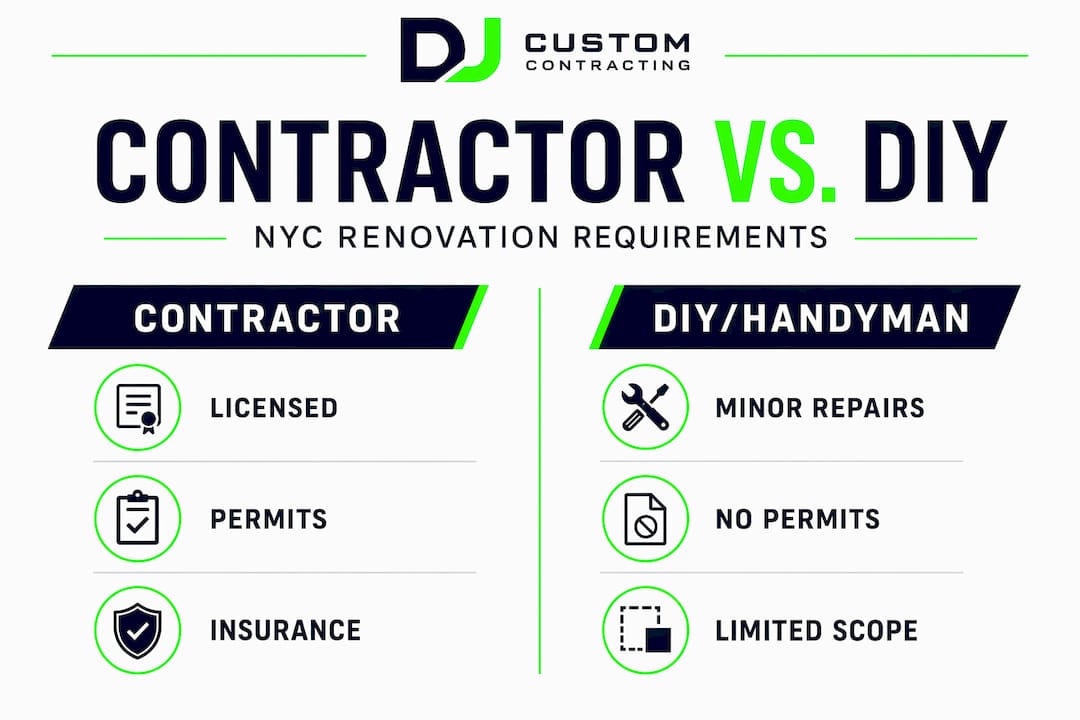
Here is a practical comparison:
Task type | Handyman | Licensed contractor required |
Painting interior walls | Yes | No |
Replacing a light fixture | Sometimes | If permit needed |
Repairing a leaky faucet | Yes | No (unless major) |
Installing a new bathroom | No | Yes |
Replacing load-bearing structure | No | Yes |
Adding a room or addition | No | Yes |
Electrical panel upgrade | No | Yes |
HVAC installation or replacement | No | Yes |
The trigger points are clear. Once a job involves:
Electrical work beyond a simple swap of a fixture.
Plumbing that requires opening walls or rerouting pipes.
Structural changes including removing or adding walls.
Any work requiring a DOB permit.
Work in a co-op or condo that the board requires to be done by a licensed contractor.
…you need a licensed contractor. No exceptions.
Pro Tip: Even if you plan to DIY a cosmetic update, pull the scope of work in writing and run it by a licensed contractor for a quick review. A one-hour consultation can prevent a costly permit violation.
Handymen in NYC operate legally for very limited, minor tasks. The moment the scope creeps into regulated territory, using an unlicensed person increases your personal liability significantly. If that person causes damage or is injured, you have very limited legal recourse. When deciding on contracting services, always err on the side of caution in a city with NYC’s enforcement environment.
How to evaluate, select, and manage your contractor
If your work calls for a contractor, choosing the right one is just as important as deciding to hire one. A poor contractor can cause just as many problems as no contractor at all. Here is how to approach the selection process systematically.
Step 1: Verify credentials before anything else. Check the DCWP database for the contractor’s HIC license. Confirm it is current and has no active complaints. Verify insurance certificates directly with the insurer, not just by reviewing a document the contractor provides. Check the DOB for any past violations associated with their license.
Step 2: Request written proposals with detailed scope. Every proposal should include a line-item breakdown of materials, labor, timeline, and payment schedule. Vague proposals invite disputes. A contractor who is reluctant to put specifics in writing is a red flag.
Step 3: Compare bids on scope, not just price.Contractor proposals can vary widely because some contractors build in perceived value to justify higher bids, while others cut corners to come in low. The only way to compare fairly is to ensure all bids are based on the same written scope of work.
Step 4: Check references and past work. Ask for at least three references from projects similar in scope to yours. Actually call them. Ask about timeline adherence, communication quality, and whether the final cost matched the bid.
Step 5: Review the contract carefully. A proper contract should include: start and end dates, payment schedule tied to milestones (not arbitrary dates), a change order process, a dispute resolution clause, and permit responsibilities spelled out clearly.
Step 6: Maintain regular communication. Once work begins, schedule weekly check-ins. Review progress against the project timeline. Address concerns in writing, not just verbally. This creates a record if disputes arise later.
Here are the key items your contractor contract must include:
Contractor name, license number, and insurance details
Full project description and scope of work
Materials list with specifications
Start date and estimated completion date
Payment schedule tied to project milestones
Change order policy and written approval requirement
Warranty terms for labor and materials
Permit responsibilities clearly assigned
Pro Tip: Never pay more than 10 to 15 percent as a down payment in NYC. Contractors who demand 50 percent or more upfront are a significant fraud risk. The NYC DCA has issued guidance on this repeatedly.
A major statistic to keep in mind: studies show that renovation disputes and contractor fraud complaints spike significantly when owners skip the written contract stage or hire based on price alone. Written contracts are your single most powerful tool for protecting your investment.
The hidden costs of cutting corners in NYC renovations
Here is a perspective that does not get discussed enough: the short-term savings from cutting corners almost always evaporate quickly, and what follows is often more expensive than doing it right the first time.
We have seen it play out repeatedly. An owner saves a few thousand dollars by hiring an unlicensed laborer for a bathroom remodel. Then the DOB issues a stop-work order mid-project. The owner now faces fines, must hire a licensed contractor to file corrective paperwork, and has to redo portions of the work that were completed without permits. What started as a cost-saving decision becomes a budget disaster.
Insurance adds another dimension most owners overlook. If unpermitted work contributes to water damage or a fire, your homeowner’s or business insurance carrier may deny the claim. That denial can happen even if the unpermitted work is not the direct cause of the damage. Carriers look for any reason to limit payouts, and unpermitted renovations hand them that reason.
There is also the resale and refinancing angle. Unpermitted work shows up during title searches and home inspections. Buyers and lenders routinely require that violations be cleared before closing. Clearing those violations after the fact costs significantly more than permitting the work correctly from the start, especially because open permits and violations can block sales for months. Reviewing NYC renovation essentials before any project helps owners understand the full picture upfront.
The pattern we see most often is this: owners who invest in licensed, properly permitted work from the beginning spend less over the full lifecycle of their property. They avoid fines, avoid rework, avoid insurance disputes, and avoid the enormous stress that comes with a project gone wrong in one of the most heavily regulated cities in the world. Professional contractors do not just build things. They protect your investment at every stage.
Find your trusted NYC contractor partner
Navigating NYC’s renovation requirements takes real expertise, and the consequences of getting it wrong are significant. That is where having the right contractor partner makes all the difference.

DJ Custom Contracting LLC has been serving residential and commercial clients across New York City since 2018. Licensed, insured, and experienced in the full range of NYC building codes and DOB requirements, DJ Custom Contracting handles everything from interior renovation projects to complex exterior renovation work, as well as ongoing building maintenance services for commercial properties. Whether your project is a single bathroom update or a full-building alteration, the team brings the licensing, insurance, and verified experience that NYC projects demand. Reach out today for a consultation and a detailed, written project proposal.
Frequently asked questions
What are the risks of not hiring a licensed contractor in NYC?
You risk fines, stop-work orders, denied insurance claims, and potential lawsuits. Code compliance and permits require specialized knowledge, and unlicensed work can also attach violations to your property title that affect future sales or refinancing.
How can I check if a contractor is licensed in NYC?
Use the NYC DCWP database to verify the contractor’s HIC license status, current insurance, and any complaint history before signing a contract or paying any money.
When is it legal to use a handyman or DIY instead of a contractor?
You may handle minor cosmetic tasks with a handyman, but electrical, plumbing, or structural work always requires a licensed contractor in NYC, as does any job that triggers a DOB permit requirement.
How much does hiring a contractor typically add to renovation costs?
Hiring a licensed contractor adds an up-front cost, but it significantly reduces risk. Liability protection and proper permitting prevent budget overruns from fines, failed inspections, rework, or insurance denials that far exceed the contractor’s fee.
Recommended


Comments