


Alterations vs Renovations: What Homeowners Must Know


An alteration is defined as a structural or layout change to a property that modifies its function, systems, or physical configuration, while a renovation updates or restores existing surfaces and finishes without changing the underlying structure. Understanding the difference between alterations vs renovations determines your permit requirements, budget, timeline, and the type of contractor you need. Misclassifying a project is one of the most common and costly mistakes property owners make. Whether you are planning a kitchen overhaul, reconfiguring office space, or simply refreshing a room, knowing which category your project falls into protects you from regulatory delays and budget surprises.
What is the difference between alterations and renovations?
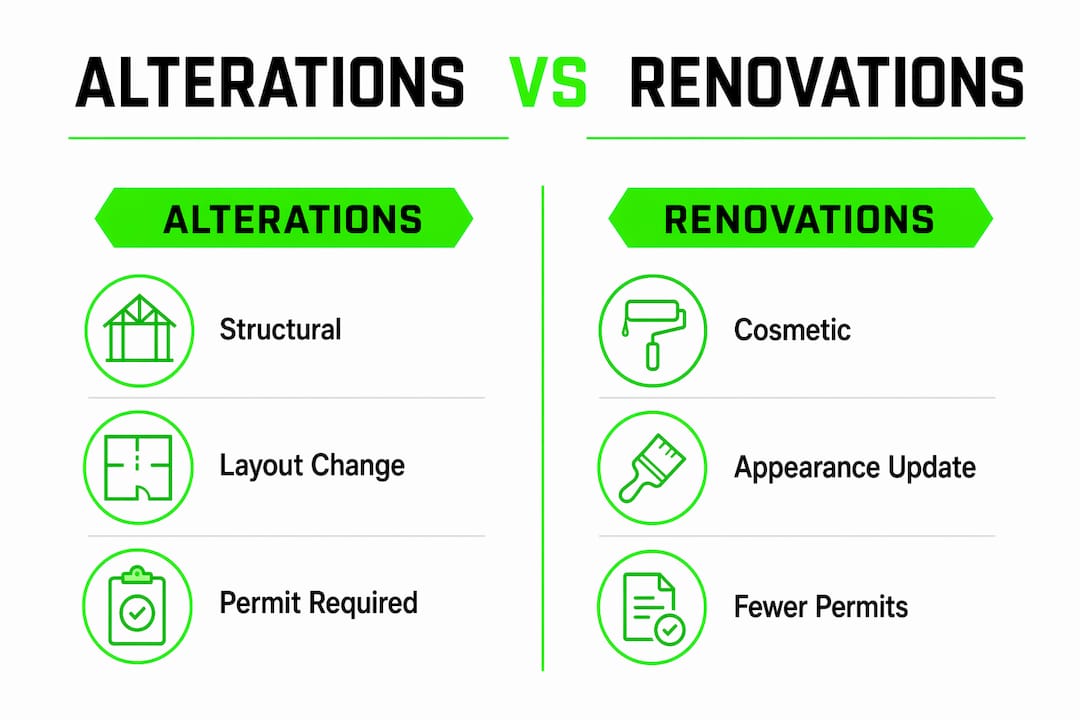
An alteration changes what a building is. A renovation changes how a building looks. That single distinction drives every downstream decision about permits, contractors, and cost.
Renovations refresh or update a space without changing its basic layout or structure, and they typically require fewer specialized permits. This means a homeowner repainting walls, replacing flooring, or updating cabinet hardware is renovating, not altering. The project stays within the existing footprint and does not touch structural, electrical, or plumbing systems in any meaningful way.

Alterations, by contrast, involve moving walls, reconfiguring mechanical systems, changing occupancy classifications, or expanding square footage. These projects trigger building department review because they affect the safety and integrity of the structure. A business owner converting an open floor plan into private offices, or a homeowner removing a load-bearing wall to open a kitchen, is performing an alteration.
The industry standard term used by building departments and licensed contractors is alteration, not “home alteration” or “structural renovation.” Knowing this terminology matters when you speak with a permit office or hire a general contractor, because permit offices classify construction by formal levels rather than lay terms, which causes significant homeowner confusion.
What does an alteration project actually involve?
Alterations are tiered by scope and complexity. Most jurisdictions, including New York City and municipalities following the International Building Code, recognize three levels.
Level 1 alterations cover simple replacements in kind, such as swapping out a window for one of the same size or replacing a door without modifying the frame. These require minimal documentation.
Level 2 alterations involve reconfiguring space, adding or removing partitions, or upgrading systems like HVAC or electrical panels. These require permit drawings and inspections.
Level 3 alterations apply when work affects more than 50% of a building’s area or systems. Level 3 requires full structural and safety inspections and is treated similarly to new construction from a code compliance standpoint.
Structural changes classified as alterations include moving load-bearing walls, widening doorways for accessibility, converting a garage into living space, and reconfiguring plumbing stacks. Accessibility modifications are a common example. Projects widening doorways to a minimum 36 inches may qualify for government grants if properly documented, but they require coordination with structural engineers and the Authority Having Jurisdiction (AHJ).
Building codes require permits for structural, electrical, or plumbing modifications that go beyond cosmetic work. The AHJ reviews plans, issues permits, schedules inspections, and signs off on completed work. Skipping this process exposes property owners to fines, forced demolition of unpermitted work, and complications when selling the property.
Pro Tip: If your project involves touching any wall that could be load-bearing, moving a light switch to a new circuit, or relocating a drain line, assume you need an alteration permit and confirm with your local building department before starting.
What does a renovation project actually involve?
A renovation restores, modernizes, or updates existing conditions without altering the structure or layout of a space. The word itself comes from the Latin renovare, meaning to make new again. That etymology is a useful mental model: you are refreshing what already exists, not creating something different.
Common renovation projects include:
Painting interior or exterior surfaces
Replacing flooring with new hardwood, tile, or carpet
Updating kitchen cabinetry without moving walls or plumbing
Installing new light fixtures on existing circuits
Replacing windows with the same size and configuration
Refinishing bathroom tile or replacing a vanity in place
Permits must be obtained prior to reconstruction beyond simple repairs, but cosmetic painting or replacing fixtures typically does not require permits if no structural changes occur. This is a significant practical advantage for homeowners working on a tight schedule or budget.
Renovations appeal to property owners who want to modernize appearance for resale appeal without the disruption of a full structural project. Quality remodeling can recoup 70 to 90% of investment, while renovations generally return 60 to 80%. That gap narrows considerably when you factor in the lower cost and shorter timeline of a renovation. For budget-conscious owners or those planning to sell within a few years, renovations often deliver better net value.
Pro Tip: If your budget is under $25,000 and you are considering any structural work, redirect that budget entirely to cosmetic renovations. Contractors recommend reserving below-threshold budgets strictly for cosmetic updates to avoid corner-cutting on structural work that could create safety risks.
Alterations vs renovations: cost, scope, and permit comparison
The practical differences between these two project types become clearest when you compare them side by side across the factors that matter most to property owners.
Factor | Alteration | Renovation |
Scope | Structural, layout, or system changes | Cosmetic or surface-level updates |
Permit required | Yes, in most cases | Rarely, unless systems are touched |
Typical cost range | $25,000 and above | Under $25,000 for most projects |
Trades involved | Structural engineers, licensed electricians, plumbers | Painters, flooring installers, finish carpenters |
Project timeline | Weeks to months | Days to weeks |
Homeowner disruption | High, often requires temporary relocation | Low to moderate |
Resale value impact | High, especially for functional improvements | Moderate, strongest for kitchens and baths |
Mislabeling a project as a renovation instead of a remodel leads to budget overruns and scheduling issues because the scope is underestimated from the start. A contractor who bids a project as a renovation and then discovers structural work is required mid-project will issue change orders that can add 20 to 40% to the original estimate. Getting the classification right before work begins is not administrative formality. It is financial protection.
For commercial property owners, the stakes are higher. The operative test most building authorities use is whether the project changes occupancy classification, structural elements, or system capacity. A retail space converted to a restaurant, for example, triggers a full alteration review because the occupancy classification and mechanical systems change entirely.
You can explore how these distinctions apply specifically to commercial properties in this guide on commercial renovations in NY and NJ.
How do you decide between an alteration and a renovation?
The decision is not always obvious, especially for projects that sit at the boundary between cosmetic and structural work. Use this sequence to clarify your path before contacting a contractor or permit office.
Assess your functional needs. Ask whether your current layout actually serves how you use the space. If the answer is no, you likely need an alteration. If the layout works but the finishes feel dated, a renovation is sufficient.
Set a realistic budget. Projects under $25,000 are generally better suited to renovations. Attempting structural changes at that budget level risks subpar quality or incomplete work.
Check your timeline. Alterations require permit review, which can take two to eight weeks depending on your jurisdiction. If you need the space functional within 30 days, a renovation is the more practical choice.
Identify permit triggers. Ask your contractor directly: does this project touch any load-bearing element, change a system’s capacity, or modify the floor plan? If yes, you are in alteration territory.
Consider your long-term plans. Renovations modernize appearance for resale appeal, while alterations adapt a home for lifestyle needs like aging-in-place or expanded family use. Match the project type to your actual goal.
Consult a licensed general contractor before finalizing scope. A qualified contractor can identify hidden structural conditions that would convert a planned renovation into a required alteration, saving you from mid-project surprises.
For homeowners focused on return on investment, reviewing high-ROI renovation projects before committing to a scope helps prioritize spending effectively.
Common mistakes that cost property owners time and money
The most frequent errors in home improvement projects stem from misclassifying scope, underestimating costs, or skipping professional consultation at the planning stage.
Assuming cosmetic work never needs a permit. Replacing a window with a larger one, adding a ceiling fan to a circuit that cannot support it, or installing a new bathroom in an unfinished basement all require permits even though they may feel like minor updates.
Hiring a handyman for alteration-level work. Alterations require licensed trades. Structural work performed by unlicensed workers creates liability, voids homeowner’s insurance in some cases, and may require demolition and redo upon inspection.
Ignoring contingency budgeting. Structural projects routinely uncover surprises: outdated wiring, water damage behind walls, or undersized framing. A 15 to 20% contingency reserve is standard practice for any alteration project.
Failing to pull permits before starting. Incorrect permit classification can delay plan review and approvals significantly. Starting work without permits compounds the problem and can result in stop-work orders.
Treating renovation terminology as universal. The word “renovation” means different things to homeowners, contractors, and building departments. Understanding renovation terms that save money before your first contractor meeting prevents miscommunication that leads to scope creep.
Pro Tip: Before signing any contract, ask your contractor to identify the permit classification for your project in writing. If they cannot answer that question confidently, that is a signal to find a more experienced professional.
Key takeaways
Choosing between an alteration and a renovation comes down to one question: does your project change the structure or layout, or does it update what already exists?
Point | Details |
Alterations change structure | Any project touching load-bearing elements, systems, or layout requires permits and licensed trades. |
Renovations update surfaces | Cosmetic updates like painting, flooring, and cabinetry rarely require permits and cost significantly less. |
Budget drives classification | Projects under $25,000 are better suited to renovations; structural work at that budget risks quality compromise. |
Permit misclassification is costly | Incorrect classification delays approvals and can trigger stop-work orders or forced demolition of unpermitted work. |
Match project type to your goal | Renovations serve resale and appearance; alterations serve function, accessibility, and long-term lifestyle needs. |
What I’ve learned from years of classifying projects correctly
I have seen the same scenario play out more times than I can count. A property owner calls with what they describe as a “simple renovation.” They want to open up the kitchen, move the sink to the island, and add a half bath off the hallway. By the time we walk the space together, it is clear that three of those four goals require alteration permits, structural drawings, and licensed plumbing work.
The confusion is not the homeowner’s fault. The industry uses terms loosely, and most online content does not explain the regulatory reality behind the words. What I tell every client upfront is this: the label you use does not matter. What matters is what the work actually involves. Building departments do not care what you call it. They care whether it changes the structure, the systems, or the occupancy.
The owners who come in with clear goals and realistic budgets always have better outcomes. The ones who anchor to a label, whether “renovation” or “quick fix,” tend to hit walls mid-project, literally and figuratively. My advice is to describe what you want the space to do, not what you want to call the project. A good contractor translates that into the right scope, the right permits, and the right trades from day one.
The other thing I have learned is that permit compliance is not red tape. It is protection. Permitted work is inspected work. Inspected work is safe work. And safe work adds verifiable value to your property when it is time to sell.
— DJ
Plan your project with Djcustomcontracting
Whether you are weighing a cosmetic refresh or a full structural overhaul, getting the scope right from the start saves time, money, and stress. Djcustomcontracting has been serving residential and commercial property owners since 2018, handling everything from interior renovations to complex alterations, DOB compliance, and permit coordination across New York and New Jersey.

The team at Djcustomcontracting assesses your project, identifies the correct permit classification, and delivers quality workmanship at every stage. No job is too large or too small. If you are ready to move forward with confidence, explore interior renovation services or learn more about addition and alteration work to find the right fit for your property goals.
FAQ
What is the main difference between alterations and renovations?
An alteration changes the structure, layout, or systems of a building and requires permits, while a renovation updates existing finishes and surfaces without structural changes and rarely requires permits.
Do renovations require building permits?
Most cosmetic renovations, such as painting, flooring, and cabinet replacement, do not require permits. However, any work that touches electrical systems, plumbing, or structural elements triggers permit requirements regardless of how the project is labeled.
How much does an alteration project typically cost?
Alteration projects generally start at $25,000 and increase based on structural complexity, permit fees, and the licensed trades required. Budgets below that threshold are better directed toward cosmetic renovations to maintain quality standards.
Can a renovation become an alteration mid-project?
Yes. Contractors frequently discover structural conditions, outdated wiring, or plumbing issues behind walls that convert a planned renovation into a required alteration. A 15 to 20% contingency budget and upfront professional assessment reduce this risk significantly.
How do I find the right contractor for alterations or renovations?
Look for a licensed general contractor with documented experience in permit coordination and the specific type of work you need. Ask them to identify the permit classification for your project before signing any contract.
Recommended


Comments