


Close Out Your NYC Certificate of Occupancy Before a 90 Day TCO Lapses

A Certificate of Occupancy (CO) from the NYC Department of Buildings is the legal document that permits occupancy, and you need one before occupying, renting, or transferring most properties in the city. If your building’s use, layout, or occupancy has changed, or you’re closing out new construction, verify the existing CO in DOB NOW or BIS first, then request a Temporary Certificate of Occupancy (TCO) or Letter of No Objection (LNO) if the final CO isn’t ready yet.
TL;DR:
Open violations and incomplete paperwork are the main causes of delays in obtaining a final Certificate of Occupancy in NYC.
Most projects require a registered architect or engineer to manage the filing process, including inspections and technical reports, to avoid rejection.
Temporary Certificates of Occupancy expire within 90 days and must be renewed with proper documentation, but they do not replace the final CO.
Buildings constructed before 1938 often do not have a CO or need a Letter of No Objection, which takes approximately three weeks to process.
Verifying the CO online requires using specific portals based on filing date, with older records available via BIS and newer ones through DOB NOW.
Table of Contents
What Does a Certificate of Occupancy Show?
A CO records the specific legal facts DOB has verified about your building. It’s not a formality. It’s the document that tells a bank, a buyer, or an inspector exactly what your building is legally allowed to be used for.
The document typically lists:
The permitted use and occupancy classification (residential, commercial, mixed-use, or a specific business group)
The number of legal dwelling units
Special conditions tied to the certificate, such as occupancy limits per floor or assembly restrictions
Once issued, a Certificate of Occupancy has no expiration date. It stays valid until the building’s use, egress, or occupancy changes, at which point you need a new or amended CO. Buildings constructed before 1938 are typically exempt from ever having one issued, unless a later alteration triggers the requirement.
How Do You Get a Certificate of Occupancy in NYC?
The certificate of occupancy process in NYC runs on paperwork almost as much as it runs on construction. DOB won’t sign off on a finished building until every filing, inspection, and affidavit lines up. Here’s the sequence that gets you there.
Determine your filing type. New buildings and full-scope alterations typically file a PW7 for the final CO; jobs requesting a temporary occupancy period file a PW6. Projects filed before March 1, 2021 route through BIS; newer filings run through DOB NOW.
Complete required final inspections. DOB requires sign-offs on construction, plumbing, electrical, and (if applicable) elevator systems before it will consider a CO application complete.
Submit the final survey and Builders Pavement Plan (BPP), where the project scope requires one, along with the Owner’s Cost Affidavit (PW3).
Confirm the Schedule of Occupancy is approved inside DOB NOW: Build, matching what was actually constructed to what was permitted.
Clear every open application and open violation tied to the property. DOB will not issue a CO while either exists, no exceptions for “minor” items.
Submit through DOB NOW or BIS eFiling, upload the required technical reports, and track the review status until DOB schedules its final walkthrough.
This is where most owners underestimate the timeline. Clearing open violations and completing paperwork is often the actual bottleneck, not the physical construction. A building can be 100% finished and still sit without a CO for weeks because of one unresolved violation from an unrelated permit.
A Registered Architect or Professional Engineer manages most of this filing chain and can flag missing documents before DOB rejects the submission. For larger or stalled projects, DOB’s Project Advocate program and your local DOB borough office can intervene directly.
Pro Tip: Pull your open violations report from BIS before you file anything. Resolving a two-year-old violation from a prior owner is far faster than discovering it mid-review and restarting the clock.
What Are the Rules for a Temporary Certificate of Occupancy?
A TCO lets you occupy a building, or part of one, while a handful of outstanding items get resolved before the final CO issues. It’s common when construction is substantially complete but a final survey, minor punch-list item, or single inspection sign-off is still pending.
TCOs typically expire 90 days after issuance, sometimes shorter depending on the outstanding scope.
The standard filing fee runs around a hundred dollars, though certain project types are exempt.
Renewal requires re-filing before expiration and completing DOB’s TCO worksheet, which documents what’s changed since the last request.
A TCO is not a substitute for a final CO, and treating it like one is a common mistake. If the space sits unoccupied for an extended period, the TCO can lapse, which immediately blocks lawful occupancy until you secure a new TCO or the final CO. Track your expiration date like a lease renewal, because missing it stops operations cold.
When Do You Need a Letter of No Objection Instead of a CO?
Not every legal building has a CO to show, and DOB has two documents that fill that gap. A Letter of No Objection (LNO) applies most often to buildings constructed before 1938, when COs weren’t yet required. A Letter of Verification (LOV) instead confirms details about a CO that already exists, useful when a lender or licensing agency wants written clarification rather than a raw printout.
LNO: requested when no CO was ever issued and none is required; commonly needed for lenders, liquor licensing, or business permits on older buildings.
LOV: requested to confirm or clarify facts on an existing CO, often for a sale or refinance.
Processing time: LNO requests typically take about three weeks to process, so build that into your closing or opening timeline.
Common denial reasons: an open ALT-1 applications on the property, or unresolved life-safety violations, will stop an LNO or LOV from being issued until cleared.
Even a pre-1938 building that’s technically exempt from needing a CO will often hit a wall at closing if there’s no LNO on file. Lenders and licensing boards routinely ask for one anyway, so requesting it early avoids a last-minute scramble.
How Do You Search for a Property’s CO Online?
Verifying a certificate of occupancy in NYC takes minutes once you know which system to use, and using the wrong one is the most common time waster.
For filings on or after March 1, 2021, search by address in the DOB NOW public portal.
For older filings, use the BIS Building Information Search, which covers records predating DOB NOW.
Review the CO PDF for the use group, legal dwelling unit count, any special conditions, and the issue date, then save or print it for your records.
If the archival record is missing or illegible, contact your building’s DOB borough office directly and request a certified copy.
What Are the Biggest Reasons CO Applications Get Delayed?
Most CO delays trace back to a short list of repeat offenders, not surprise construction problems. Walking through this checklist before you file saves weeks.
Clear every open violation tied to the block and lot, including ones from prior owners or unrelated permits.
Confirm all inspection sign-offs are logged: construction, plumbing, electrical, and elevator where applicable.
Submit the PW3 Owner’s Cost Affidavit and PW7 together, not sequentially.
Upload every required technical report in eFiling before requesting the final walkthrough.
Confirm the Schedule of Occupancy in DOB NOW matches the as-built condition exactly.
Open ALT-1 applications and life-safety violations cause the most stalls, followed closely by missing final surveys or incomplete BPP filings. Rejected submissions almost always trace back to a missing signature or an outdated technical report.
Match the task to the right professional. A Registered Architect or PE handles the technical filings and Schedule of Occupancy. A licensed contractor handles the physical remediation, punch-list closeout, and violation removal that DOB is waiting on. Complex, stalled, or multi-agency projects benefit from DOB’s Project Advocate service. For alteration work that’s likely to trigger a CO amendment, review permit requirements before you file.
Pro Tip: If DOB flags a stop-work order mid-project, resolve it before touching the CO application. A CO filed on top of an active stop-work order will bounce every time.
Why Owners Underestimate the CO Closeout Process
The conventional advice treats a Certificate of Occupancy like a formality tacked onto the end of construction. It isn’t. It’s a compliance audit dressed up as paperwork, and the buildings that sail through it are the ones where violation removal started before the drywall did.
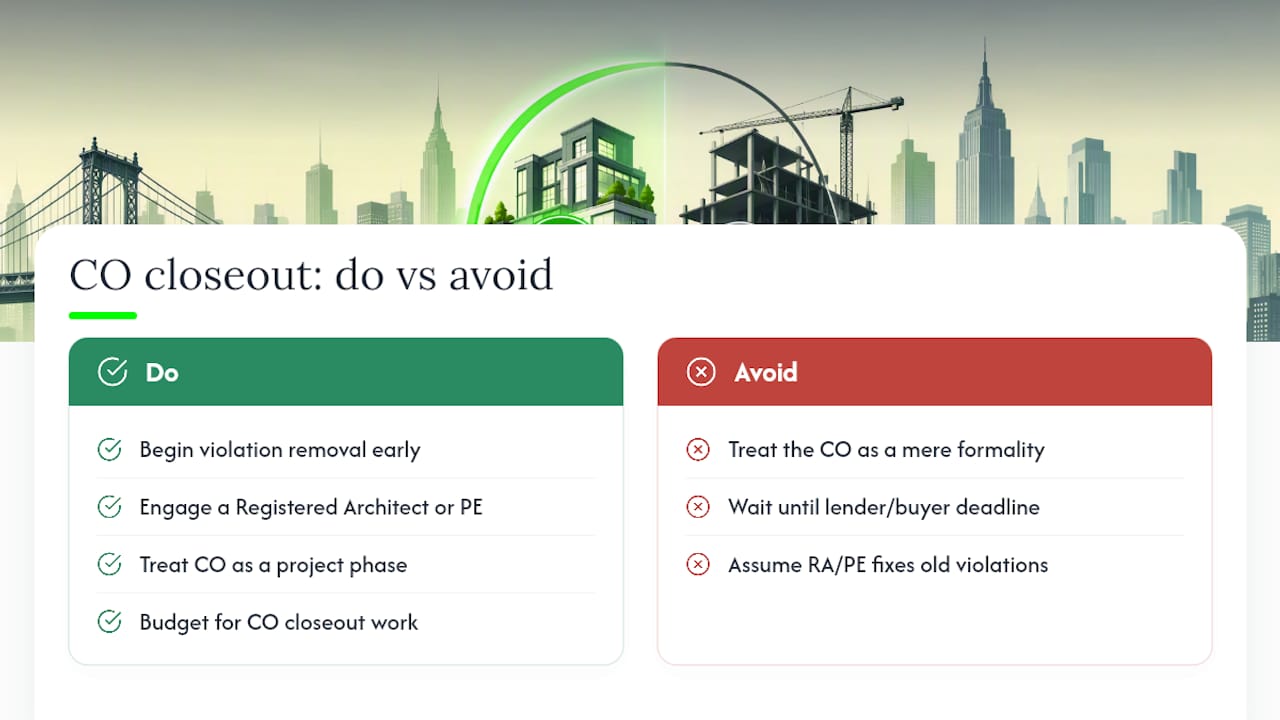
What actually slows owners down isn’t the inspection itself, it’s discovering an open violation from a previous owner’s unrelated permit three weeks before closing. Early engagement with a Registered Architect or PE reduces rejected DOB submissions, but it doesn’t fix a violation that’s been sitting open for years. That takes remediation work, and remediation work takes time you don’t have once a lender or buyer is waiting on the CO.
Treat CO closeout as a project phase, not a final step. Budget for it the same way you budget for permits.
— DJ
Get Help Closing Out Your Certificate of Occupancy
Clearing DOB violations, coordinating final inspection sign-offs, and prepping an inspection-ready punch list is exactly where a stalled CO closeout turns into a moving one. Professional contractors handle the physical side of that equation for property owners, including DOB and DOT violation removal, code compliance repairs, and the final-condition work that inspectors are waiting to see before they sign off.

That means fewer surprises between “construction complete” and “CO issued.” If your building has open violations, an expired TCO, or a punch list standing between you and your final Certificate of Occupancy, request a consultation on our commercial renovation page and get a clear plan for closeout instead of another delay. For contractors managing their own certification renewals alongside client projects, this WBE certification renewal overview is worth a look as well.
Sources
Recommended


Comments