


Contractors: Trim 30–90 Day Delays with a Kickoff Closeout Process


Construction closeout is the final project phase that hands a fully documented, inspected, and operable building to the owner. Success means a signed certificate of occupancy, a cleared punch list, and released retainage in the general contractor’s account. The project manager owns this outcome, and the projects that close fastest are those where documentation started at kickoff, not the final walkthrough.
TL;DR:
Collect documentation like warranties, as-built drawings, and manuals early during installation to prevent delays caused by scattered subcontractor responses.
Formal certifications of substantial and final completion set clear deadlines for punch list resolution and document turnover, reducing project delays.
A comprehensive turnover package, including all inspection certificates, lien waivers, and pictures, is critical for timely final payments and project closure.
Effective punch list management involves detailed entries with photos, responsible trades, and strict deadlines to avoid disputes and extend timelines.
Assigning clear responsibilities among the contractor, subcontractors, architect, and owner ensures a smooth closeout process and minimizes delays.
Table of Contents
What Does the Construction Closeout Process Actually Cover?
Closeout is not one meeting at the end of a job. It’s the phase where physical work, paperwork, inspections, and money all get reconciled at the same time, and each piece depends on the others moving on schedule.
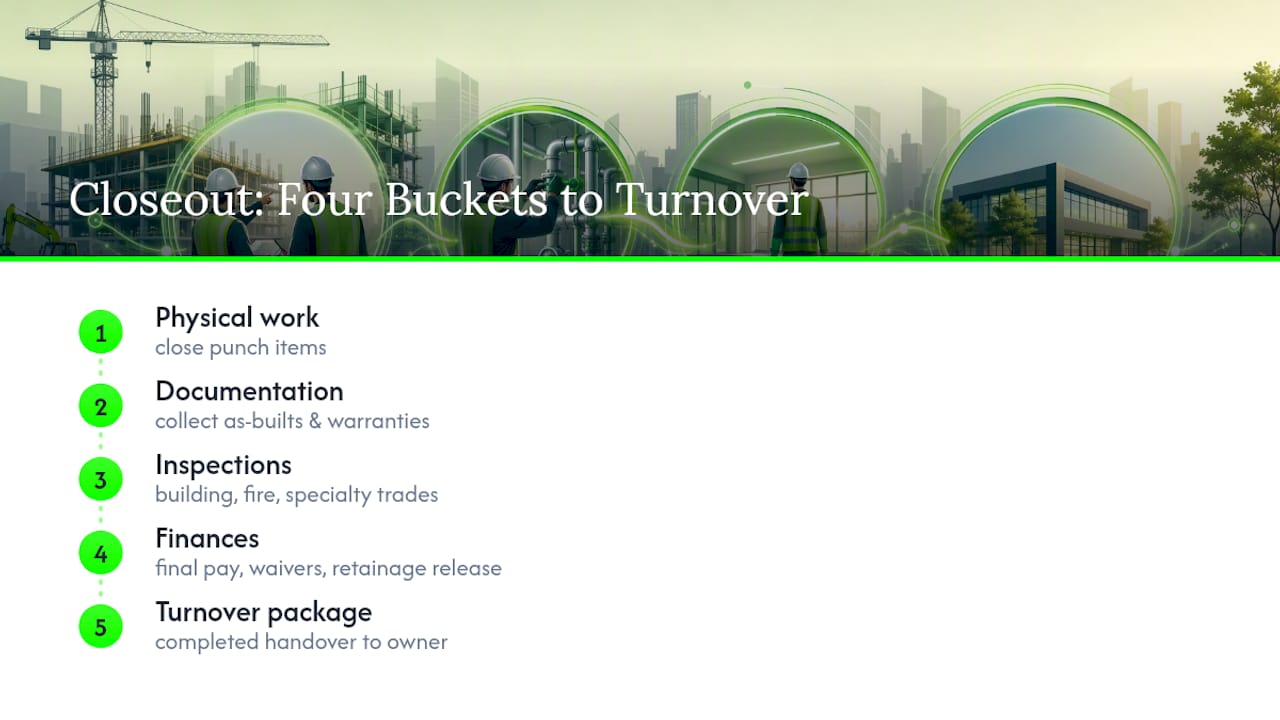
The scope breaks into four buckets: finishing the physical work (punch items), assembling documentation (as-builts, warranties, manuals), passing inspections (building, fire, specialty trades), and settling the finances (final payment application, lien waivers, retainage release). Miss one, and the other three stall regardless of how clean the rest of the package looks.
Two milestones anchor this phase. Substantial completion is the point where the owner can use the space for its intended purpose, even if minor items remain. It typically triggers a formal document, often modeled on the AIA’s Certificate of Substantial Completion, which starts the warranty clock and shifts insurance and maintenance responsibilities toward the owner. Final completion comes later, after every punch item closes, every inspection passes, and every document lands in the turnover package.
The gap between those two milestones is where most closeout pain lives. A punch list that should take two weeks stretches to two months because nobody assigned deadlines, and warranty documentation that should already be filed gets chased down from five different subcontractors after they’ve moved on to other jobs.
This is why experienced project managers treat closeout as a continuous habit rather than a final sprint. Contractors who collect closeout documents progressively during construction close projects faster and protect cash flow, because they’re not scrambling to track down a warranty card or a commissioning report from a sub who finished six months earlier. Starting the closeout checklist at the same meeting where you kick off the project isn’t extra work. It’s the same work, spread out instead of stacked at the end.
What Are the Steps in a Construction Closeout?
A typical closeout unfolds in a sequence of phases: substantial completion, punch list resolution, final inspections, documentation turnover, financial closeout, and final acceptance. Here’s how each phase actually plays out on a live job site.
Pre-closeout documentation collection. Long before the last coat of paint dries, start pulling O&M manuals, product data sheets, and warranty cards from subcontractors as each system gets installed. Waiting until the job is “done” to request this paperwork is the single biggest cause of closeout delay, because subs scatter to new jobs and stop answering emails.
Substantial completion certification. Once the space is usable, the architect or project manager issues a certificate documenting the date, the remaining punch items, and the responsibilities that transfer to the owner. This is the formal starting gun for the punch list phase and the warranty period.
Punch list walk and assignment. The design team, GC, and often the owner walk the space together, documenting every deficiency with a photo, exact location, and trade responsible. Items get assigned to specific subcontractors with hard deadlines, not vague “as soon as possible” language.
Final inspections and regulatory sign-offs. This covers the certificate of occupancy inspection, fire marshal walkthrough, elevator and life-safety inspections, and any specialty sign-offs tied to your jurisdiction’s building code requirements. Schedule these early. Inspectors book weeks out in busy markets, and a failed inspection means rescheduling at the back of the line.
Turnover package assembly. As-builts, warranties, O&M manuals, commissioning reports, and inspection certificates get compiled into one indexed package delivered to the owner. This is the deliverable the owner actually judges you on, regardless of how clean the physical construction looked.
Financial closeout. The final application for payment, supported by lien waivers and reconciled change orders, goes to the owner alongside the documentation package. Retainage release usually follows once the owner confirms the punch list is complete and the paperwork is in hand.
Final acceptance and project archive. The owner signs off, the certificate of final completion gets issued, and the project team archives the full record. This archive matters more than most teams realize. It’s the first place anyone looks when a warranty claim surfaces eighteen months later.
Local jurisdictions add wrinkles to this sequence. Projects in dense urban markets, for example, often carry additional inspection and CO coordination steps that smaller markets don’t require, which is worth mapping out before you build your closeout schedule, not after an inspector flags a missing permit sign-off.
What Documents Do You Need for Closeout?
A complete turnover package typically includes these core items, and missing even one commonly delays final payment:
As-built drawings showing the actual installed conditions, redlined from the original construction documents as changes happened in the field.
Operation and maintenance (O&M) manuals for every major system, including equipment specs, maintenance schedules, and manufacturer contacts.
Warranties from manufacturers and subcontractors, with start dates tied to the substantial completion certificate.
Commissioning reports documenting that mechanical, electrical, and life-safety systems were tested and perform as designed.
Final inspection certificates, including the certificate of occupancy and any specialty trade sign-offs.
Lien waivers from every subcontractor and supplier who touched the project, conditional and unconditional versions as appropriate.
Photo and video records documenting completed work, particularly for concealed conditions like wall cavities or below-grade utilities.
Each item needs a minimum content standard, not just a checked box. An O&M manual missing the equipment’s maintenance interval is functionally useless to a facilities manager six months later. As-built redlines need to show dimensional changes clearly enough that a future contractor can trust them without re-verifying the field. If you want a structured approach to capturing those changes accurately, as-built verification methods built around consistent photo and measurement records reduce the guesswork considerably.
Build the package around a single index document, numbered and cross-referenced, with digital files named consistently (project name, document type, date) and stored in one shared cloud folder. Owners reviewing dozens of subcontractor submittals do not want to hunt through unlabeled PDFs.
Pro Tip: Deliver both a digital archive and a printed binder for facilities-critical documents like fire system certifications. Some owners and AHJs still want a physical copy on-site for emergency reference, and a binder in the mechanical room costs you almost nothing to prepare.

How Do You Manage a Punch List Efficiently?
The punch list is where closeout timelines quietly fall apart, and it’s also where disciplined process makes the biggest visible difference. Run an internal pre-punch walkthrough before the owner and architect ever see the space. Fixing obvious items yourself, before the formal walk, shrinks the official punch list dramatically and makes the owner’s first impression a good one.
Time the pre-punch walk roughly one to two weeks before the scheduled owner walkthrough, giving trades room to close items without rushing the final review.
Write every item with a photo, exact location, responsible trade, and deadline. Vague entries like “fix drywall” get argued over; “patch drywall, room 204, north wall, 3-foot section, due Friday” does not.
Sequence trades in waves rather than sending every sub back at once, so painters aren’t touching up walls before the electrician finishes trim work in the same room.
Require photo proof of closure for every item before marking it complete, and have the architect or owner’s representative verify a sample before final sign-off.
Avoid the common trap of closing items verbally without documentation. Undocumented closures are the first thing that gets disputed when retainage release stalls.
Mobile tracking tools that let field crews pin punch items with photos directly on a floor plan cut down on double entry and give the architect a live view of progress instead of a static spreadsheet updated once a week. For interior fit-out work specifically, a structured snagging checklist approach applies the same discipline to furniture and finish details that often get overlooked in a mechanical-focused punch process. For a deeper look at running the pre-punch walk itself, our guide on starting punch lists early walks through the field sequence in more detail.
How Does Final Payment Work at Closeout?
The final application for payment needs to include the completed schedule of values, all reconciled change orders, and documentation for any stored materials still being billed. Owners and their lenders will not release funds against an application that doesn’t tie back cleanly to the original contract sum plus approved changes.
Assemble the final application package with a clean schedule of values, executed change order log, and backup for any remaining stored-materials claims.
Understand the difference between conditional and unconditional lien waivers. A conditional waiver takes effect once payment clears; an unconditional waiver takes effect immediately, whether or not the check has cleared.
Never sign an unconditional waiver before funds are confirmed in your account. This single habit prevents more payment disputes than almost any other closeout practice.
Expect retainage release to follow punch list completion and document delivery, though the exact timing depends on your contract terms and the owner’s internal approval process.
Reconcile every change order and credit before submitting final numbers. Post-payment disputes almost always trace back to a change order that was verbally agreed to but never formally documented.
Missing documentation is consistently cited as a leading cause of delayed final payments, which makes the connection between your turnover package and your bank account more direct than most contractors assume.
How Long Does Construction Closeout Take?
Residential and small commercial projects usually close in one to four weeks. Larger commercial jobs run 30 to 90 days depending on complexity. Weak documentation habits can stretch that far longer. One MSU study found internal closeout periods running into hundreds of days when tracking was poor.
Who Is Responsible for What During Closeout?
Closeout falls apart when nobody owns a task clearly, so assign responsibility before the punch walk even starts.
General contractor: coordinates the entire schedule, submits the final payment application, and assembles the turnover package from subcontractor inputs.
Subcontractors: deliver their own warranties, product data sheets, test reports, and signed lien waivers on the GC’s timeline, not their own.
Architect or designer: verifies punch list completion and confirms the work matches contract documents before signing off on final acceptance.
Owner and authority having jurisdiction (AHJ): the owner confirms occupancy readiness and releases retainage; the AHJ issues the certificate of occupancy and any required inspection approvals.
A commercial closeout checklist that spells out these roles in writing before the job starts eliminates most of the finger-pointing that happens when a document goes missing three weeks before the final walkthrough.
What Best Practices Speed Up Closeout?
Rolling documentation beats end-of-job scrambling every time. Collect warranty cards, product data, and O&M content the week each system gets installed, not the week the job wraps.
Photo-enabled mobile tracking for punch items removes the ambiguity that drags out verification. Calendar the owner walkthrough and retainage milestones the day you issue the substantial completion certificate, so nobody’s waiting on a scheduling conversation that should have happened weeks earlier. And never sign an unconditional lien waiver before the check clears. These are small process changes, but on a mid-sized commercial job they routinely shave weeks off a closeout that would otherwise drift.
Pro Tip: Treat your closeout checklist like a live document from day one of the project, not a form you fill out at the end. Update it every time a sub finishes a scope of work, and closeout becomes a formality instead of a scramble.
Who Handles Closeout at DJ Custom Contracting?
DJ Custom Contracting LLC has managed full-service residential and commercial renovation projects since 2018, covering interior and exterior renovations, additions, DOB and DOT violation removal, and commercial maintenance work across a range of project scales. That range means the closeout process gets applied on everything from a single-room remodel to multi-phase commercial builds.
For readers building out their own process, related guides cover construction purchase order management for stored materials tracking and the commercial project checklist for mapping responsibilities before a job starts. Portfolio case studies, licensing details, and project certifications are available directly through the company for readers evaluating a contractor for their next project.
Why Disciplined Closeout Protects Your Margin
Closeout is where profit either survives or evaporates. A punch list dragging into month three eats crew hours you didn’t budget for, and a missing lien waiver can freeze a payment you already spent. Experienced contractors handle late-stage compliance sign-offs and turnover coordination precisely because that discipline is what protects both the schedule and the number on the final check.
— DJ
Let DJ Custom Contracting Manage Your Closeout
Some contractors offer services for owners and property managers who would rather not chase down warranty cards, lien waivers, and inspection certificates themselves. Closeout packages, from punch list resolution to final documentation turnover, can be coordinated in-house rather than split across multiple subcontractors.
Such coordination can cover violation removal for owners facing outstanding city sign-offs, commissioning coordination for mechanical and life-safety systems, and full turnover package assembly to ensure necessary documents arrive organized and on time. For renovation projects specifically, the interior renovation team manages closeout from the same crew that ran the build, which means no handoff gaps between construction and turnover. Exterior projects get the same coordinated approach through the exterior renovation service line.
If your project is approaching substantial completion and you want a contractor who treats documentation as part of the build rather than an afterthought, reach out to DJ Custom Contracting to scope your closeout timeline and turnover deliverables before the punch walk even starts.
Sources
FAQ
What Is the Closeout Phase of Construction?
The closeout phase is the final stage of a project where punch list items get resolved, required documentation gets assembled and delivered, final inspections get passed, and financial matters like retainage and final payment get settled before the owner takes full possession.
What Are the 7 Stages of a Construction Project?
Most projects move through initiation, planning, procurement, construction, substantial completion, punch list and closeout, and final acceptance, though naming conventions vary by contractor and contract type.
How Long Does It Take to Close Out a Construction Project?
Residential and small commercial projects typically close out in one to four weeks, while larger commercial projects often take 30 to 90 days depending on complexity, and poor documentation habits can stretch that timeline into hundreds of days.
What Is a Closeout Submittal in Construction?
A closeout submittal is any document required for project turnover, including as-built drawings, O&M manuals, warranties, commissioning reports, and lien waivers, typically compiled into one indexed package for the owner.
Who Prepares the Punch List?
The design team, general contractor, and often the owner’s representative walk the project together and jointly document remaining deficiencies, with the GC assigning each item to the responsible subcontractor for closure.
Recommended


Comments