


File by Feb 21 or Pay $250/Month: Local Law 11 for NYC Owners

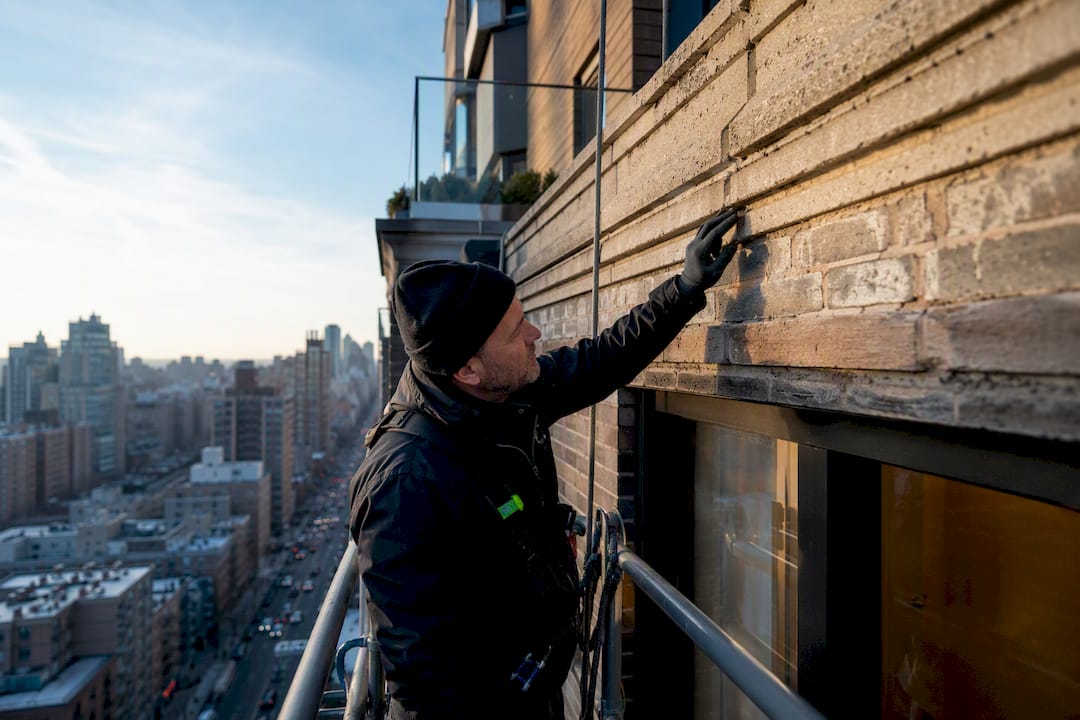
If your building rises more than six stories, Local Law 11 requires an exterior inspection every five years, performed by a Qualified Exterior Wall Inspector and filed through DOB NOW by your sub-cycle’s February 21 deadline. Act now on three fronts: retain a QEWI, schedule the critical examination before scaffolding and inspector calendars fill up, and confirm someone on your team will actually submit the technical report. If the facade comes back Unsafe, sidewalk sheds and repairs need to start right away.
TL;DR:
Buildings taller than six stories must retain a qualified exterior wall inspector and file inspection reports through DOB NOW by February 21 every five years.
Scheduling inspections and securing access equipment early are critical, as scaffold availability and inspector calendars fill quickly near deadlines.
Only a DOB-approved engineer or architect can perform the inspection and submit the technical report, which must be confirmed as filed to avoid violations and penalties.
Penalties for missing deadlines start at $250 per month and can escalate based on access costs, repair scope, and documentation lapses, especially for Unsafe facade conditions.
After inspection, owners must act promptly on Unsafe findings with immediate protective measures and file amended reports within two weeks of repairs to stay compliant.
Table of Contents
What Local Law 11 Covers, and Why It Exists
Local Law 11, formally the Facade Inspection Safety Program (FISP), is codified under NYC Construction Codes §28-302.1 and RCNY §103-04. It requires owners of buildings taller than six stories to have exterior walls and appurtenances, cornices, parapets, balconies, and anything else attached to the facade, inspected every five years by a QEWI.
The rule exists because pieces of buildings used to fall on people. New York adopted its first version, Local Law 10, after fatal masonry incidents in the 1970s, then expanded it into Local Law 11 in 1998 to close gaps in coverage and enforcement.
That history matters again right now. In 2024, the Department of Buildings brought in engineering firm Thornton Tomasetti to conduct an 18-month review of FISP under the Get Sheds Down initiative, analyzing tens of thousands of inspection reports to find evidence-based ways to cut unnecessary long-term sidewalk sheds without loosening safety standards. A few things to keep in mind as this modernization effort plays out:
Expect updated technical guidance and possibly revised classification criteria in the next filing cycles.
Sheds that have sat for years may face new scrutiny under the city’s push to reduce “permanent” scaffolding.
Owners who document repairs well now will have an easier time adapting to whatever rule changes follow.
Who Does the Inspection, and How Filing Actually Works
A Qualified Exterior Wall Inspector must be a New York State licensed professional engineer or registered architect who meets DOB’s experience and approval criteria. Only a DOB-approved QEWI can legally file your technical report.
The inspection itself, called a critical examination, is not a pair of binoculars from the sidewalk. For any condition the QEWI can’t fully assess remotely, the inspection requires up-close, hands-on access using a suspended scaffold, mast climber, or similar equipment reaching every story of the facade.
Here’s the process most owners miss a step in:
The QEWI completes the critical examination and documents conditions story by story.
The QEWI classifies the facade as Safe, SWARMP, or Unsafe and drafts the technical report.
The report gets filed electronically through DOB NOW: Safety, the portal DOB now requires for FISP submissions.
The owner confirms filing actually happened, not just that the site visit occurred.
That last step is where a surprising number of buildings get into trouble. The inspection can be flawless, and the building still ends up in violation because nobody pushed the report through DOB NOW.
Inspection Cycles, Sub-Cycles, and How to Find Your Deadline
FISP runs on five-year cycles, and within each cycle, buildings are split into three sub-cycles, A, B, and C, each with its own filing window closing February 21. Which sub-cycle your building falls into depends on its block number, and DOB publishes the assignments through the FISP filing instructions and Universe Map.
Don’t guess at this. Two buildings on the same street can land in different sub-cycles depending on block boundaries, and filing under the wrong assumption is exactly how owners end up scrambling in December for a deadline that already passed.
A few practical steps worth taking well before your window opens:
Look up your building’s block number and cross-reference it against the current FISP Universe Map.
Confirm the assignment directly with DOB records rather than relying on a property manager’s memory of “last time.”
Start QEWI outreach at least six to nine months ahead. Firms with strong FISP experience book up fast near deadline season.
Line up access equipment early. Scaffolding and mast climber availability tightens considerably as the February 21 date approaches.
Pro Tip: Order your access equipment the same week you retain a QEWI, not after the inspection is scheduled. Rig-and-scaffold companies get slammed every fall, and a two-week wait on equipment can push your entire filing past deadline.
The current Façade Rule was last revised in November 2021, so if you’re working from an older PDF or a property manager’s notes from a prior cycle, verify the details against DOB’s current published guidance before you rely on them.
Facade Classifications and What Each One Requires
Once the critical examination wraps, your QEWI assigns one of three classifications, and each carries different obligations.
Safe. No hazardous conditions identified. File the report, keep the paperwork, and you’re done until the next cycle.
SWARMP (Safe with a Repair and Maintenance Program). Minor deficiencies exist that aren’t immediately hazardous but need monitoring and repair on a documented schedule. The QEWI outlines the program and timeline in the report itself.
Unsafe. A hazardous condition exists that requires immediate action. Owners must install public protection, typically a sidewalk shed, right away, and repairs generally need to be completed within 90 days of the report.
Once Unsafe repairs are finished, the QEWI must file an amended report within two weeks confirming the work resolved the hazard. Skip that step and the building can remain flagged as Unsafe in DOB’s system even after the shed comes down and the wall is fixed.
SWARMP deserves more respect than it usually gets. A condition marked SWARMP twice in a row, meaning it was noted but never actually repaired, tends to draw closer scrutiny from DOB in later cycles. Treat SWARMP items as a to-do list with a deadline, not a pass.
Penalties and What Actually Drives Your Costs
Missing the Feb 21 filing deadline triggers monthly penalties starting at $250, assessed by the Environmental Control Board and compounding for every month the report remains unfiled. That’s the visible cost. The bigger budget item is usually something else entirely.
Inspection fees themselves are often the smallest line in a FISP budget. What actually drives cost is access equipment, suspended scaffolds, mast climbers, or swing stages, priced by building height, facade complexity, and how long the rig needs to stay up. Repair scope varies wildly too: repointing a few courses of brick costs a fraction of replacing failed parapet anchors across an entire elevation.
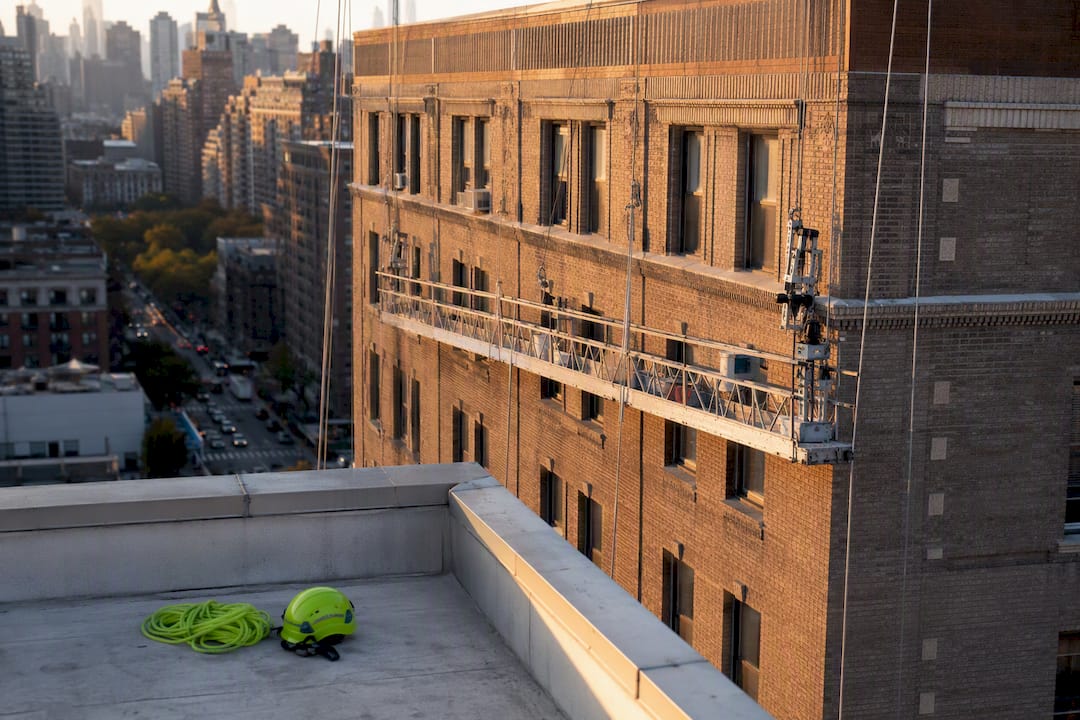
Then there’s the administrative trap covered above: inspection done, report never filed. It’s one of the most common and entirely avoidable ways buildings end up owing penalties, and recent legal commentary points to a broader shift toward risk-based enforcement, meaning documentation gaps are getting less forgiving, not more. Emergency shed installation after a violation notice also runs considerably higher than scheduling the same equipment months in advance.
A Practical Checklist for Your Next FISP Cycle
Running through a cycle without surprises comes down to sequencing. Here’s the order that works:
Confirm applicability. Six stories or fewer generally exempts you; taller buildings are in scope.
Verify your sub-cycle (A, B, or C) against DOB’s current records, not last cycle’s paperwork.
Retain a DOB-approved QEWI with genuine FISP filing history, not just general facade experience.
Coordinate access equipment (scaffold, mast climber) before the inspection date, not after.
Complete the critical examination, including any required hands-on checks.
File the technical report in DOB NOW and get written confirmation it was accepted.
If Unsafe, execute repairs within the required window and file the amended report within two weeks of completion.
When vetting a QEWI or contractor, ask directly about their FISP filing history, expected equipment needs for your building type, and whether they can show a sample report. A firm that hedges on any of those three is a red flag worth taking seriously.
Pro Tip: Keep a single folder, physical or digital, with every technical report, amended report, and repair invoice from the last two cycles. When DOB or a buyer’s attorney asks for history during a sale or refinance, having it organized saves weeks.
What Happens After the Inspection: Acting on the QEWI’s Report
Getting the report back is the beginning of the real work, not the end of it. Read the QEWI’s findings closely, especially anything flagged SWARMP, because that’s where owners tend to lose track of obligations between cycles.
For a Safe classification, your job is mainly recordkeeping: confirm DOB NOW shows the filing as accepted, file the report with your building’s compliance records, and set a calendar reminder for the next cycle now, while it’s fresh.
A SWARMP classification comes with a repair and maintenance program the QEWI has outlined, often with specific timelines for specific conditions. Treat that program as a contract with future you. Assign each item an owner and a completion date, and don’t let it sit untouched until the next inspection reveals it’s gotten worse.
An Unsafe finding means the clock started the moment the report was filed. Public protection needs to go up immediately, and repairs generally need to wrap within 90 days. Get a contractor scoped and mobilized fast, because the 90-day window includes permitting time, not just the physical repair work.
Whatever the classification, don’t treat the QEWI’s recommendations as suggestions. If they flagged a hairline crack as something to monitor, put a monitoring date on the calendar. If they recommended a specific repair method, get a second opinion from your contractor before overriding it, since deviating from the QEWI’s documented recommendation without justification can complicate your next cycle’s report.
Common Facade Defects Inspectors Actually Find
Most FISP reports aren’t uncovering exotic structural failures. They’re catching the slow, predictable damage that comes from decades of New York weather working on masonry, steel, and sealant.
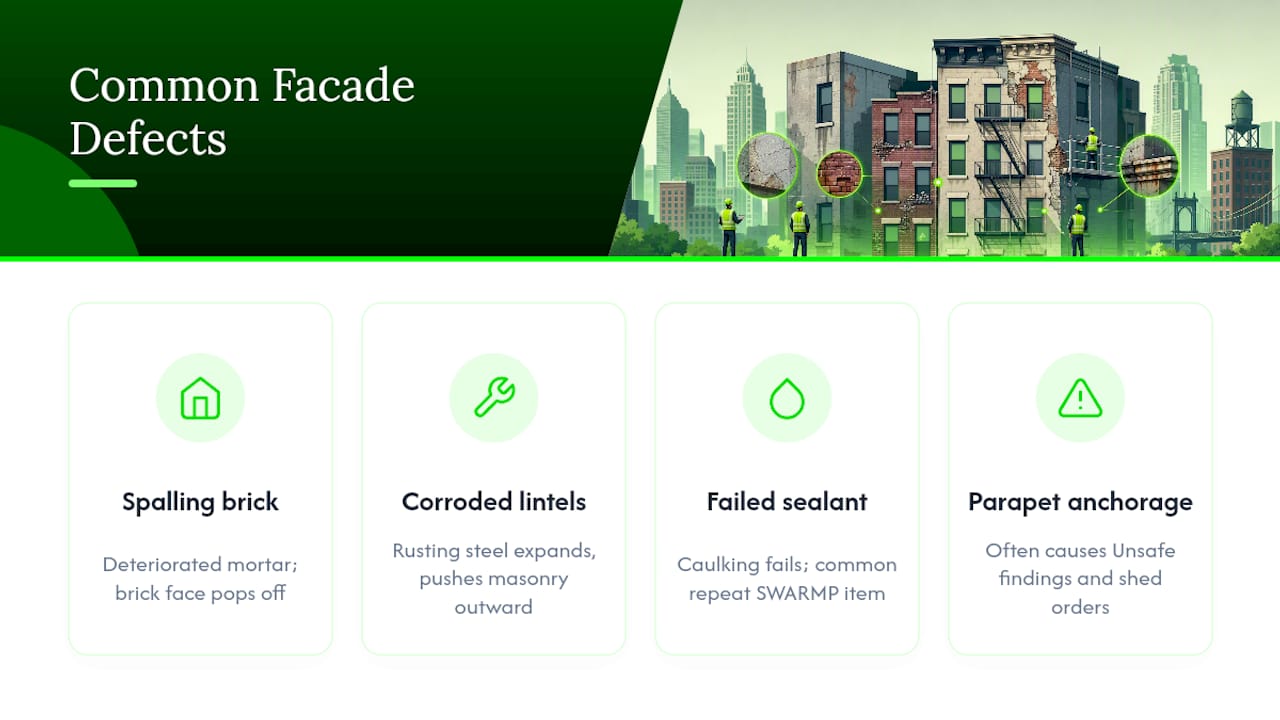
Spalling brick and deteriorated mortar joints top the list, especially on prewar buildings where original mortar has outlived its intended lifespan by fifty years or more. Water gets into a joint, freezes, expands, and the brick face pops off. Left alone, it’s an Unsafe finding. Caught early, it’s routine repointing.
Corroded lintels and shelf angles are another frequent finding, particularly above windows on older brick buildings. Rusting steel expands and pushes the brick above it outward, sometimes cracking a whole course of masonry. This is exactly the kind of condition that starts as SWARMP and escalates to Unsafe if a monitoring recommendation gets ignored for a cycle or two.
Failed sealant and caulking joints around windows and expansion joints show up constantly on newer curtain wall and precast buildings. It’s cheap to fix and easy to defer, which is precisely why it’s a common repeat SWARMP item.
Parapet and cornice anchorage failures round out the list, and they’re the ones that tend to generate Unsafe classifications and immediate shed requirements, since a failing anchor at the top of a building poses the most direct pedestrian risk.
Who’s Actually Responsible: Owner and Manager Roles
The building owner bears ultimate legal responsibility for FISP compliance, full stop. That responsibility doesn’t transfer to the QEWI, the property manager, or the contractor doing repairs, even though all three play essential roles.
Property managers typically handle the operational side: getting quotes from QEWIs, scheduling access equipment, and tracking deadlines across a portfolio. That’s valuable work, but managers should confirm in writing with ownership who has final authority to approve repair budgets, since Unsafe findings on a 90-day clock leave no room for a slow decision chain.
Boards and ownership groups at co-ops and condos need a designated point person for DOB NOW filing specifically. This is the single most common gap: everyone assumes someone else hit submit. Naming one person, by title, not just by current employee, and confirming submission with a DOB NOW confirmation screenshot closes that gap for good.
Whoever holds this responsibility should also keep an eye on repeat SWARMP items across cycles, since those patterns tend to draw closer DOB attention over time rather than less.
How to Vet a QEWI Before You Sign a Contract
A Qualified Exterior Wall Inspector has to be a New York State licensed professional engineer or registered architect approved by DOB to file FISP reports, but that baseline license doesn’t tell you much about whether they’ll do a good job on your specific building.
Ask for their FISP filing history directly. A QEWI who’s filed dozens of reports across similar building types, prewar masonry, curtain wall high rises, brownstone conversions, will spot problems faster than one who mostly does new construction inspections.
Request a sample report, with identifying details redacted if needed. A thorough report documents conditions story by story with photos and specific locations, not vague summary language. If the sample reads like boilerplate, that’s a signal.
Confirm they’ve priced out access equipment needs for your building’s height and facade type before quoting a flat fee. A QEWI who quotes without discussing scaffold or mast climber requirements may be underestimating the job, and that gap tends to surface as a change order mid-inspection.
Finally, ask how they handle SWARMP documentation and timeline recommendations. You want specific dates and specific conditions, not generic “monitor annually” language that gives you nothing to act on before the next cycle.
Why Lenders and Insurers Care About Your FISP Status
Mortgage lenders and insurance underwriters both request FISP compliance status during due diligence, and an Unsafe classification or a lapsed filing can complicate both a refinance and a renewal.
Lenders reviewing a commercial building for refinancing or a new loan routinely pull DOB violation history as part of underwriting. An open FISP violation, especially one tied to an Unsafe facade classification, signals unaddressed physical risk to the collateral, and it can slow approval or trigger a lender requirement that repairs be completed before closing.
Property insurers factor facade condition into both pricing and coverage decisions. A building with a clean FISP history and documented repairs generally presents lower liability risk than one with open violations or a pattern of deferred SWARMP items. Some insurers will request the most recent technical report directly during renewal underwriting, particularly for older masonry buildings in dense pedestrian areas.
For co-op and condo boards, this shows up at the worst possible time: during a unit sale, when a buyer’s attorney or lender’s counsel asks for the building’s compliance history and finds an open violation or an unfiled report. That single documentation gap can delay or derail a closing that has nothing directly to do with the buyer’s own finances.
Keeping a clean, filed, and current FISP record isn’t just a safety requirement. It’s collateral protection that shows up on both sides of a real estate transaction.
The Compliance Trap Nobody Talks About Enough
Every guide to Local Law 11 walks through cycles, deadlines, and classifications. Almost none of them dwell on the part that actually costs owners money: the gap between “the inspection happened” and “the report got filed.” That administrative disconnect, not ignorance of the five-year cycle, is what generates most of the avoidable penalties I’ve seen discussed across DOB’s own compliance guidance.
The conventional advice tells owners to focus on hiring a good QEWI and budgeting for repairs. That’s necessary but incomplete. The real risk sits in the handoff between inspector and DOB NOW submission, and in the slow drift of SWARMP items that get noted, ignored, and noted again three years later as something worse.
What should change first: name one person, by title, responsible for confirming DOB NOW acceptance on every filing, and treat every SWARMP item as a dated obligation rather than a footnote. The Get Sheds Down modernization work suggests the city is heading toward more evidence-based, less blanket enforcement, which rewards owners who document remediation carefully and penalizes those who treat FISP as a box to check every five years.
— DJ
Get a Local Law 11 Readiness Review Before Your Deadline Hits
Some contractors handle the part of Local Law 11 compliance that inspection reports don’t cover: the actual repair work, DOB and DOT violation removal, and the project coordination that keeps a filing on schedule instead of stuck behind a change order. Where many owners hit a wall is finding a contractor who can move from “Unsafe” on a report to permits pulled and scaffolding down within the 90-day window.

If your QEWI flagged spalling brick, failed lintels, or parapet anchorage issues, or if you’ve got open DOB violations tied to a prior FISP cycle, Djcustomcontracting’s exterior renovation team can scope the repair, coordinate access equipment, and manage permitting so your amended report gets filed on time. For broader compliance questions across a portfolio, the local law compliance guide covers how contractor coordination fits into ongoing obligations beyond FISP alone, including Local Law 97 filing deadlines that many of the same buildings face.
Request a readiness review or site visit now, before your sub-cycle deadline puts you on someone else’s waiting list for scaffolding and permits.
Sources
Recommended


Comments