


Local Law Compliance Guide for NY and NJ Owners


Local law compliance is the requirement to follow all applicable municipal, county, and state regulations governing property management and renovations within your jurisdiction. For homeowners and business owners in New York and New Jersey, this means navigating layered rules from city building departments, county zoning boards, and state agencies simultaneously. Missing a single permit or license can trigger fines, forced shutdowns, or costly remediation work. This local law compliance guide breaks down exactly how to find, interpret, and maintain compliance with the regulations that apply to your property or business.
What is a local law compliance guide and why does it matter?
Local law compliance covers every rule that governs how you use, modify, or operate a property. These rules come from three overlapping sources: municipal codes (city or town ordinances), county regulations, and state statutes. Each layer can impose different requirements, and all three apply at once.
Non-compliance carries real financial consequences. Zoning violations can lead to daily fines and potential forced closure until resolved. That means a single unresolved zoning issue can compound into thousands of dollars in penalties before you even appear before a hearing officer.
Business owners face an additional layer of risk. Failure to maintain a business license can result in fines starting at $100 to over $1,000 and cease-and-desist orders. For a property owner running a commercial operation, a cease-and-desist order can halt revenue entirely.
The standard industry term for this process is “regulatory compliance,” but in the context of property and construction, practitioners typically call it “local code compliance.” Both terms describe the same obligation: know the rules, follow them, and document that you did.
How do you identify which local laws apply to your property?
Jurisdiction is the first question to answer. A property in Jersey City, New Jersey falls under Jersey City ordinances, Hudson County regulations, and New Jersey state law. A property in Brooklyn falls under New York City Administrative Code, New York State law, and potentially special district rules. Knowing exactly which government bodies have authority over your address determines which rules you must follow.
Start your research with these steps:
Check your property’s jurisdiction. Use your county assessor’s website or a GIS mapping tool to confirm the exact municipality and zoning district for your address.
Locate the municipal code online. Most New York and New Jersey municipalities publish their codes through platforms like Municode or their official city websites. Search by address or municipality name.
Navigate the code hierarchy. Municipal codes are organized hierarchically by Title, Chapter, and Section. This structure helps you locate and cite specific laws precisely, and it reveals related provisions that a broad keyword search would miss.
Verify the current version. Online codes are not always up to date. Cross-reference the publication date on the code platform with recent council meeting minutes or the municipal clerk’s office to confirm you are reading the current ordinance.
Call the local building or zoning department. Staff can confirm which version of a code is currently enforced and flag any recent amendments not yet reflected online.
Pro Tip: Use the hierarchical section number, not just a keyword search, when researching a specific requirement. Searching “Title 9, Chapter 3, Section 12” returns the exact provision and its cross-references. A keyword search for “signage” may return dozens of unrelated results.
Effective compliance research targets specific provisions using municipal code hierarchical numbering rather than broad keyword searches, which avoids missing related rules. This approach saves time and reduces the risk of acting on incomplete information.
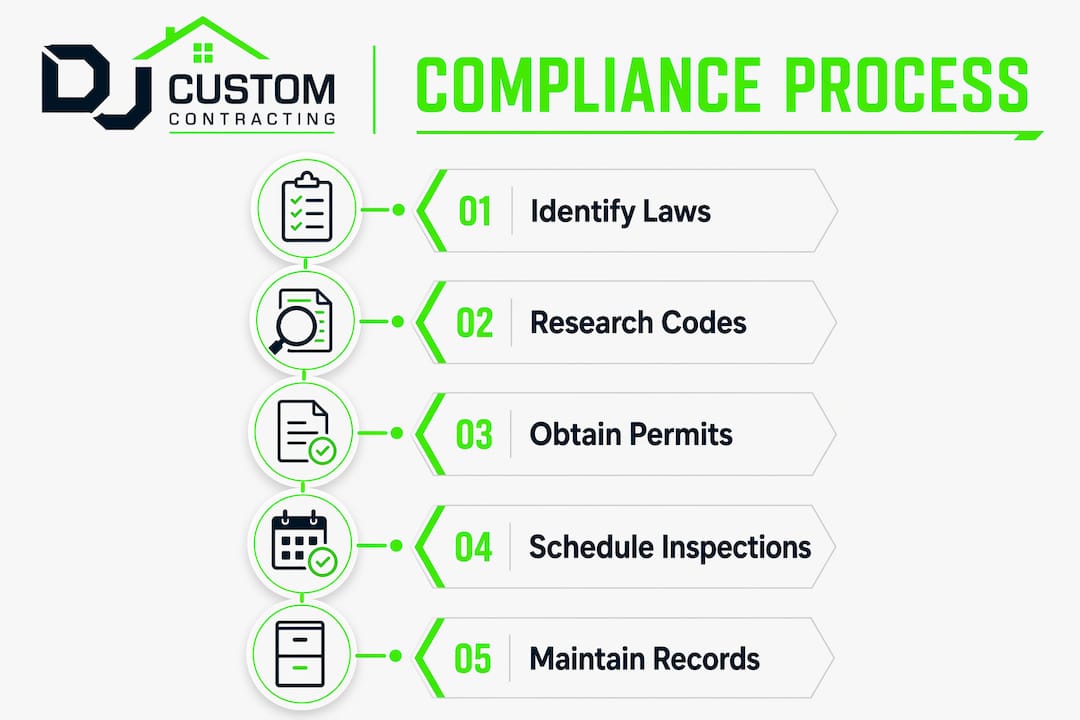
What are the key compliance areas: zoning, permits, licenses, and inspections?
Four categories cover the majority of local compliance obligations for property and business owners in New York and New Jersey.
Zoning and land use
Zoning rules determine what activities are permitted on a given parcel. A residential zone may prohibit commercial operations entirely. A commercial zone may restrict the type of business, hours of operation, or building modifications. Before signing a lease or starting a renovation, verify that your intended use is permitted in the zoning district. Permits for construction, signage, health, and safety are usually required and must be obtained before starting work. Certain activities like food service or auto repairs require special use permits beyond standard zoning approval.

Licenses and permits
Compliance Category | Typical Requirement | Consequence of Non-Compliance |
Business license | Annual renewal, fee $50–$500 | Fines $100–$1,000+, cease-and-desist |
Construction permit | Required before any structural work | Stop-work order, fines, demolition |
Signage permit | Required for exterior signs | Removal order, daily fines |
Special use permit | Required for food service, auto repair | Forced closure |
Home occupation permit | Required for home-based businesses | Fines, license revocation |
Home-based businesses must adhere to local licensing ordinances with very limited exemptions. A home-based hair stylist, for example, still needs a business license, a home occupation permit, and potentially a health department permit. The assumption that working from home exempts you from licensing is one of the most common and costly compliance mistakes.
For construction and renovation projects, the role of permits in construction extends beyond paperwork. Permits trigger inspections that protect you legally if a dispute arises later.
Inspections and reporting
Mandatory inspections apply to fire safety systems, electrical work, plumbing, and structural elements. In New York City, facade inspections under Local Law 11 are required on a five-year cycle for buildings taller than six stories. Fire safety and public health violations carry higher fines than standard building code infractions. Missing an inspection deadline can place your property on a violation list, which affects your ability to sell or refinance.
Pro Tip: Keep a copy of every passed inspection report in a dedicated compliance folder, physical or digital. Inspectors change, records get lost, and having your own documentation protects you if a question arises years later.
Maintaining safe commercial spaces is part of ongoing compliance, not just a one-time inspection concern. Regular upkeep directly supports your ability to pass recurring safety checks.
How do you read and interpret a municipal code correctly?
Municipal code language follows legal drafting conventions that differ from everyday writing. Two words carry outsized importance: “shall” and “may.” “Shall” means mandatory, “may” means permissive, and misinterpreting this distinction leads to direct compliance errors. If a code says a property owner “shall obtain a permit,” there is no discretion. If it says a permit “may be required,” you need to read further to determine the triggering conditions.
Follow this process when reading a municipal code provision:
Identify the governing body. Confirm whether the provision comes from a city ordinance, a county code, or a state statute. Each has different enforcement authority.
Check the effective date. Verifying the currency of municipal codes by checking publication dates and cross-referencing council minutes is essential to avoid relying on outdated laws.
Understand home rule vs. Dillon’s Rule. New Jersey municipalities operate under home rule, meaning they have broad authority to legislate locally. New York municipalities operate under a mix of home rule and state preemption depending on the subject matter. Understanding whether a municipality operates under home rule or Dillon’s Rule affects the scope of local legislative authority and potential conflicts with state law.
Check for state preemption. State-level statutes can preempt local ordinances, meaning some local laws may not be enforceable if overridden by the state. A local ordinance that conflicts with a state statute is unenforceable, but you need to know which one controls before you rely on it.
Read cross-references. Most code sections reference related provisions. Follow those references before concluding what is required.
Pro Tip: When in doubt about a code’s meaning, submit a written interpretation request to the local building or zoning department. Their written response becomes your documented defense if an enforcement action arises later.
Understanding building codes at a structural level makes this interpretation process significantly faster for renovation projects.
What are the best practices for maintaining ongoing compliance?
Compliance is not a one-time event. Regulations change, licenses expire, and inspection cycles recur. Property and business owners who treat compliance as an ongoing process avoid the penalties that catch reactive owners off guard.
Build a compliance calendar. Maintaining a compliance calendar with renewal dates and monitoring local law amendments helps avoid missed deadlines and penalties. Include license renewal dates, inspection due dates, and any reporting deadlines specific to your property type.
Monitor law changes actively. Subscribe to your municipality’s official newsletter or council meeting notifications. New York City and New Jersey municipalities frequently update codes, and changes can take effect with little public notice.
Respond to violations immediately. When a citation arrives, read it carefully, note the response deadline, and contact the issuing department within 48 hours. Most jurisdictions allow a cure period before fines escalate.
Document everything. Keep records of permits, licenses, inspection reports, correspondence with officials, and any legal opinions you receive. Good documentation is your primary defense in an enforcement proceeding.
Consult a professional for complex issues. Zoning variances, appeals, and multi-jurisdictional projects require legal counsel or a licensed expediter who knows the local process.
Pro Tip: Set calendar reminders 60 days before any license or permit expiration. Renewals often require inspections or updated documentation, and 60 days gives you time to gather what you need without rushing.
A commercial project checklist built around compliance milestones is one of the most practical tools for keeping a renovation or build on track legally.
What specific compliance challenges do NY and NJ property owners face?
New York and New Jersey share a border but operate under very different compliance frameworks. Recent updates have intensified facade inspection and energy use reporting in NYC, while New Jersey mandates vary widely by municipality, creating a patchwork that catches property owners off guard.
Key considerations for New York property owners:
New York City’s Department of Buildings (DOB) enforces Local Law 11 facade inspections, Local Law 97 carbon emissions limits for large buildings, and mandatory annual fire safety inspections.
DOB violations must be resolved within specific timeframes or fines escalate daily. Violation removal is a formal process, not simply fixing the underlying issue.
New York State’s Multiple Dwelling Law imposes additional requirements on residential rental properties, separate from NYC’s local code.
Key considerations for New Jersey property owners:
New Jersey operates under the Uniform Construction Code (UCC), administered at the local level by municipal construction officials.
Each municipality sets its own fee schedule and inspection timelines within the UCC framework, so requirements in Newark differ from those in Hoboken even though both follow state law.
New Jersey’s home rule authority means local zoning ordinances can be highly specific, and variances require board approval that can take months.
Both states require local licensing compliance for contractors performing work on your property. Hiring an unlicensed contractor can make the property owner liable for code violations, even if the contractor caused them.
Key Takeaways
Consistent, documented compliance with municipal codes, permits, and licensing requirements is the most reliable way to protect your property investment and avoid escalating fines in New York and New Jersey.
Point | Details |
Jurisdiction first | Confirm your exact municipality and zoning district before researching any specific requirement. |
Code hierarchy matters | Navigate by Title, Chapter, and Section to find precise rules and related provisions. |
“Shall” means mandatory | Misreading permissive vs. mandatory language in municipal codes causes direct compliance failures. |
Compliance is ongoing | A calendar with renewal and inspection deadlines prevents the missed-deadline penalties that compound quickly. |
State preemption applies | Some local ordinances are unenforceable when state law overrides them; always verify which level controls. |
What I’ve learned after years of working inside NY and NJ compliance systems
Most property owners treat compliance as a bureaucratic hurdle. I’ve seen that mindset cost people far more than the original permit fee would have. The owners who come out ahead are the ones who treat compliance research as part of the project budget from day one, not an afterthought when a stop-work order arrives.
The single most underused resource in New York and New Jersey is the local building department itself. Most staff will tell you exactly what you need if you ask directly and in writing. That written record protects you later. I’ve watched property owners spend thousands on legal fees disputing violations that a single pre-construction meeting with a building official would have prevented.
The other thing I’d push back on is the assumption that online municipal codes are current. They often lag behind actual enforcement by months. The code on Municode may not reflect an amendment passed at last month’s council meeting. Always call the clerk’s office and confirm the effective date of any provision you are relying on.
Compliance also builds relationships. Inspectors and zoning officers remember the owners who communicate proactively and fix issues without argument. That goodwill matters when you need a variance approved or an inspection expedited. Treat every interaction with a local official as a long-term investment in your ability to operate without friction.
— DJ
How Djcustomcontracting supports your compliance-ready renovation
Djcustomcontracting has worked on residential and commercial projects across New York and New Jersey since 2018, operating in full accordance with local building codes, DOB requirements, and state licensing regulations.

Every project Djcustomcontracting takes on includes permit coordination, inspection scheduling, and violation removal support where needed. For property owners facing DOB violations or planning a renovation that requires navigating local code requirements, Djcustomcontracting’s commercial renovation services cover the full scope from initial compliance review through final inspection sign-off. No job is too large or too small. Contact Djcustomcontracting to discuss your project and get a clear picture of what local compliance requires before work begins.
FAQ
What is local law compliance for property owners?
Local law compliance means following all applicable municipal, county, and state regulations that govern how a property is used, modified, or operated. For NY and NJ owners, this includes zoning rules, building permits, business licenses, and mandatory inspections.
How do I find the municipal code for my property in New York or New Jersey?
Most municipalities publish their codes on Municode or their official city websites. Confirm the current version with your municipal clerk’s office, since online databases sometimes lag behind recent amendments.
What happens if I ignore a zoning violation?
Zoning violations and building code infractions typically incur fines that escalate daily if not remediated, plus possible forced closure. Addressing a violation immediately is always less costly than letting it compound.
Do home-based businesses need permits in NY and NJ?
Yes. Home-based businesses must adhere to local licensing ordinances with very limited exemptions. A home occupation permit and a business license are typically required regardless of business size.
How often do local laws change in New York and New Jersey?
Local ordinances can change at any council or board meeting, which may occur monthly. Subscribing to official municipal newsletters and reviewing council minutes regularly is the most reliable way to stay current.
Recommended


Comments