


Why Is Building Code Compliance Important for Owners


Building code compliance is defined as the practice of adhering to legally mandated safety, structural, and operational standards that govern how buildings are constructed, renovated, and maintained. Understanding why building code compliance is important protects you from physical harm, legal liability, and serious financial loss. In New York and New Jersey, property owners face a layered system of federal model codes, state adoptions, and local amendments. The International Code Council publishes model codes that states then adopt and modify. Djcustomcontracting operates under this exact framework, rendering every service in accordance with applicable local laws, licensing requirements, and building codes.
Why is building code compliance important for safety?
Building codes exist because tragedies made them necessary. Fire safety codes and structural standards were developed through a consensus-driven expert process, built on decades of lessons learned from real disasters. That history is why codes carry the weight they do.
Codes protect occupants through several specific mechanisms:
Fire safety systems: Codes mandate sprinkler systems, fire-rated materials, and emergency egress routes. A building without compliant egress can trap occupants during a fire.
Structural integrity: Standards require buildings to withstand wind loads, snow loads, and seismic stress. A structure that skips these requirements can fail under conditions that a compliant building would survive.
Health and air quality: Ventilation requirements, sanitation standards, and moisture controls prevent mold growth and poor indoor air quality, both of which cause long-term health problems.
Workplace safety: Proper code compliance reduces workplace accidents and supports safer job site operations throughout the construction process.
The consequences of ignoring these protections are not theoretical. Structural collapses, electrical fires, and carbon monoxide incidents in non-compliant buildings have caused deaths that compliant construction would have prevented.
Pro Tip: When planning any renovation in New York or New Jersey, confirm that your contractor references the current adopted code edition for your specific municipality. Local amendments can add requirements beyond the state baseline.
What are the legal and financial consequences of non-compliance?
Non-compliance with building codes creates financial exposure that grows quickly and can follow a property for years.
Daily fines: Code violations generate fines ranging from several hundred to several thousand dollars per day. Fines scale with severity and increase for repeat offenses or ignored notices.
Stop Work Orders: Authorities can issue a Stop Work Order that halts construction immediately. A contractor who continues work after receiving one risks license suspension.
Insurance denials: Unpermitted work leads to denied insurance claims, lapses in coverage, and failed financing. Lenders routinely reject mortgage applications on properties with open violations.
Forced demolition: In serious cases, authorities can order unpermitted structures torn down entirely, at the owner’s expense.
Litigation risk: A formal notice of code violation documents that a property owner knew about a hazard. In a negligence lawsuit, that documented knowledge is critical evidence against the owner.
Receiving a notice of violation is not just a bureaucratic inconvenience. It creates a legal record proving you were aware of a safety hazard on your property. If someone is later injured because of that hazard, that notice becomes the foundation of a negligence claim against you.
One of the most overlooked risks involves property sales. Code compliance obligations transfer with ownership, meaning a buyer inherits every open violation on a property. This reality kills deals, delays closings, and forces sellers into emergency remediation at the worst possible time. For property managers in New York and New Jersey, understanding how to remove building code violations before a sale is not optional. It is a financial necessity.
How do evolving codes, state adoption, and local amendments affect compliance?
Building codes are not static documents. The International Code Council updates its model codes on a three-year cycle. The problem is that states typically lag 6–8 years behind the latest edition. That gap means a building can be legally compliant with the adopted state code while missing safety improvements that experts already consider standard practice.
The interplay of federal, state, and local regulations creates a layered compliance obligation that owners must understand.
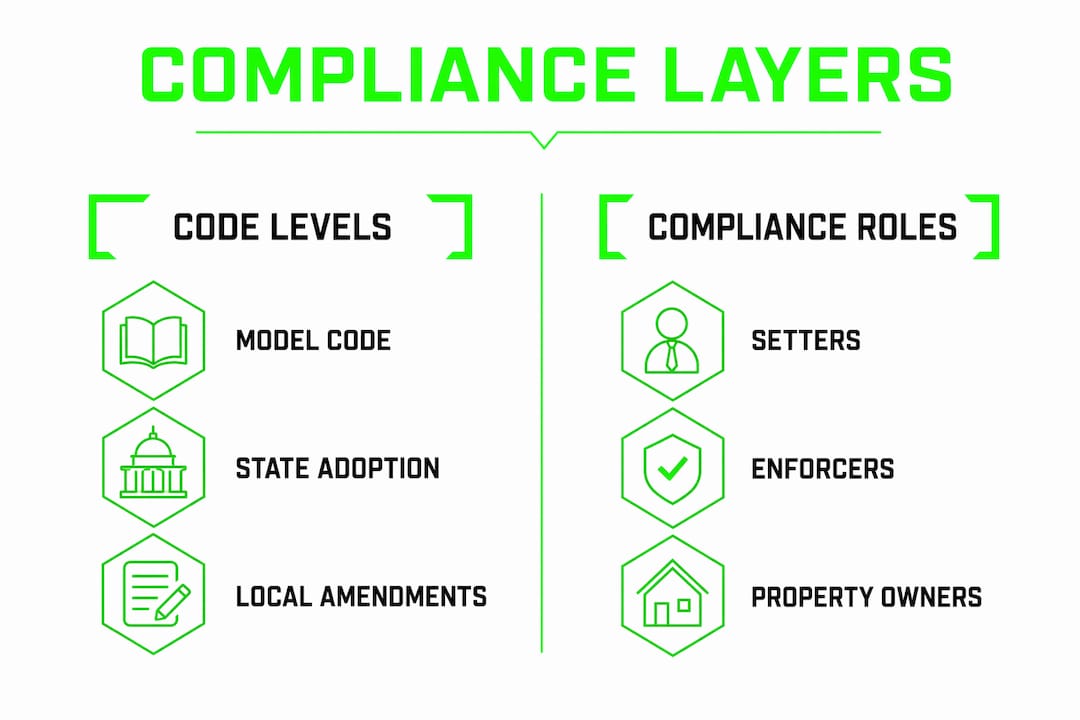
Code level | Who sets it | Who enforces it |
Model code | International Code Council | Not directly enforced |
State code | State legislature or agency | State building department |
Local amendment | City or county government | Local building inspector |
New York City operates under the New York City Building Code, which is a heavily amended local version of the International Building Code. New Jersey adopts the Uniform Construction Code, administered by the Department of Community Affairs. Both jurisdictions update their codes on their own schedules, independent of each other.
For historic buildings, the International Existing Building Code offers alternative compliance pathways that balance preservation requirements with modern safety standards. This matters for owners of older properties in Brooklyn, Newark, or Jersey City who want to renovate without gutting historic character.
Pro Tip: Before starting any addition or alteration in New York or New Jersey, verify which code edition your local building department is currently enforcing. The adopted edition in your municipality may differ from what your contractor assumes.
Practical steps for staying compliant during construction and property management
Maintaining compliance is a process, not a one-time checkbox. The steps below apply whether you are managing a residential renovation or overseeing a commercial property.
Pull permits before work begins. Unpermitted work is the single most common source of violations, insurance problems, and failed sales. Every structural, electrical, plumbing, or mechanical project requires a permit in New York and New Jersey.
Schedule and pass inspections. Permits require inspections at defined stages. Do not cover walls or pour concrete before the required inspection. Failing to schedule inspections is treated the same as failing them.
Document everything. Accurate documentation and early coordination with building departments help secure permits faster and reduce costly delays. Keep copies of all permits, inspection reports, and certificates of occupancy.
Address violations immediately. Ignoring a notice of violation does not make it go away. Fines accumulate daily, and the violation stays on the property record.
Work with contractors who know local codes. A contractor unfamiliar with New York City’s local amendments or New Jersey’s Uniform Construction Code will create compliance problems even with good intentions. Review the NYC building codes guide to understand what your contractor should already know.
Plan renovations with future code updates in mind. Code-aligned construction planning reduces inspection failures, prevents rework, and improves long-term building quality.
For property managers, compliance is an ongoing obligation tied to the property itself. Ownership changes do not reset the clock on existing violations. Conducting a compliance audit before acquiring any property in New York or New Jersey protects you from inheriting problems you did not create.
Key takeaways
Building code compliance is a legal, financial, and safety obligation that transfers with property ownership and grows more costly the longer it is ignored.
Point | Details |
Safety is the foundation | Codes mandate fire systems, structural standards, and health protections that prevent injuries and deaths. |
Violations follow the property | Open code violations transfer to new owners, threatening sales, financing, and insurance coverage. |
Fines escalate fast | Daily fines scale with severity and increase for ignored notices, making early resolution the only practical choice. |
Code editions lag behind best practice | States adopt model codes 6–8 years late, so legal compliance does not always equal the safest available standard. |
Documentation prevents disputes | Permits, inspection records, and certificates of occupancy are your legal defense in any violation or litigation scenario. |
What I’ve learned about compliance after years in New York and New Jersey construction
Property owners consistently underestimate how much code compliance protects them personally, not just their buildings. The conversation usually starts with cost. Owners ask why they need a permit for a bathroom renovation or why a structural inspection is required for what looks like a simple addition. The answer is always the same: the permit and the inspection are not for the building department. They are for you.
A formal inspection creates a paper trail that proves your property met the required standard at a specific point in time. Without that record, you have no defense if a future owner claims the work was defective, or if an insurer denies a claim after a fire. I have seen property sales collapse weeks before closing because a seller could not produce documentation for work done years earlier. That situation is entirely avoidable.
The other thing owners miss is the edition lag problem. Your building may be fully compliant with the code your municipality adopted, but that edition could be a decade old. Newer fire suppression requirements, updated egress standards, and improved structural specifications exist that your building does not meet. Legally, you are fine. Practically, your building is less safe than it could be. Proactive owners close that gap during renovations rather than waiting for the next code cycle to force the issue.
Compliance is not a regulatory hurdle. It is the most cost-effective risk management tool available to any property owner.
— DJ
Djcustomcontracting: code-compliant contracting for New York and New Jersey
Djcustomcontracting has delivered residential and commercial contracting services since 2018, with every project executed in accordance with applicable local laws, building codes, and insurance regulations.

Whether you need interior renovation services that meet New York City’s strict local amendments or exterior renovation work compliant with New Jersey’s Uniform Construction Code, Djcustomcontracting manages the permit process, coordinates inspections, and delivers documentation you can rely on. The team also handles DOB violation removal and DOT violation removal, so existing compliance problems do not block your project. No job is too large or too small. Contact Djcustomcontracting to discuss your project and get a competitive rate from a contractor who knows the codes.
FAQ
What is building code compliance?
Building code compliance is the practice of meeting legally mandated safety, structural, and operational standards set by federal model codes, state adoptions, and local amendments. In New York and New Jersey, these standards are enforced by local building departments through permits and inspections.
What happens if you ignore a building code violation?
Daily fines accumulate from several hundred to several thousand dollars, and the violation stays attached to the property record. Continued non-compliance can result in a Stop Work Order, license suspension for contractors, and in serious cases, forced demolition.
Do building code violations transfer when you sell a property?
Yes. Code compliance obligations are tied to the property, not the owner, and transfer with every ownership change. Buyers inherit all open violations, which can block financing and delay or cancel closings.
Why do building codes differ between New York and New Jersey?
New York City enforces its own heavily amended local building code, while New Jersey uses the Uniform Construction Code administered by the Department of Community Affairs. Both jurisdictions adopt and amend model codes on independent schedules, creating different compliance requirements even for neighboring properties.
Can historic buildings get exemptions from current building codes?
The International Existing Building Code provides alternative compliance pathways for historic structures, allowing owners to balance preservation with modern safety requirements. These pathways require approval from the local building authority and are evaluated case by case.
Recommended


Comments