


NYC Owners: How to Legalize Unpermitted Work and Avoid $15,000 Penalties

Most structural, mechanical, and system work in New York City requires a Department of Buildings permit before a contractor lifts a hammer. Only a narrow list of ordinary repairs and true emergencies fall outside that rule. Skip the permit on anything bigger, and you risk a Stop Work Order, a civil penalty, and a legalization process that can take months to clear before you can sell, refinance, or safely occupy the space.
TL;DR:
Unpermitted work in NYC often results in significant fines, property liens, and delays in sales or refinancing, with penalties reaching up to $15,000 depending on building type.
Most minor surface finishes or fixtures can be exempt from permits but still require licensed trades to sign off, especially in complex or regulated environments.
Enforcement usually begins with a complaint, often through 311, leading to a Stop Work Order and violation notice, which can only be lifted after permit approval or violation correction.
Legalizing unpermitted work involves a lengthy process, typically taking 6 to 18 months, with costs increasing if corrective construction is necessary or violations are contested.
Certain conditions like zoning violations, structural safety issues, or landmark restrictions prevent legalization altogether, often requiring removal or legal variance procedures.
Table of Contents
Work Without a Permit NYC: What Actually Qualifies as Exempt
Owners often assume “minor” work means “no paperwork.” That’s not how the Department of Buildings draws the line. Under Administrative Code §28-105.4 and 1 RCNY §101-14, a specific, limited set of jobs is exempt:
Painting, wallpapering, and similar surface finishes
Replacing cabinets or countertops without altering plumbing or electrical rough-in
Resurfacing floors, provided no structural elements are touched
Swapping certain plumbing fixtures on a like-for-like basis, such as replacing a toilet in the same location
Emergency work gets its own carve-out. If a collapsed ceiling or burst pipe demands immediate action, you can proceed without a permit in hand, but you must file an Emergency Work Notification with DOB within two business days of starting. Miss that window, and the emergency exception stops protecting you.
Here’s the part owners miss most often: a job can be permit-exempt and still require a licensed trade. Swapping a toilet may not need a DOB permit, but a licensed Master Plumber still has to sign off on the work under city plumbing rules. The same logic applies to electrical work. And if your building sits in a historic district, sits near a public roadway, or has fire suppression systems in play, the Landmarks Preservation Commission, DOT, or FDNY may still need to weigh in even when DOB doesn’t.
What It Actually Costs to Work Without a Permit in NYC
The dollar exposure for unpermitted work follows a formula, not a guess. Under 1 RCNY §102-04, civil penalties are calculated differently depending on building type.
For one- and two-family dwellings: the penalty is six times the permit fee that should have been paid, or $600, whichever is greater, capped at $10,000.
For all other buildings: the multiplier jumps to 21 times the permit fee, or a $6,000 minimum, capped at $15,000.
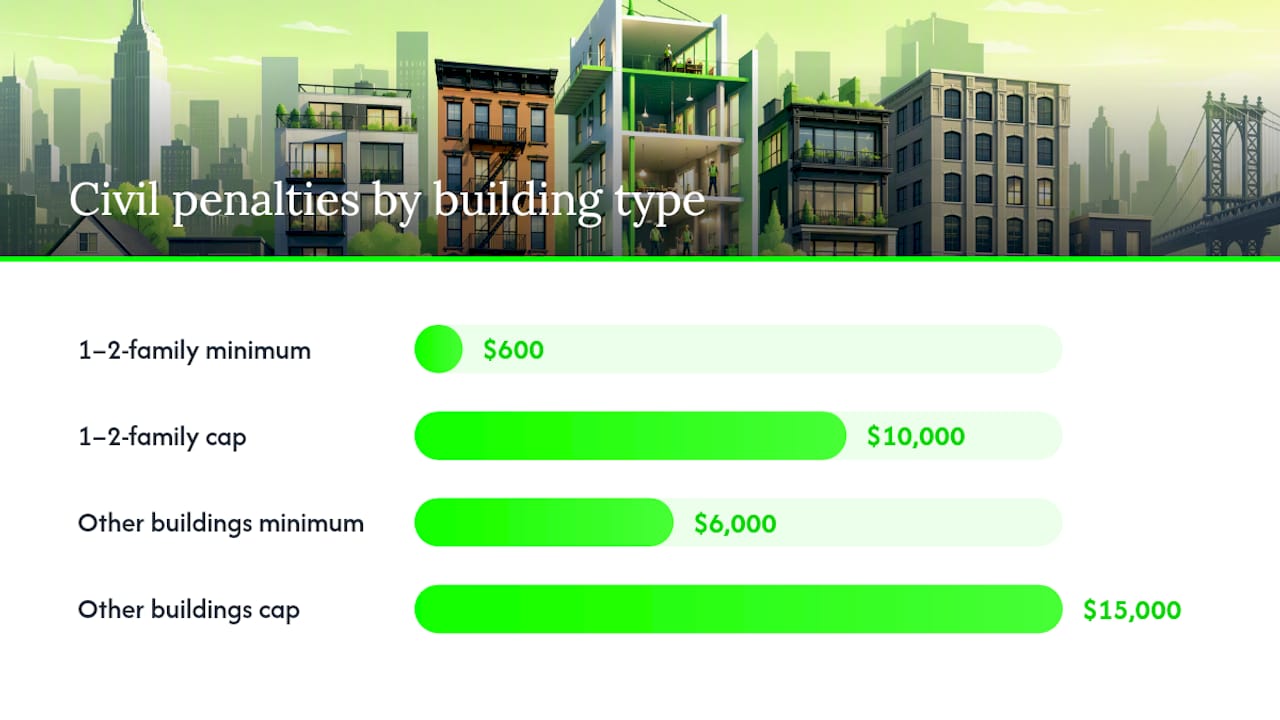
Those figures assume voluntary compliance once caught. Ignore a Stop Work Order and keep working, and the penalties escalate on a per-diem basis, separate from the original fine. DOB can also waive or reduce penalties in specific situations, including for a bona fide subsequent purchaser who inherited someone else’s unpermitted work, or when an emergency filing was submitted promptly.
Beyond the fine itself, unpermitted work creates problems that outlast the penalty:
A property lien can attach if civil penalties go unpaid, following the property through a sale.
Title companies and lenders routinely flag open DOB violations, which can delay or kill a refinance or sale outright.
Insurers can deny claims tied to damage from unpermitted alterations, arguing the work itself created the loss.
ECB/OATH hearings add their own fees and appearance requirements on top of the DOB penalty.
How the Department of Buildings Actually Finds Unpermitted Work
Owners rarely get caught by a random audit. Enforcement almost always starts with a trigger, and the most common one is a 311 complaint filed by a neighbor who notices construction noise, dumpsters, or scaffolding with no posted permit. Referrals from other city agencies, like DOT flagging sidewalk work or FDNY responding to a call, also open DOB files regularly.
Once a complaint lands, the process moves fast:
A DOB inspector visits the site and checks for a posted permit and matching approved plans.
If none exists, the inspector issues a Notice of Violation, often paired with a Stop Work Order that halts all activity immediately.
The owner receives formal notice and a civil penalty assessment tied to the scope of work found.
The owner can contest the violation at an ECB/OATH hearing or begin the corrective filing process to rescind the SWO.
Work cannot legally resume until DOB confirms either a valid permit is in place or the violation is cured.
If an inspector shows up mid-project, stop work immediately, gather every contract, invoice, and photo you have, and call a licensed architect or engineer before you say anything to the inspector about scope.
Legalizing Unpermitted Work: Steps, Timeline, and Real Costs
Legalization is a construction project of its own, layered on top of whatever work already happened. The process generally runs in this order: an assessment of what was actually built, hiring a Registered Architect or Professional Engineer for anything structural or complex, preparing as-built drawings alongside corrective plans, filing an after-the-fact (ATF) application or Alteration application, paying the civil penalty, and clearing final inspections for DOB sign-off.
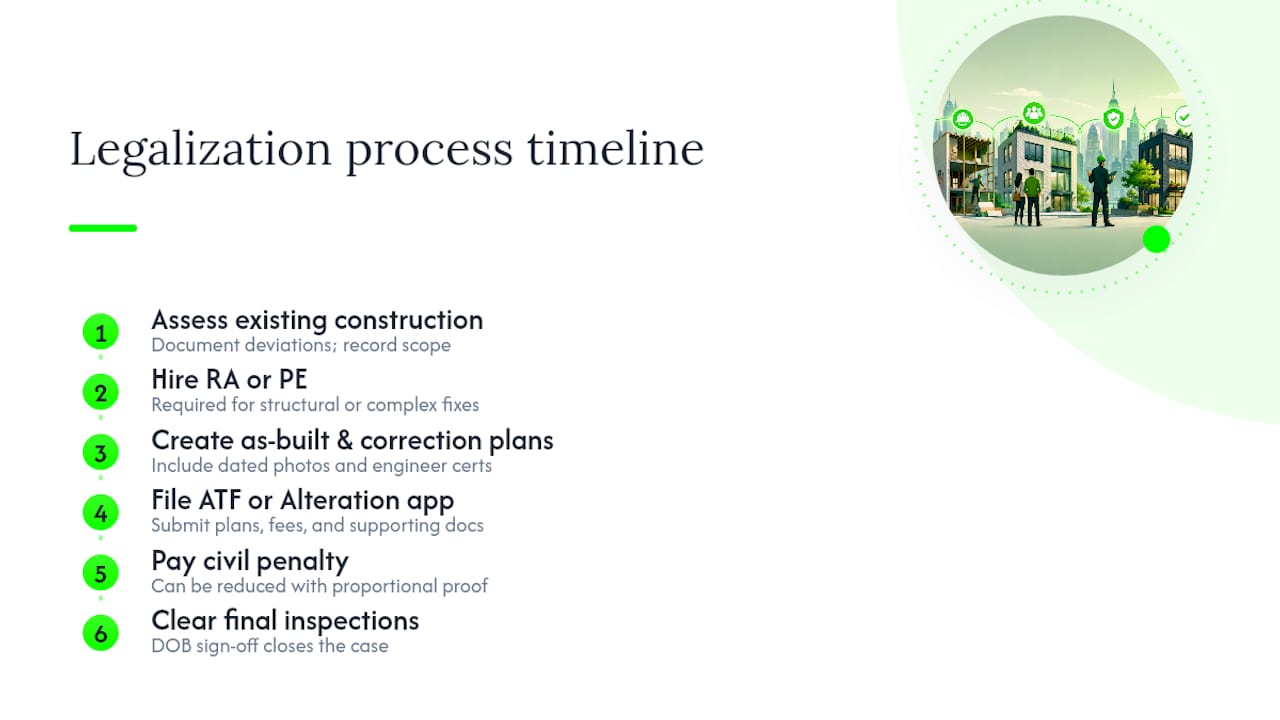
Industry timelines typically run 6 to 18 months from first filing to closeout, depending on how much corrective construction DOB requires and how backed up the borough office is.
If only part of a project was unpermitted, say the kitchen renovation was filed but a rear extension wasn’t, DOB can apply proportional penalty reductions rather than treating the entire job as violative. Strong documentation moves everything faster. PE or RA structural certifications, dated photos of the work in progress, and copies of contractor licenses all give an owner leverage to contest or reduce a penalty rather than accept the maximum assessment by default. For alteration-specific rules on what triggers a filing in the first place, DOB’s construction codes and bulletins spell out the categories in more detail than most contractors ever explain to clients.
When Legalization Isn’t an Option
Not every unpermitted job can be fixed with paperwork and a check. Some conditions block legalization outright:
Zoning violations, like exceeding allowable floor area ratio (FAR) or using space for a purpose the zoning district doesn’t permit
Structural work that’s physically impossible to certify safe after the fact
Landmarked buildings where the unpermitted alteration violates preservation rules
Hazardous conditions that require full removal rather than correction, particularly where fire code requirements weren’t met
When one of these applies, the likely outcome is forced removal or demolition of the offending work, often with a larger fine attached for the delay. Owners in this position sometimes have a path through a zoning variance or direct negotiation with DOB, but that route requires legal counsel, not a contractor alone. If you’re selling or refinancing with any of these conditions unresolved, disclose them. Buyers’ attorneys and lenders find open violations anyway, and disclosure protects you far more than silence does.
Hiring Right the First Time: A Compliance Checklist
Most WWP problems start with a hiring decision, not a construction mistake. Before signing a contract:
Confirm whether the scope needs a Registered Architect or Professional Engineer, and ask to see their license number directly.
Verify the contractor’s license and any trade licenses (Master Plumber, licensed electrician) that the job requires.
Put permit responsibility in writing in the contract, specifying who files and who pays if DOB rejects the application.
Ask to see the DOB NOW filing yourself before work starts, not after.
On-site, the rules are simple but frequently ignored: post the permit where an inspector can see it, keep approved plans on site for comparison, schedule DOB inspections at each construction milestone rather than waiting until the end, and don’t consider the job finished until you have a Certificate of Completion in hand.
Pro Tip: Budget an extra 10 to 15 percent of project cost for permit fees and plan review delays. Owners who skip this step are the ones most likely to start work “just to stay on schedule” and end up with a Stop Work Order instead.
A Contractor’s Note on Fixing Work Without a Permit
The mistake we see most is owners assuming a previous contractor “handled the paperwork” because the job looked finished. Always confirm the permit is active and posted before work resumes, not after. Most WWP situations can be legalized. Few of them are quick, and almost none are free, so plan for both time and cost from the start.
— DJ
How DJ Custom Contracting Handles DOB Violations and Legalization
A practical alternative to juggling an architect, an expeditor, and a general contractor separately when facing a DOB violation is to have one team manage the inspection, estimate, legalization plan, and corrective construction under a single contract.

The engagement runs in a straightforward sequence: an on-site inspection to document what exists, an estimate covering both permit fees and corrective work, a legalization plan coordinated with the RA, PE, or expeditor your project needs, the actual DOB filings, scheduled inspections, and final closeout once DOB signs off. Djcustomcontracting handles addition and alteration projects that require corrective construction as part of a legalization filing, along with ongoing commercial renovation work that keeps future projects compliant from day one. If you have an open violation or a stalled project because of one, consider requesting an inspection and estimate to understand what legalization will require for your property.
Where to Verify These Rules Yourself
For the exact code language behind everything above, start with DOB’s own permit guidance, the construction codes and bulletins page, and the FDNY Fire Code for fire-safety overlaps. For a comparative look at how other jurisdictions handle legalization workflows, see this Zaragoza legalization guide from an international partner, though U.S. rules govern any NYC property.
Sources
FAQ
What happens if you do work without a permit in NYC?
DOB can issue a Stop Work Order and a civil penalty calculated under 1 RCNY §102-04, ranging from a $600 minimum for one- and two-family homes to $15,000 for larger buildings, plus per-diem fines if work continues after the order.
Do I need a permit to do construction work in New York City?
Yes, most alteration, structural, and system work requires a DOB permit; only specific exemptions like painting, cabinet swaps, and certain plumbing fixture replacements fall outside that requirement.
What renovation work requires a permit in NYC?
Structural changes, electrical and plumbing system work, additions, and most alterations that change a building’s use or layout all require a permit, while ordinary maintenance and finish work generally do not.
How do I report unpermitted work in NYC?
File a complaint through NYC’s 311 system, which is the most common way DOB opens an investigation into construction happening without a posted permit.
Can unpermitted work always be legalized after the fact?
No. Zoning violations, structurally unsafe conditions, landmarked building restrictions, and unresolved fire code issues can all block legalization and may require removal instead.
Recommended


Comments